. 2016 Jul 12;7(4):e01006-16.
doi: 10.1128/mBio.01006-16.

The Role of Lipid Competition for Endosymbiont-Mediated Protection against Parasitoid Wasps in Drosophila

Affiliations

The Role of Lipid Competition for Endosymbiont-Mediated Protection against Parasitoid Wasps in Drosophila

Juan C Paredes et al. mBio. .

Abstract

Insects commonly harbor facultative bacterial endosymbionts, such as Wolbachia and Spiroplasma species, that are vertically transmitted from mothers to their offspring. These endosymbiontic bacteria increase their propagation by manipulating host reproduction or by protecting their hosts against natural enemies. While an increasing number of studies have reported endosymbiont-mediated protection, little is known about the mechanisms underlying this protection. Here, we analyze the mechanisms underlying protection from parasitoid wasps in Drosophila melanogaster mediated by its facultative endosymbiont Spiroplasma poulsonii Our results indicate that S. poulsonii exerts protection against two distantly related wasp species, Leptopilina boulardi and Asobara tabida S. poulsonii-mediated protection against parasitoid wasps takes place at the pupal stage and is not associated with an increased cellular immune response. In this work, we provide three important observations that support the notion that S. poulsonii bacteria and wasp larvae compete for host lipids and that this competition underlies symbiont-mediated protection. First, lipid quantification shows that both S. poulsonii and parasitoid wasps deplete D. melanogaster hemolymph lipids. Second, the depletion of hemolymphatic lipids using the Lpp RNA interference (Lpp RNAi) construct reduces wasp success in larvae that are not infected with S. poulsonii and blocks S. poulsonii growth. Third, we show that the growth of S. poulsonii bacteria is not affected by the presence of the wasps, indicating that when S. poulsonii is present, larval wasps will develop in a lipid-depleted environment. We propose that competition for host lipids may be relevant to endosymbiont-mediated protection in other systems and could explain the broad spectrum of protection provided.

Importance: Virtually all insects, including crop pests and disease vectors, harbor facultative bacterial endosymbionts. They are vertically transmitted from mothers to their offspring, and some protect their host against pathogens. Here, we studied the mechanism of protection against parasitoid wasps mediated by the Drosophila melanogaster endosymbiont Spiroplasma poulsonii Using genetic manipulation of the host, we provide strong evidence supporting the hypothesis that competition for host lipids underlies S. poulsonii-mediated protection against parasitoid wasps. We propose that lipid competition-based protection may not be restricted to Spiroplasma bacteria but could also apply other endosymbionts, notably Wolbachia bacteria, which can suppress human disease-causing viruses in insect hosts.


Figures

FIG 1
FIG 1
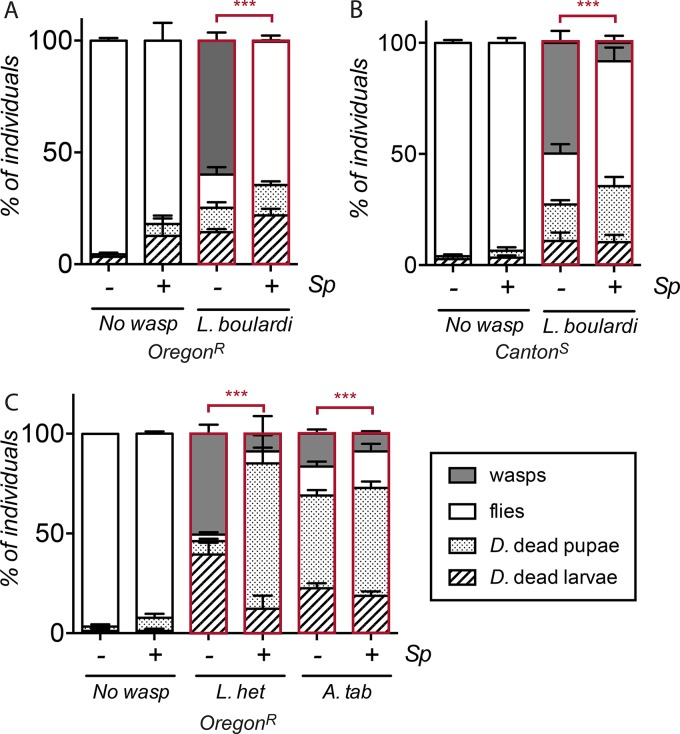
Spiroplasma poulsonii confers protection against two distantly related species of parasitoid wasps. Quantification of D. melanogaster (D.) dead larvae and pupae, emerging fly adults, and wasp adults. (A) Leptopilina boulardi infestation in D. melanogaster flies with an Oregon-R genetic background (***, P < 2.2 × 10⁻¹⁶; chi-square = 1,240.5; df = 3). (B) Leptopilina boulardi infestation in D. melanogaster flies with a Canton-S genetic background (***, P < 2.2 × 10⁻¹⁶; chi-square = 175.81; df = 3). (C) Leptopilina heterotoma (L. het) (***, P < 2.2 × 10⁻¹⁶; chi-square = 180.82; df = 3) and Asobara tabida (A. tab) (***, P < 5.75 × 10⁻¹⁰; chi-square = 45.972; df = 3) infections in D. melanogaster flies with an Oregon-R genetic background harboring (+) or not harboring () S. poulsonii (Sp). (A to C) Results are represented as mean percentages ± standard errors of the means (SEM) of a minimum of 270 D. melanogaster larvae from three independent experiments. Statistical significance was calculated using Pearson’s chi-square test.
FIG 2
FIG 2
Spiroplasma inhibits wasp growth at the pupal stage. (A and C) Quantification of wasp growth was performed by monitoring the amount of wasp 28S rRNA relative to D. melanogaster RpL32 RNA in D. melanogaster larvae/pupae harboring (Sp+) or not harboring (Sp−) S. poulsonii. ***, P < 0.001 for comparison of wasp growth in presence or absence of S. poulsonii (A); ***, P < 0.001; t = 24.22; df = 4, for comparison of wasp growth with or without tetracycline treatment at 7 days using unpaired Student t test (C). (B) S. poulsonii absolute titers monitored by qPCR of the S. poulsonii dnaA gene. Wasp infestation has no effect on S. poulsonii growth. Not significant [ns], P = 0.2867. (A and B) Statistical significance of the data was calculated using two-way analysis of variance (ANOVA); see details in Table S1 in the supplemental material. (D) Quantification of D. melanogaster (D.) dead larvae and pupae, fly adults, and wasp adults on medium complemented or not, 1.5 days postinfestation, with the bacteriostatic antibiotic tetracycline. ***, P < 2.2 × 10⁻¹⁶; chi-square = 102.61; df = 3, using Pearson’s chi-squared test. Results are the percentages of a minimum of 270 Drosophila larvae. (A to D) Results are means ± SEM from three independent experiments.
FIG 3
FIG 3
S. poulsonii does not affect the fly immune response. (A) Left, ratios of lamellocytes over total number of hemocytes (plasmatocytes and lamellocytes) in D. melanogaster flies harboring (+) or not harboring (−) S. poulsonii (Sp); right, hemocyte preparation stained with phalloidin to reveal cell shape. Nuclei of hemocytes are stained with 4[prime],6-diamidino-2-phenylindole (DAPI). Lamellocytes are identified by their large size and flat shape (white arrows). ns, P = 0.76; t = 0.3053; df = 33. (B) Crystal cell counts in whole larvae after heat treatment. ns, P = 0.60; t = 0.5260; df = 38. (C) Percentages of melanized wasp eggs or larvae. Data shown are from an experiment representative of three independent experiments. ns, P = 0.6110; t = 5363; df = 6. Statistical significance was calculated using the unpaired Student’s t test.
FIG 4
FIG 4
S. poulsonii and wasps compete for hemolymph lipids. (A) Quantification of hemolymphatic DAGs in D. melanogaster flies with or without wasp infestation and harboring (+) or not harboring (−) S. poulsonii (Sp). *, P = 0.0041; t = 3.268; df = 19; **, P = 0.0450; t = 2; df = 18; **, P = 0.0020; t = 3.612; df = 18; using unpaired Student’s t test. (B) Absolute quantification of S. poulsonii titers by qPCR. **, P = 0.00286; two-way ANOVA; see Table S1 in the supplemental material for details. (C) Fly survival after Lpp knockdown mediated by the activation of UAS-iLpp in the fat body using a specific thermosensitive driver (C564-Gal4TS, C564TS>). UAS-iLpp in the absence of driver (UAS-iLpp/+) and Oregon-R (ORR) flies were used as negative controls. (C) D. melanogaster (D.) dead larvae and pupae, emerging fly adults, and wasp adults. Results are percentages of a minimum of 270 D. melanogaster larvae. ***, from left to right, respectively: P < 2.2 × 10⁻¹⁶; chi-square = 153.96; df = 3; P < 2.2 × 10⁻¹⁶; chi-square = 620.75; df = 3; P < 2.2 × 10⁻¹⁶; chi-square = 84.458; df = 3; using Pearson’s chi-square test. (A to C) Results are means ± SEM from at least three independent experiments.

References

    1. Zug R, Hammerstein P. 2012. Still a host of hosts for Wolbachia: analysis of recent data suggests that 40% of terrestrial arthropod species are infected. PLoS One 7:e38544. doi: 10.1371/journal.pone.0038544. - DOI - PMC - PubMed
    1. Douglas AE, Prosser WA. 1992. Synthesis of the essential amino acid tryptophan in the pea aphid (Acyrthosiphon pisum) symbiosis. J Insect Physiol 38:565–568. doi: 10.1016/0022-1910(92)90107-O. - DOI
    1. Pool JE, Wong A, Aquadro CF. 2006. Finding of male-killing Spiroplasma infecting Drosophila melanogaster in Africa implies transatlantic migration of this endosymbiont. Heredity 97:27–32. doi: 10.1038/sj.hdy.6800830. - DOI - PMC - PubMed
    1. Stouthamer R, Breeuwer JA, Hurst GD. 1999. Wolbachia pipientis: microbial manipulator of arthropod reproduction. Annu Rev Microbiol 53:71–102. doi: 10.1146/annurev.micro.53.1.71. - DOI - PubMed
    1. Haine ER. 2008. Symbiont-mediated protection. Proc Biol Sci 275:353–361. doi: 10.1098/rspb.2007.1211. - DOI - PMC - PubMed

Publication types

LinkOut - more resources