


Alternative Lengthening of Telomeres and Loss of DAXX/ATRX Expression Predicts Metastatic Disease and Poor Survival in Patients with Pancreatic Neuroendocrine Tumors
- PMID: 27407094
- PMCID: PMC6560642
- DOI: 10.1158/1078-0432.CCR-16-1113
Alternative Lengthening of Telomeres and Loss of DAXX/ATRX Expression Predicts Metastatic Disease and Poor Survival in Patients with Pancreatic Neuroendocrine Tumors
Abstract
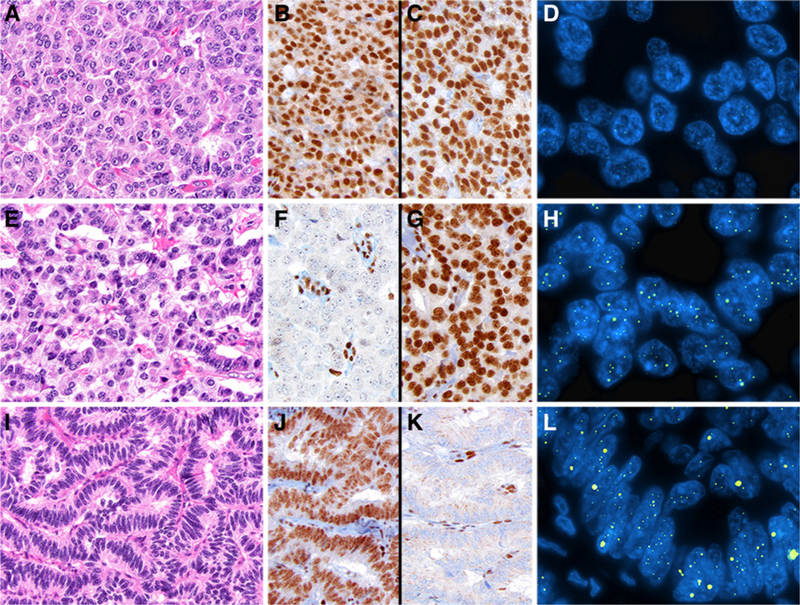
Purpose: Pancreatic neuroendocrine tumors (PanNET) are a heterogeneous group of neoplasms with increasing incidence and unpredictable behavior. Whole-exome sequencing has identified recurrent mutations in the genes DAXX and ATRX, which correlate with loss of protein expression and alternative lengthening of telomeres (ALT). Both ALT and DAXX/ATRX loss were initially reported to be associated with a favorable prognosis; however, recent studies suggest the contrary. Our aims were to assess the prevalence and prognostic significance of ALT and DAXX/ATRX in both primary and metastatic PanNETs.
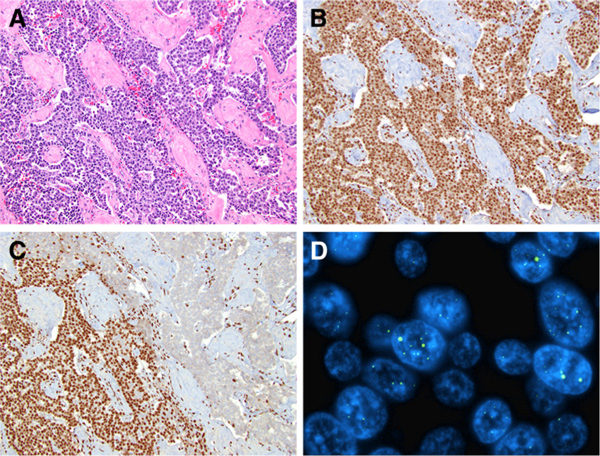
Experimental design: Telomere-specific FISH and DAXX/ATRX IHC was performed on a multi-institutional cohort of 321 patients with resected PanNET and 191 distant metastases from 52 patients. These results were correlated with clinicopathologic features, including disease-free survival (DFS) and disease-specific survival (DSS).
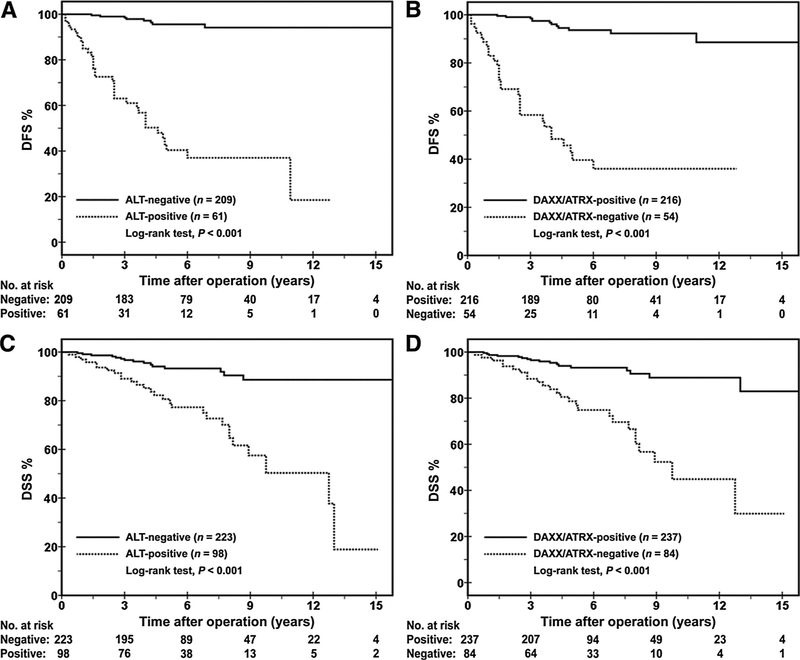
Results: The prevalence of ALT and DAXX/ATRX loss in resected PanNETs was 31% and 26%, respectively, and associated with larger tumor size, higher WHO grade, lymph node metastasis, and distant metastasis (P < 0.001). The 5-year DFS and 10-year DSS of patients with ALT-positive and DAXX/ATRX-negative PanNETs were 40% and 50%, respectively, as compared with 96% and 89%, respectively, for wild-type PanNETs. Among distant metastases, ALT and DAXX/ATRX loss was 67% and 52%, respectively, and only occurred in the setting of an ALT-positive and DAXX/ATRX-negative primary PanNET. By multivariate analysis, both ALT and DAXX/ATRX loss were negative, independent prognostic factors for DFS.
Conclusions: ALT and DAXX/ATRX loss in PanNETs was associated with shorter DFS and DSS and likely plays a significant role in driving metastatic disease. Clin Cancer Res; 23(2); 600-9. ©2016 AACR.
©2016 American Association for Cancer Research.
Conflict of interest statement
Disclosure of Potential Conflicts of Interest
A. Slivka is a consultant/advisory board member for Boston Scientific. No potential conflicts of interest were disclosed by the other authors.
Figures
References
-
- Yao JC, Hassan M, Phan A, Dagohoy C, Leary C, Mares JE, et al. One hundred years after “carcinoid”: epidemiology of and prognostic factors for neuroendocrine tumors in 35,825 cases in the United States. J Clin Oncol 2008;26:3063–72. - PubMed
-
- Fraenkel M, Kim MK, Faggiano A, Valk GD. Epidemiology of gastroenteropancreatic neuroendocrine tumours. Best Pract Res Clin Gastroenterol 2012;26:691–703. - PubMed
-
- Lawrence B, Gustafsson BI, Chan A, Svejda B, Kidd M, Modlin IM. The epidemiology of gastroenteropancreatic neuroendocrine tumors. Endocrinol Metab Clin North Am 2011;40:1–18. - PubMed
MeSH terms
Substances
Grants and funding
LinkOut - more resources
Full Text Sources
Other Literature Sources
Medical
