


Summarizing health-related quality of life (HRQOL): development and testing of a one-factor model
- PMID: 27408606
- PMCID: PMC4940947
- DOI: 10.1186/s12963-016-0091-3
Summarizing health-related quality of life (HRQOL): development and testing of a one-factor model
Abstract
Background: Health-related quality of life (HRQOL) is a multi-dimensional concept commonly used to examine the impact of health status on quality of life. HRQOL is often measured by four core questions that asked about general health status and number of unhealthy days in the Behavioral Risk Factor Surveillance System (BRFSS). Use of these measures individually, however, may not provide a cohesive picture of overall HRQOL. To address this concern, this study developed and tested a method for combining these four measures into a summary score.
Methods: Exploratory and confirmatory factor analyses were performed using BRFSS 2013 data to determine potential numerical relationships among the four HRQOL items. We also examined the stability of our proposed one-factor model over time by using BRFSS 2001-2010 and BRFSS 2011-2013 data sets.
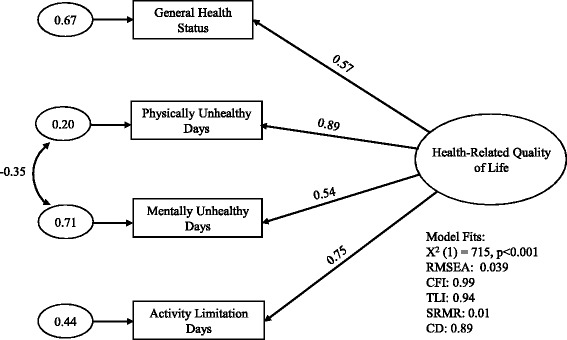
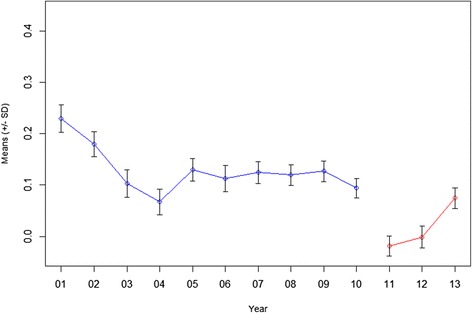
Results: Both exploratory factor analysis and goodness of fit tests supported the notion that one summary factor could capture overall HRQOL. Confirmatory factor analysis indicated acceptable goodness of fit of this model. The predicted factor score showed good validity with all of the four HRQOL items. In addition, use of the one-factor model showed stability, with no changes being detected from 2001 to 2013.
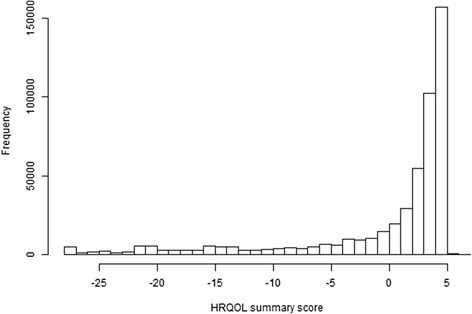
Conclusion: Instead of using four individual items to measure HRQOL, it is feasible to study overall HRQOL via factor analysis with one underlying construct. The resulting summary score of HRQOL may be used for health evaluation, subgroup comparison, trend monitoring, and risk factor identification.
Keywords: Factor analysis; Health-related quality of life; Summary score.
Figures
References
-
- Centers for Disease Control and Prevention. Measuring Healthy Days: Population assessment of health-related quality of life. Atlanta, Georgia: CDC. 2000. https://www.cdc.gov/hrqol/pdfs/mhd.pdf. Accessed Nov 2000.
LinkOut - more resources
Full Text Sources
Other Literature Sources
