


Future healthy life expectancy among older adults in the US: a forecast based on cohort smoking and obesity history
- PMID: 27408607
- PMCID: PMC4941025
- DOI: 10.1186/s12963-016-0092-2
Future healthy life expectancy among older adults in the US: a forecast based on cohort smoking and obesity history
Abstract
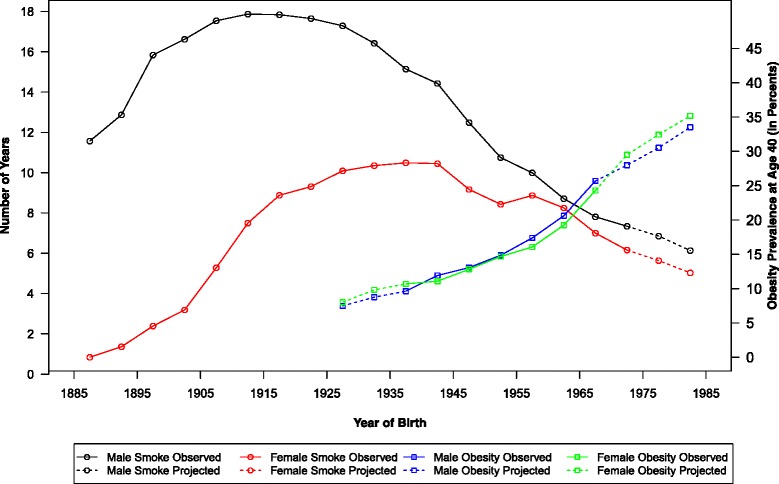
Background: In the past three decades, the elderly population in the United States experienced increase in life expectancy (LE) and disability-free life expectancy (LE(ND)), but decrease in life expectancy with disability (LE(D)). Smoking and obesity are two major risk factors that had negative impacts on these trends. While smoking prevalence continues to decline in recent decades, obesity prevalence has been growing and is currently at a high level. This study aims to forecast the healthy life expectancy for older adults aged 55 to 85 in the US from 2011 to 2040, in relation to their smoking and obesity history.
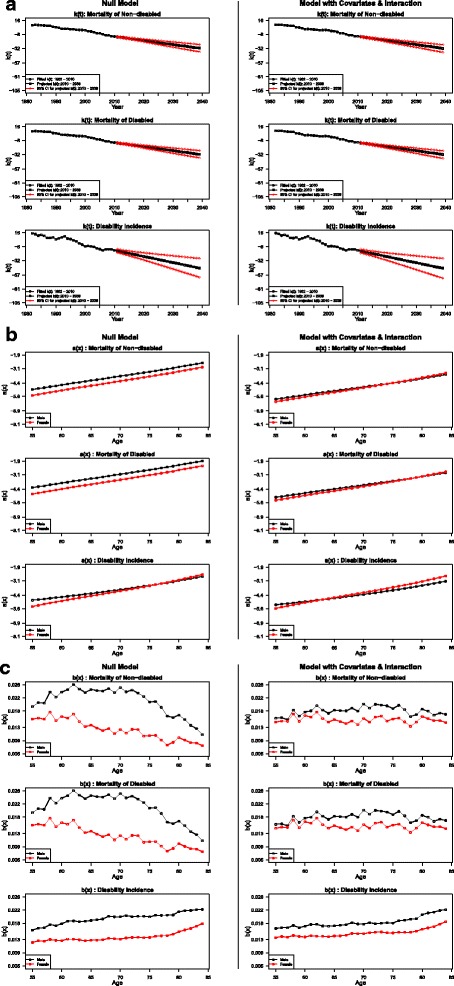
Methods: First, population-level mortality data from the Human Mortality Database (HMD) and individual-level disability data from the US National Health Interview Survey (NHIS) were used to estimate the transition rates between different health states from 1982 to 2010, using a multi-state life table (MSLT) model. Second, the estimated transition rates were fitted and projected up to 2040, using a modified Lee-Carter model that incorporates cohort smoking and obesity history from NHIS.
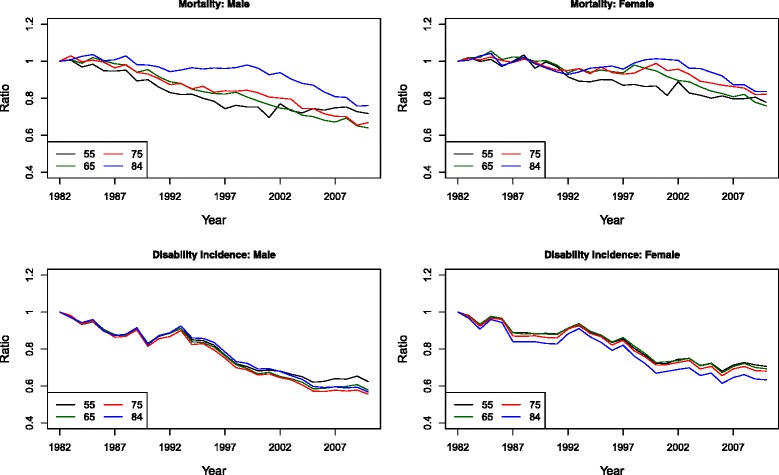
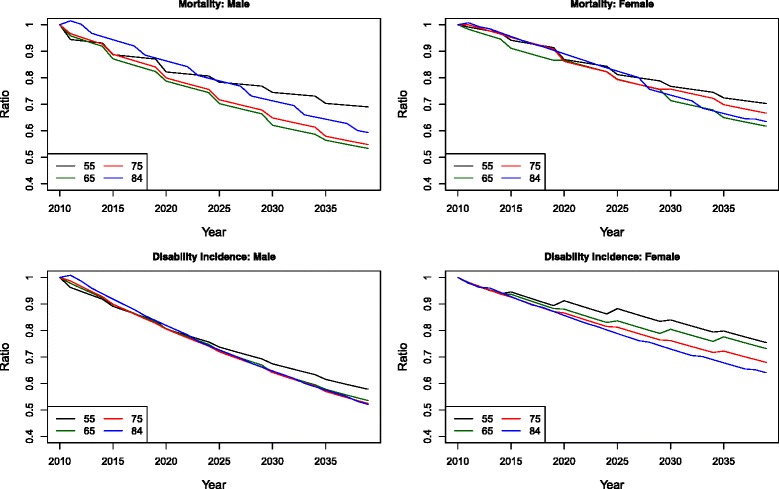
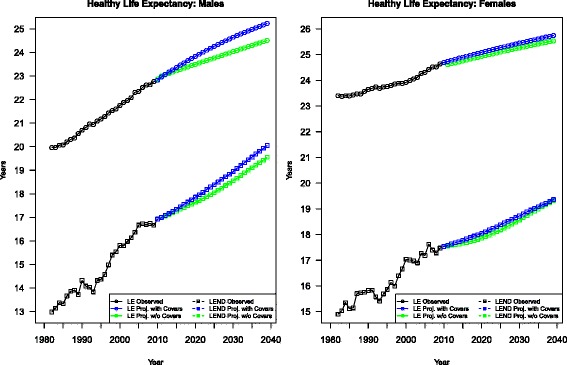
Results: Mortality and morbidity for both sexes will continue to decline in the next decades. Relative to 2010, men are expected to have 3.2 years gain in LE(ND) and 0.8 years loss in LE(D). For women, there will be 1.8 years gain in LE(ND) and 0.8 years loss in LE(D). By 2040, men and women are expected to spend respectively 80 % and 75 % of their remaining life expectancy between 55 and 85 disability-free.
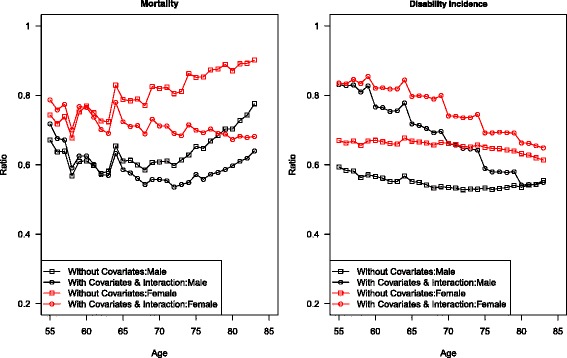
Conclusions: Smoking and obesity have independent negative impacts on both the survival and disability of the US older population in the coming decades, and are responsible for the present and future gender disparity in mortality and morbidity. Overall, the US older population is expected to enjoy sustained health improvements and compression of disability, largely due to decline in smoking.
Keywords: Forecast; Healthy life expectancy; Lee-Carter model; Morbidity; Mortality; Multi-state life table; Obesity; Smoking.
Figures
References
-
- Murphy SL, Xu J, Kochanek KD: National Vital Statistics Reports Vol 61 No 4 Deaths: Final Data for 2010. Volume 61. Centers for Disease Control and Prevention; 2013 - PubMed
-
- Robine J-M, Romieu I, Michel J-P. Trends in Health Expectancies. In: Determining Health Expectancies. John Wiley & Sons, Ltd; 2003. p. 75–101
-
- Moolgavkar SH, Holford TR, Levy DT, Kong CY, Foy M, Clarke L, Jeon J, Hazelton WD, Meza R, Schultz F, McCarthy W, Boer R, Gorlova O, Gazelle GS, Kimmel M, McMahon PM, De Koning HJ, Feuer EJ. Impact of reduced tobacco smoking on lung cancer mortality in the united states during 1975–2000. J Natl Cancer Inst. 2012;104:541–548. doi: 10.1093/jnci/djs136. - DOI - PMC - PubMed
Grants and funding
LinkOut - more resources
Full Text Sources
Other Literature Sources
Miscellaneous
