Review
. 2016 Jun;12(2):140-7.
doi: 10.1183/20734735.007016.

Endurance training: is it bad for you?

Affiliations
Review

Endurance training: is it bad for you?

Giuseppe Morici et al. Breathe (Sheff). 2016 Jun.

Abstract

To illustrate the characteristics of endurance exercise training and its positive effects on health.To provide an overview on the effects of endurance training on airway cells and bronchial reactivity.To summarise the current knowledge on respiratory health problems in elite athletes. Endurance exercise training exerts many positive effects on health, including improved metabol-ism, reduction of cardiovascular risk, and reduced all-cause and cardiovascular mortality. Intense endurance exercise causes mild epithelial injury and inflammation in the airways, but does not appear to exert detrimental effects on respiratory health or bronchial reactivity in recreational/non-elite athletes. Conversely, elite athletes of both summer and winter sports show increased susceptibility to development of asthma, possibly related to environmental exposures to allergens or poor conditioning of inspired air, so that a distinct phenotype of "sports asthma" has been proposed to characterise such athletes, who more often practise aquatic and winter sports. Overall, endurance training is good for health but may become deleterious when performed at high intensity or volume.


Conflict of interest statement

Conflict of interest None declared.

Figures

Figure 1
Figure 1
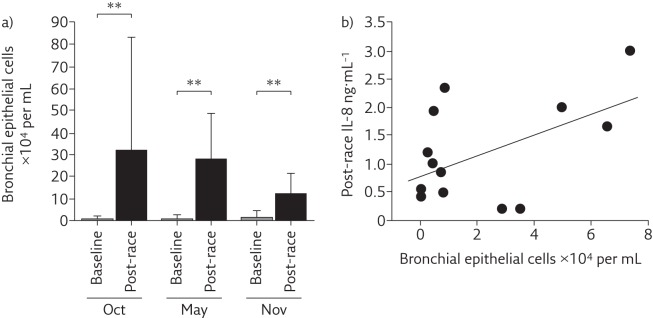
a) Bronchial epithelial cell counts in induced sputum significantly increased post-race. **: p<0.01. b) IL-8 concentration in sputum supernatants was positively correlated with bronchial epithelial cell absolute counts post-race. Oct, May and Nov refer to three different half-marathon races during which samples were collected. Reproduced from [15] with permission.
Figure 2
Figure 2
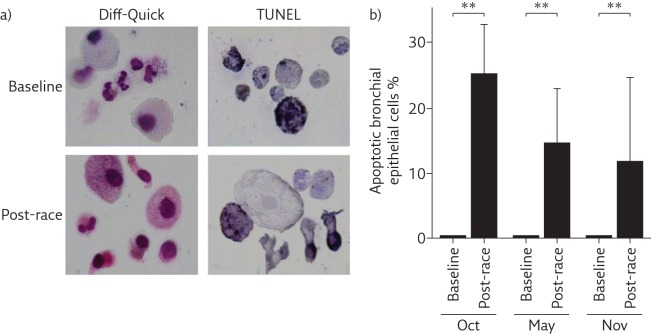
Apoptosis of bronchial epithelial cells in post-race samples. a) Airway cell composition (Diff-Quick staining) and apoptosis (TdT-mediated dUTP nick end labelling (TUNEL)) of airway cells in induced sputum at baseline and after a half-marathon race. b) A large proportion of bronchial epithelial cells were apoptotic in post-race samples. Oct, May and Nov refer to three different half-marathon races during which samples were collected. **: p<0.01. Reproduced from [15] with permission.
Figure 3
Figure 3
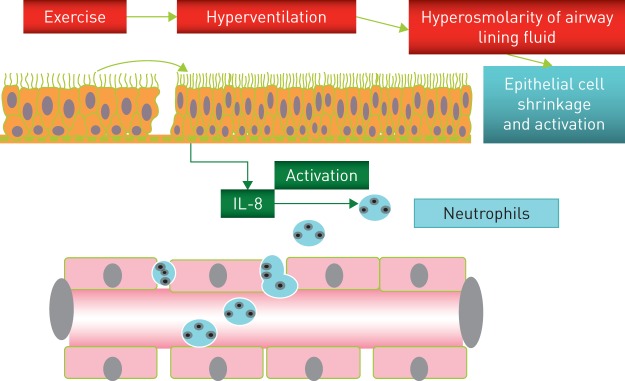
Mechanisms responsible for epithelial injury and influx of neutrophils into the airways during endurance exercise. Reproduced and modified from [18] with permission.
Figure 4
Figure 4
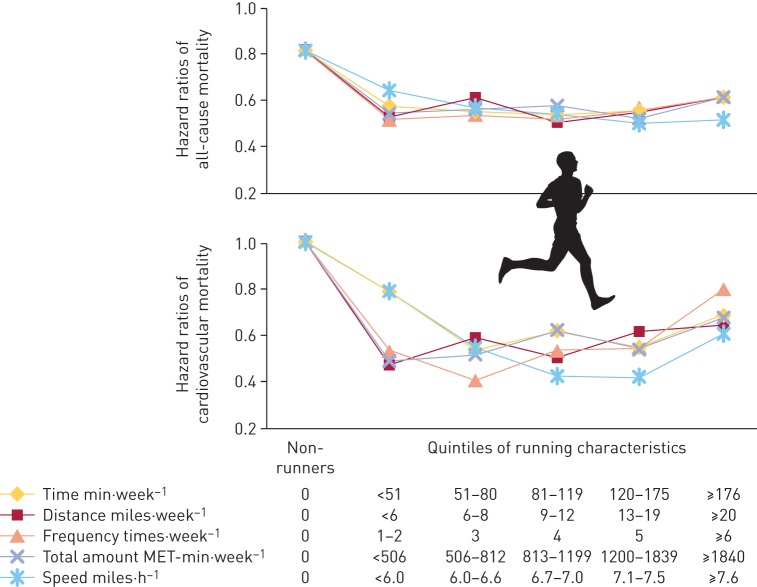
All-cause and cardiovascular mortality according to running quintiles. MET: metabolic equivalent. Reproduced from [5] with permission.

References

    1. NCD Risk Factor Collaboration (NCD-RisC). Trends in adult body-mass index in 200 countries from 1975 to 2014: a pooled analysis of 1698 population-based measurement studies with 19.2 million participants. Lancet 2016; 387: 1377–1396. - PMC - PubMed
    1. Ekelund U, Ward HA, Norat T, et al. Physical activity and all-cause mortality across levels of overall and abdominal adiposity in European men and women: the European Prospective Investigation into Cancer and Nutrition Study (EPIC). Am J Clin Nutr 2015; 101: 613–621. - PMC - PubMed
    1. Joyner MJ, Green DJ. Exercise protects the cardiovascular system: effects beyond traditional risk factors. J Physiol 2009; 587: 5551–5558. - PMC - PubMed
    1. Lavie CJ, Arena R, Swift DL, et al. Exercise and the cardiovascular system: clinical science and cardiovascular outcomes. Circ Res 2015; 117: 207–219. - PMC - PubMed
    1. Lee DC, Pate RR, Lavie CJ, et al. Leisure-time running reduces all-cause and cardiovascular mortality risk. J Am Coll Cardiol 2014; 64: 472–481. - PMC - PubMed

LinkOut - more resources