


TREM-1 expression in craniopharyngioma and Rathke's cleft cyst: its possible implication for controversial pathology
- PMID: 27409178
- PMCID: PMC5226603
- DOI: 10.18632/oncotarget.10501
TREM-1 expression in craniopharyngioma and Rathke's cleft cyst: its possible implication for controversial pathology
Abstract
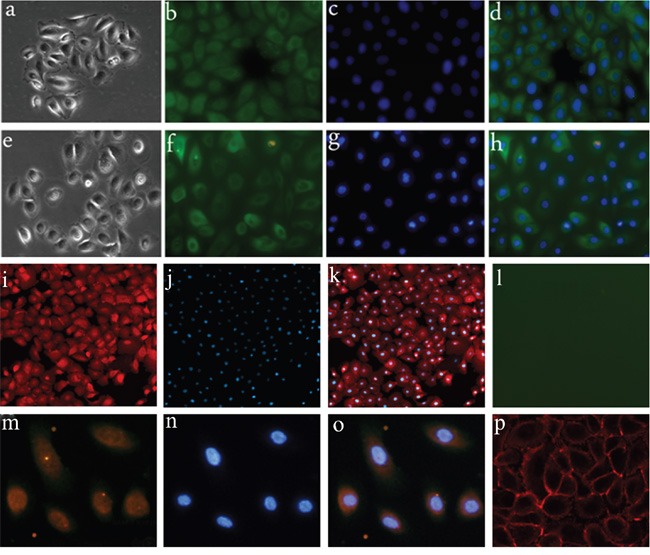
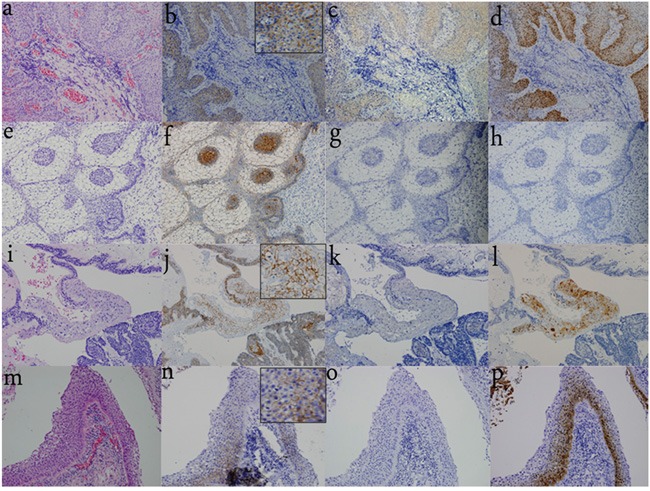
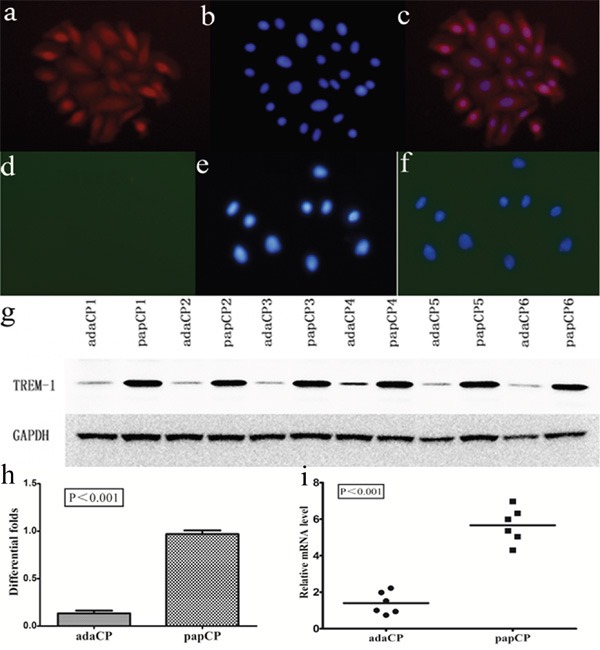
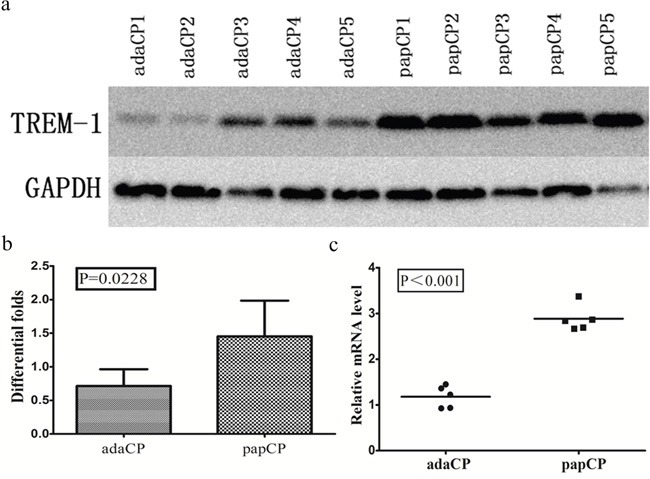
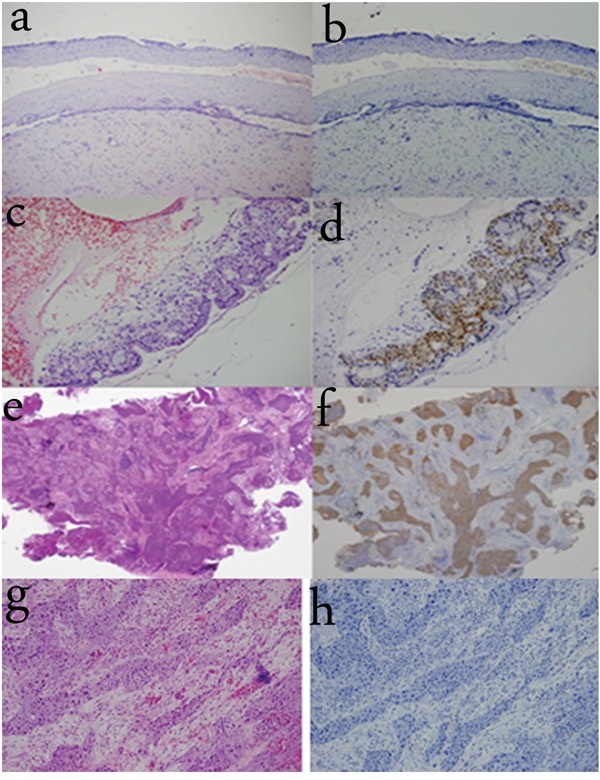
Whether a mixed type of craniopharyngioma (CP) exists and whether papillary craniopharyngioma (pCP) is on a histopathological continuum with Rathke's cleft cyst (RCC) remain controversial. Herein, we examined the expression and localization of β-catenin, BRAF p.V600E (V600E), and triggering receptor expressed on myeloid cells-1 (TREM-1) in 58 samples including 20 pCPs, 26 adamantinomatous craniopharyngiomas (aCP), and 12 RCCs. Five aCPs were diagnosed with mixed type CPs and the remaining 21 cases were pure aCPs. Four of the 12 RCCs presented with significant squamous epithelium (SE). V600E immunoreactivity was observed in all pCPs in the cytoplasm, but not in the nuclei. aCPs and RCCs, including mixed type CP, did not express V600E. Nuclear β-catenin translocation was detected exclusively in aCPs. TREM-1 was expressed in pCPs. Additionally, TREM-1 expression was detected in the SE of 5 "mixed type" CPs, while it was absent in pure aCPs. TREM-1 was expressed in 4 RCCs with SE, but not in the remaining 8 RCCs. TREM-1 mRNA levels were compared in cultured pCP and aCP cells. TREM-1 mRNA level was significantly (p < 0.001; up to 4.045 fold) higher in pCPs than in aCPs. Western blotting revealed a significantly (p < 0.001; up to 7.19 fold) lower level of TREM-1 expression in aCP cells compared to that in pCP cells. Our findings further supported that RCC and pCP may represent two ends of a morphological spectrum. A variant showing overlapping histological features of aCP and pCP should not be considered as a mixed type.
Keywords: Rathke’s cleft cyst; SE; TREM-1; craniopharyngioma; metaplasia.
Conflict of interest statement
The authors declare that they have no conflicts of interest.
Figures
References
-
- Larkin SJ, Ansorge O. Pathology and pathogenesis of craniopharyngiomas. Pituitary. 2013;16:9–17. - PubMed
-
- Martinez-Barbera JP, Buslei R. Adamantinomatous craniopharyngioma: pathology, molecular genetics and mouse models. J Pediatr Endocrinol Metab. 2015;28:7–17. - PubMed
-
- Prabhu VC, Brown HG. The pathogenesis of craniopharyngiomas. Childs Nerv Syst. 2005;21:622–627. - PubMed
-
- Zada G, Lin N, Ojerholm E, Ramkissoon S, Laws ER. Craniopharyngioma and other cystic epithelial lesions of the sellar region: a review of clinical, imaging, and histopathological relationships. Neurosurg Focus. 2010;28:E4. - PubMed
-
- Okada T, Fujitsu K, Ichikawa T, Mukaihara S, Miyahara K, Kaku S, Uryuu Y, Niino H, Yagishita S, Shiina T. Coexistence of adamantinomatous and squamous-papillary type craniopharyngioma: case report and discussion of etiology and pathology. Neuropathology. 2012;32:171–173. - PubMed
MeSH terms
Substances
LinkOut - more resources
Full Text Sources
Other Literature Sources
Research Materials
Miscellaneous
