


Relationships of Dietary Histidine and Obesity in Northern Chinese Adults, an Internet-Based Cross-Sectional Study
- PMID: 27409634
- PMCID: PMC4963896
- DOI: 10.3390/nu8070420
Relationships of Dietary Histidine and Obesity in Northern Chinese Adults, an Internet-Based Cross-Sectional Study
Abstract
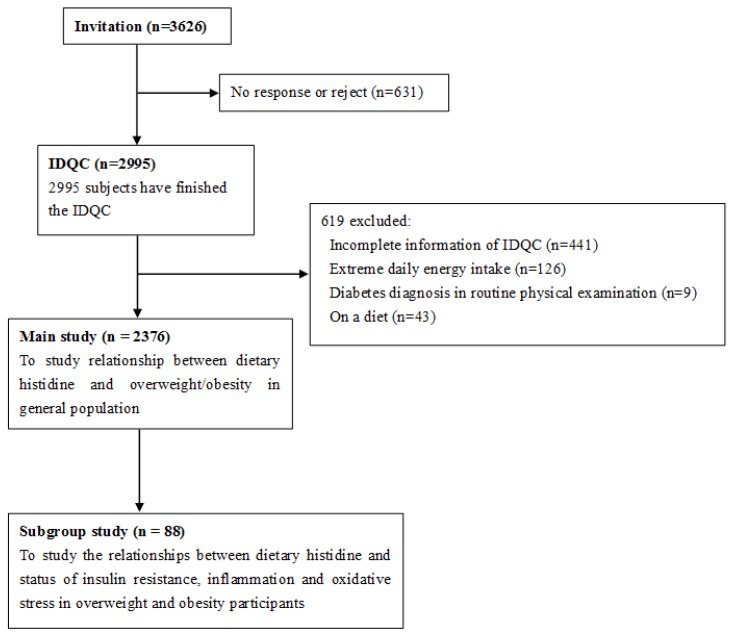
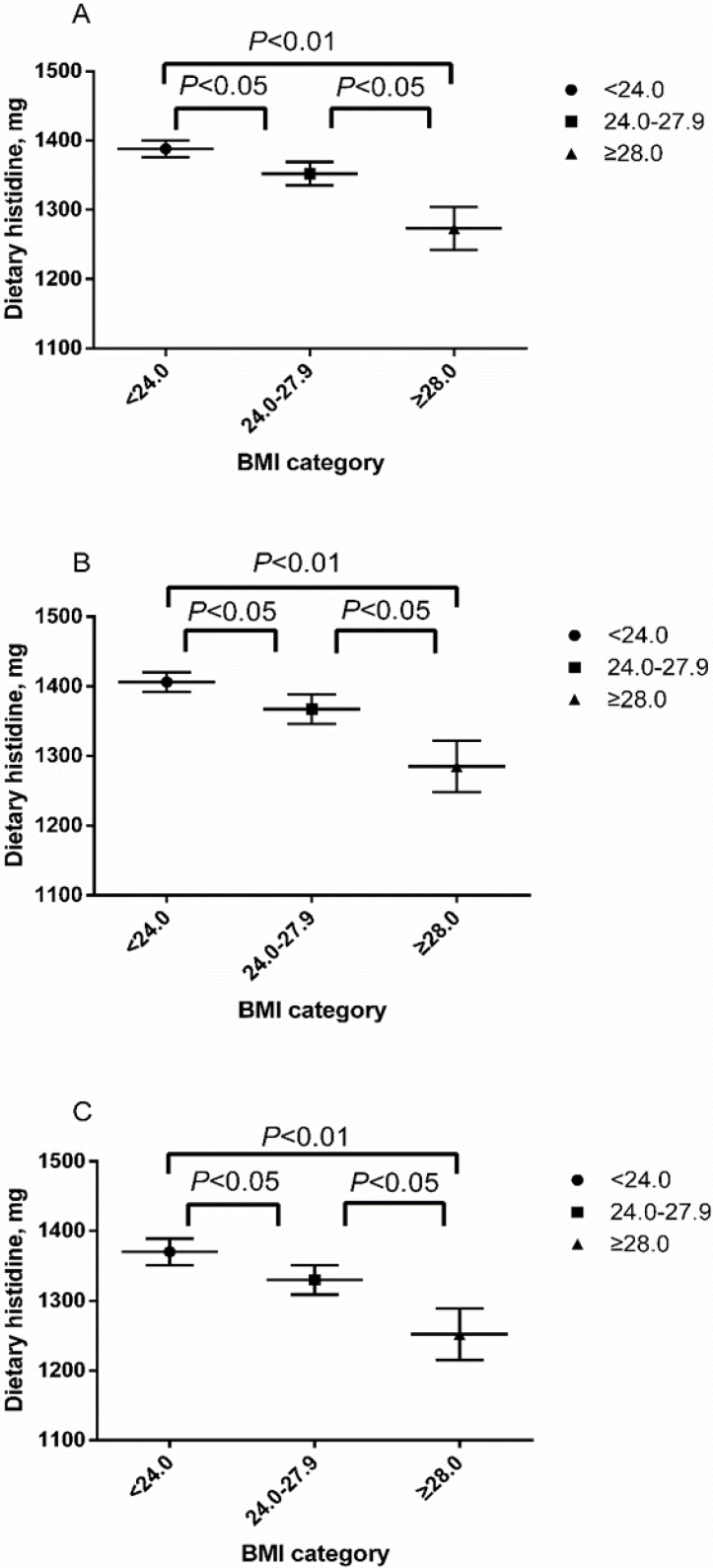
Our previous studies have demonstrated that histidine supplementation significantly ameliorates inflammation and oxidative stress in obese women and high-fat diet-induced obese rats. However, the effects of dietary histidine on general population are not known. The objective of this Internet-based cross-sectional study was to evaluate the associations between dietary histidine and prevalence of overweight/obesity and abdominal obesity in northern Chinese population. A total of 2376 participants were randomly recruited and asked to finish our Internet-based dietary questionnaire for the Chinese (IDQC). Afterwards, 88 overweight/obese participants were randomly selected to explore the possible mechanism. Compared with healthy controls, dietary histidine was significantly lower in overweight (p < 0.05) and obese (p < 0.01) participants of both sexes. Dietary histidine was inversely associated with body mass index (BMI), waist circumference (WC) and blood pressure in overall population and stronger associations were observed in women and overweight/obese participants. Higher dietary histidine was associated with lower prevalence of overweight/obesity and abdominal obesity, especially in women. Further studies indicated that higher dietary histidine was associated with lower fasting blood glucose (FBG), homeostasis model assessment of insulin resistance (HOMA-IR), 2-h postprandial glucose (2 h-PG), tumor necrosis factor-α (TNF-α), interleukin-1β (IL-1β), interleukin-6 (IL-6), C-reactive protein (CRP), malonaldehyde (MDA) and vaspin and higher glutathione peroxidase (GSH-Px), superoxide dismutase (SOD) and adiponectin of overweight/obese individuals of both sexes. In conclusion, higher dietary histidine is inversely associated with energy intake, status of insulin resistance, inflammation and oxidative stress in overweight/obese participants and lower prevalence of overweight/obesity in northern Chinese adults.
Keywords: dietary histidine; inflammation; insulin resistance; overweight/obesity; oxidative stress.
Figures
References
-
- Ng M., Fleming T., Robinson M., Thomson B., Graetz N., Margono C., Mullany E.C., Biryukov S., Abbafati C., Abera S.F., et al. Global, regional, and national prevalence of overweight and obesity in children and adults during 1980–2013: A systematic analysis for the global burden of disease study 2013. Lancet. 2014;384:766–781. doi: 10.1016/S0140-6736(14)60460-8. - DOI - PMC - PubMed
-
- Kim S.K., Kim H.J., Hur K.Y., Choi S.H., Ahn C.W., Lim S.K., Kim K.R., Lee H.C., Huh K.B., Cha B.S. Visceral fat thickness measured by ultrasonography can estimate not only visceral obesity but also risks of cardiovascular and metabolic diseases. Am. J. Clin. Nutr. 2004;79:593–599. - PubMed
-
- De Simone G., Devereux R.B., Chinali M., Roman M.J., Best L.G., Welty T.K., Lee E.T., Howard B.V. Strong Heart Study Investigators. Risk factors for arterial hypertension in adults with initial optimal blood pressure: The strong heart study. Hypertension. 2006;47:162–167. doi: 10.1161/01.HYP.0000199103.40105.b5. - DOI - PubMed
MeSH terms
Substances
LinkOut - more resources
Full Text Sources
Other Literature Sources
Medical
Research Materials
Miscellaneous
