


Geographic Distribution of Leishmania Species in Ecuador Based on the Cytochrome B Gene Sequence Analysis
- PMID: 27410039
- PMCID: PMC4943627
- DOI: 10.1371/journal.pntd.0004844
Geographic Distribution of Leishmania Species in Ecuador Based on the Cytochrome B Gene Sequence Analysis
Abstract
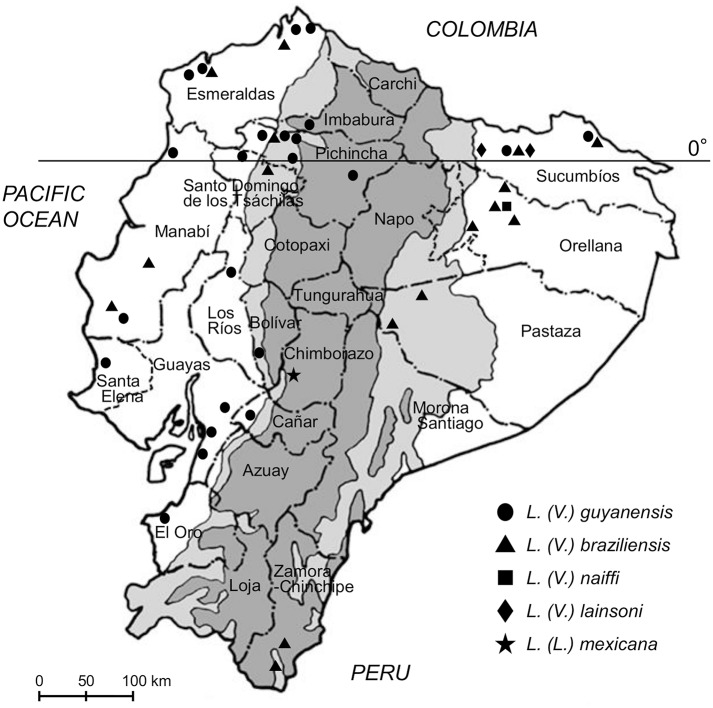
A countrywide epidemiological study was performed to elucidate the current geographic distribution of causative species of cutaneous leishmaniasis (CL) in Ecuador by using FTA card-spotted samples and smear slides as DNA sources. Putative Leishmania in 165 samples collected from patients with CL in 16 provinces of Ecuador were examined at the species level based on the cytochrome b gene sequence analysis. Of these, 125 samples were successfully identified as Leishmania (Viannia) guyanensis, L. (V.) braziliensis, L. (V.) naiffi, L. (V.) lainsoni, and L. (Leishmania) mexicana. Two dominant species, L. (V.) guyanensis and L. (V.) braziliensis, were widely distributed in Pacific coast subtropical and Amazonian tropical areas, respectively. Recently reported L. (V.) naiffi and L. (V.) lainsoni were identified in Amazonian areas, and L. (L.) mexicana was identified in an Andean highland area. Importantly, the present study demonstrated that cases of L. (V.) braziliensis infection are increasing in Pacific coast areas.
Conflict of interest statement
The authors have declared that no competing interests exist.
Figures
References
-
- Gomez EA, Hashiguchi Y. Monthly variation in natural infection of the sand-fly Lutzomyia ayacuchensis with Leishmania mexicana in an endemic focus in the Ecuadorian Andes. Ann Trop Med Parasitol. 1991; 85:407–411. - PubMed
-
- Hashiguchi Y, Gómez Landires EA. A review of leishmaniasis in Ecuador. Bull Pan Am Health Organ. 1991; 25:64–76. - PubMed
-
- Hashiguchi Y, Gomez EA, de Coronel VV, Mimori T, Kawabata M, Furuya M, Nonaka S, Takaoka H, Alexander JB, Quizhpe AM, Grimaldi G Jr, Kreutzer RD, Tesh RB. Andean leishmaniasis in Ecuador caused by infection with Leishmania mexicana and L. major-like parasites. Am J Trop Med Hyg. 1991; 44:205–217. - PubMed
-
- Calvopiña M, Armijos RX, Hashiguchi Y. Epidemiology of leishmaniasis in Ecuador: current status of knowledge—a review. Mem Inst Oswaldo Cruz. 2004; 99:663–672. - PubMed
Publication types
MeSH terms
Substances
LinkOut - more resources
Full Text Sources
Other Literature Sources
Medical
