Review
. 2016 Jul 13;23(1):53.
doi: 10.1186/s12929-016-0269-9.

Zinc finger proteins in cancer progression

Affiliations
Review

Zinc finger proteins in cancer progression

Jayu Jen et al. J Biomed Sci. .

Abstract

Zinc finger proteins are the largest transcription factor family in human genome. The diverse combinations and functions of zinc finger motifs make zinc finger proteins versatile in biological processes, including development, differentiation, metabolism and autophagy. Over the last few decades, increasing evidence reveals the potential roles of zinc finger proteins in cancer progression. However, the underlying mechanisms of zinc finger proteins in cancer progression vary in different cancer types and even in the same cancer type under different types of stress. Here, we discuss general mechanisms of zinc finger proteins in transcription regulation and summarize recent studies on zinc finger proteins in cancer progression. In this review, we also emphasize the importance of further investigations in elucidating the underlying mechanisms of zinc finger proteins in cancer progression.

Keywords: Cancer progression; Transcription factor; Zinc finger protein.


Figures
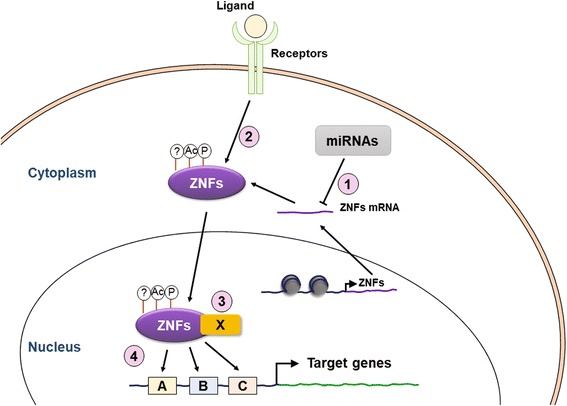
Fig. 1
Fig. 1
Various regulations of ZNF proteins’ functions in cancer progression. The versatile roles of ZNF proteins in cancer progression can be regulated at different levels. Differential expression of ZNF proteins in different cancer types can be regulated by 1) cancer-related miRNAs, including miR-199a-3p, miR-525-3p, miR-940 and miR-31, or 2) different environmental stimuli, which activate signaling cascades and therefore fine-tune ZNF protein functions through various of PTMs, including phosphorylation (P) and acetylation (Ac). 3) ZNF proteins at different protein domains or with various PTMs recruit different interacting proteins namely X, including transcription co-activators/co-repressors, chromatin modifiers and other transcription factors, to activate or suppress downstream genes. 4) ZNF proteins show diverse sequence-specific DNA binding abilities due to different combinations of zinc finger motifs shown as boxes

References

    1. Arenzana TL, Schjerven H, Smale ST. Regulation of gene expression dynamics during developmental transitions by the Ikaros transcription factor. Genes Dev. 2015;29:1801–16. doi: 10.1101/gad.266999.115. - DOI - PMC - PubMed
    1. Krebs CJ, Zhang D, Yin L, Robins DM. The KRAB zinc finger protein RSL1 modulates sex-biased gene expression in liver and adipose tissue to maintain metabolic homeostasis. Mol Cell Biol. 2014;34:221–32. doi: 10.1128/MCB.00875-13. - DOI - PMC - PubMed
    1. Ma X, Huang M, Wang Z, Liu B, Zhu Z, Li C. ZHX1 inhibits gastric cancer cell growth through inducing cell-cycle arrest and apoptosis. J Cancer. 2016;7:60–8. doi: 10.7150/jca.12973. - DOI - PMC - PubMed
    1. Chauhan S, Goodwin JG, Chauhan S, Manyam G, Wang J, Kamat AM, et al. ZKSCAN3 is a master transcriptional repressor of autophagy. Mol Cell. 2013;50:16–28. doi: 10.1016/j.molcel.2013.01.024. - DOI - PMC - PubMed
    1. Lai KP, Chen J, He M, Ching AK, Lau C, Lai PB, et al. Overexpression of ZFX confers self-renewal and chemoresistance properties in hepatocellular carcinoma. Int J Cancer. 2014;135:1790–9. doi: 10.1002/ijc.28819. - DOI - PubMed

Substances

LinkOut - more resources
