. 2016 Dec;100(24):10453-10461.
doi: 10.1007/s00253-016-7722-2. Epub 2016 Jul 13.

A novel fusion partner for enhanced secretion of recombinant proteins in Saccharomyces cerevisiae

Affiliations

A novel fusion partner for enhanced secretion of recombinant proteins in Saccharomyces cerevisiae

Jung-Hoon Bae et al. Appl Microbiol Biotechnol. 2016 Dec.

Abstract

Expressing proteins with fusion partners improves yield and simplifies the purification process. We developed a novel fusion partner to improve the secretion of heterologous proteins that are otherwise poorly excreted in yeast. The VOA1 (YGR106C) gene of Saccharomyces cerevisiae encodes a subunit of vacuolar ATPase. We found that C-terminally truncated Voa1p was highly secreted into the culture medium, even when fused with rarely secreted heterologous proteins such as human interleukin-2 (hIL-2). Deletion mapping of C-terminally truncated Voa1p, identified a hydrophilic 28-amino acid peptide (HL peptide) that was responsible for the enhanced secretion of target protein. A purification tag and a protease cleavage site were added to use HL peptide as a multi-purpose fusion partner. The utility of this system was tested via the expression and purification of various heterologous proteins. In many cases, the yield of target proteins fused with the peptide was significantly increased, and fusion proteins could be directly purified with affinity chromatography. The fusion partner was removed by in vitro processing, and intact proteins were purified by re-application of samples to affinity chromatography.

Keywords: Fusion partner; Purification; Saccharomyces cerevisiae; VOA1.


Conflict of interest statement

The authors declare that they have no conflict of interest. Ethical approval This article does not contain any studies with human participants or animals performed by any of the authors

Figures

Fig. 1
Fig. 1
Expression analysis of C-terminally truncated VOA1 derivatives. a The predicted amino sequence and domains encoded by the VOA1 gene. Truncation sites are indicated by arrows. Glycosylation sites are highlighted in bold. b Schematic diagram of serially deleted VOA1 genes. Sig signal peptide, N N-linked glycosylation site, HL hydrophilic domain, TM: transmembrane domain. c Expression levels of VOA1 derivatives were analyzed by SDS-PAGE. Lanes 1–5 culture broth of S. cerevisiae transformed with YGaT41–YGaT45 vector, respectively; lane M pre-stained protein size marker (Invitrogen)
Fig. 2
Fig. 2
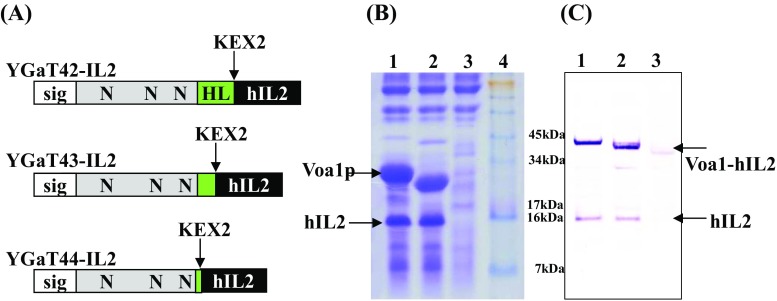
Expression analysis of VOA1 derivatives fused with hIL2. a Schematic representation of VOA1-hIL2 fusion proteins. Sig signal peptide, N N-linked glycosylation site, HL hydrophilic domain. b Confirmation of hIL2 expression by SDS-PAGE analysis. Lanes 1–3 culture broth of S. cerevisiae transformed with YGaT42-IL2, YGaT43-IL2, and YGaT44-IL2 vector, respectively; lane M pre-stained protein size marker (Invitrogen). c Western blot analysis of intracellular proteins. Lanes 1–3 cell extract of recombinant strains carrying YGaT42-IL2, YGaT43-IL2, and YGaT44-IL2 vector, respectively
Fig. 3
Fig. 3
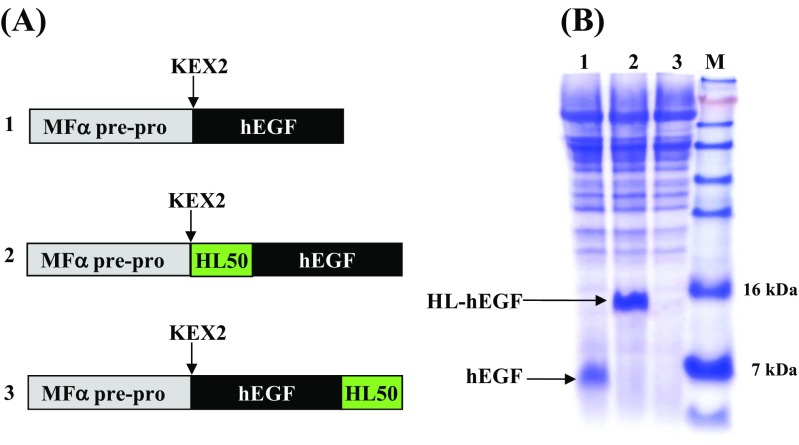
Effects of HL50 tagging on the expression of hEGF. a Schematic representation of the hEGF secretion cassette. b SDS-PAGE analysis of culture broth of S. cerevisiae transformed with YEGα-EGF (lane 1), YEGα-HL50-EGF (lane 2), and YEGα-EGF-HL50 (lane 3), respectively; lane M pre-stained protein size marker (Invitrogen)
Fig. 4
Fig. 4
Expression of hEGF using modified HL peptides. a Amino acid sequence of modified HL peptides. b Schematic representation of the hEGF secretion cassette. c SDS-PAGE analysis of culture broth of S. cerevisiae transformed with YEGα-EGF (lanes 1, 5, 9); YEGα-HL50-EGF (lanes 2, 6, 10); YEGα-HL37-EGF (lanes 3, 7, 11); and YEGα-HL28-EGF (lanes 4, 8, 12); respectively. Lanes 5–8 after deglycosylation, lanes 9–12 after digestion with EK, lane M pre-stained protein size marker (Invitrogen)
Fig. 5
Fig. 5
Confirmation of recombinant hEGF expression. a Time profiles of fed-batch fermentation of S. cerevisiae expressing YEGα-HL28-EGF. b SDS-PAGE analysis of culture supernatants. Samples of culture supernatants (10 μl) at the indicated times were analyzed. c SDS-PAGE of the purified hEGF. Lane 1 after ultrafiltration of fermentation broth, lane 2 after Ni-NTA affinity chromatography, and lane 3 purified hEGF after EK digestion. d Bioactivity assay of the purified hEGF. The EL-4 cell line was cultured in the presence of the indicated amounts of hEGF, and cell proliferation was analyzed following bromodeoxyuridine (BrdU) labeling
Fig. 6
Fig. 6
Expression of EXD-4 and hIGF-1 using HL28. SDS-PAGE analysis of culture broth of S. cerevisiae transformed with YEGα-EXD4 (lane 1), YEGα-HL28-EXD4 (lane 2), YEGα-IGF (lane 3), and YEGα-HL28-IGF (lane 4), lane M pre-stained protein size marker (Invitrogen)

References

    1. Ahn JO, Choi ES, Lee HW, Hwang SH, Kim CS, Jang HW, Haam SJ, Jung JK. Enhanced secretion of Bacillus stearothermophilus L1 lipase in Saccharomyces cerevisiae by translational fusion to cellulose-binding domain. Appl Microbiol Biotechnol. 2004;64(6):833–839. doi: 10.1007/s00253-003-1547-5. - DOI - PubMed
    1. Andres I, Gallardo O, Parascandola P, Javier Pastor FI, Zueco J. Use of the cell wall protein Pir4 as a fusion partner for the expression of Bacillus sp. BP-7 xylanase a in Saccharomyces cerevisiae. Biotechnol Bioeng. 2005;89(6):690–697. doi: 10.1002/bit.20375. - DOI - PubMed
    1. Bae JH, Sung BH, Kim HJ, Park SH, Lim KM, Kim MJ, Lee CR, Sohn JH. An efficient genome-wide fusion partner screening system for secretion of recombinant proteins in yeast. Sci Rep. 2015;5:12229. doi: 10.1038/srep12229. - DOI - PMC - PubMed
    1. Buckholz RG, Gleeson MA. Yeast systems for the commercial production of heterologous proteins. Biotechnology (N Y) 1991;9(11):1067–1072. doi: 10.1038/nbt1191-1067. - DOI - PubMed
    1. Carla Fama M, Raden D, Zacchi N, Lemos DR, Robinson AS, Silberstein S. The Saccharomyces cerevisiae YFR041C/ERJ5 gene encoding a type I membrane protein with a J domain is required to preserve the folding capacity of the endoplasmic reticulum. Biochim Biophys Acta. 2007;1773(2):232–242. doi: 10.1016/j.bbamcr.2006.10.011. - DOI - PMC - PubMed

MeSH terms

Substances