. 2016 Jul 26;113(30):E4286-93.
doi: 10.1073/pnas.1603929113. Epub 2016 Jul 13.

Protein-protein docking by fast generalized Fourier transforms on 5D rotational manifolds

Affiliations

Protein-protein docking by fast generalized Fourier transforms on 5D rotational manifolds

Dzmitry Padhorny et al. Proc Natl Acad Sci U S A. .

Abstract

Energy evaluation using fast Fourier transforms (FFTs) enables sampling billions of putative complex structures and hence revolutionized rigid protein-protein docking. However, in current methods, efficient acceleration is achieved only in either the translational or the rotational subspace. Developing an efficient and accurate docking method that expands FFT-based sampling to five rotational coordinates is an extensively studied but still unsolved problem. The algorithm presented here retains the accuracy of earlier methods but yields at least 10-fold speedup. The improvement is due to two innovations. First, the search space is treated as the product manifold [Formula: see text], where [Formula: see text] is the rotation group representing the space of the rotating ligand, and [Formula: see text] is the space spanned by the two Euler angles that define the orientation of the vector from the center of the fixed receptor toward the center of the ligand. This representation enables the use of efficient FFT methods developed for [Formula: see text] Second, we select the centers of highly populated clusters of docked structures, rather than the lowest energy conformations, as predictions of the complex, and hence there is no need for very high accuracy in energy evaluation. Therefore, it is sufficient to use a limited number of spherical basis functions in the Fourier space, which increases the efficiency of sampling while retaining the accuracy of docking results. A major advantage of the method is that, in contrast to classical approaches, increasing the number of correlation function terms is computationally inexpensive, which enables using complex energy functions for scoring.

Keywords: FFT; manifold; protein docking.


Conflict of interest statement

The authors declare no conflict of interest.

Figures

Fig. 1.
Fig. 1.
Schematic representation of FFT-based docking methods. In Cartesian FFT sampling (upper path), the ligand protein is translated along three Cartesian coordinates in Fourier space using the translational operator T. The translation must be repeated for each rotation of the ligand. In 5D FMFT docking (lower path), the direction of the vector from the center of the receptor to the center of the ligand is defined by two Euler angles, and the ligand is rotated around its center, resulting in the search space (SO(3)S)×SO(3). All rotations are performed in generalized Fourier space, where D denotes the rotational operator. The only traditional search is the 1D translation along the vector between the centers of the two proteins.
Fig. S1.
Fig. S1.
(A) Matching of a pair of patterns via rotation around two different points. The patterns can be regarded as printed on the surfaces of two rotatable spheres with centers coinciding with the points of rotation. (B) A pair of spherical coordinate systems that are used for representation of functions f and g describing the patterns to be superimposed.
Fig. S2.
Fig. S2.
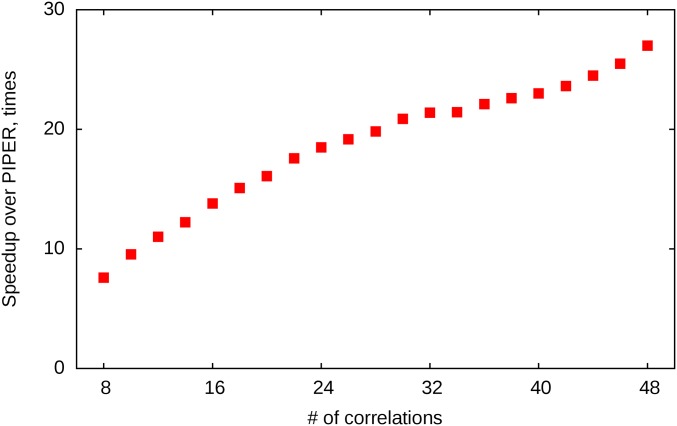
Speedup of the FMFT appproach over PIPER as a function of the number of correlations. Although FMFT is generally faster than PIPER by an order of magnitude, the difference further increases with the increasing number of correlation terms, allowing for routine use of much more complex correlation-based energy functions. All execution times were measured on the E2A-HPr system and averaged over three runs. Additional correlation terms used were extra-repulsive van der Waals energy components, reweighted to provide a constant repulsive van der Waals contribution.
Fig. 2.
Fig. 2.
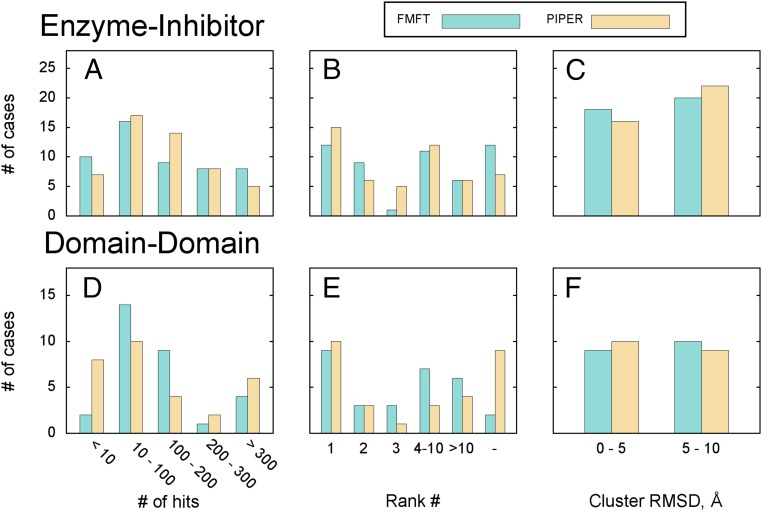
Results of docking enzyme–inhibitor and domain-domain pairs. Bar heights represent the number of docking cases that fall into an appropriate category. (A) The number of hits among the 1,000 low-energy poses generated for enzyme–inhibitor complexes. (B) Ranking of final near-native models for enzyme–inhibitor complexes. (C) Cα IRMSD of the final model for enzyme–inhibitor complexes (here only cases with both FMFT and PIPER producing a near-native model were taken into account). (D) The number of hits among the 1,500 low-energy poses generated for domain–domain complexes. (E) Ranking of final near-native models for domain–domain complexes. (F) Cα IRMSD of the final model for domain–domain complexes. As in C, only cases with both FMFT and PIPER producing a near-native model were taken into account.
Fig. 3.
Fig. 3.
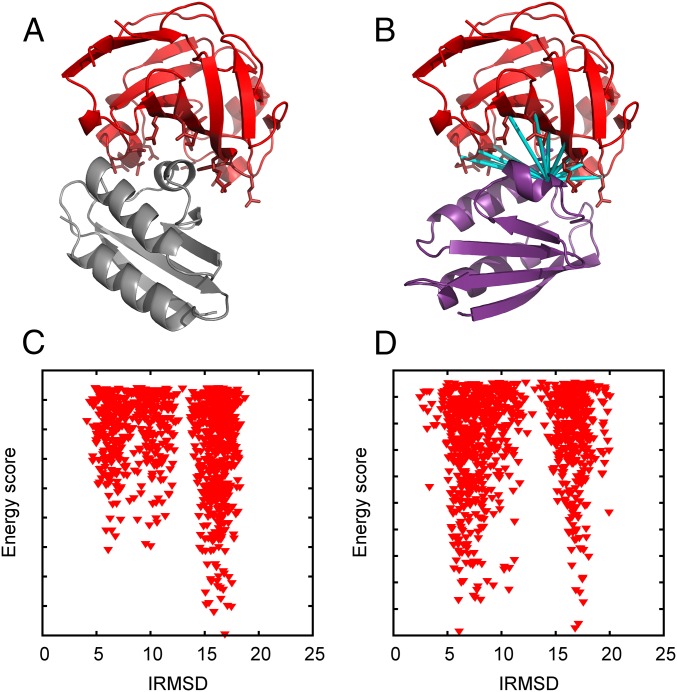
Docking of E2A and HPr proteins. (A) Model defined by the most populated cluster obtained without restraints. (B) Model defined by the most populated cluster obtained with restraints. A set of cyan cylinders represents one of the 20 restraints. (C) IRMSD versus energy score for docking without restraints. (D) IRMSD versus energy score for docking with restraints. Incorporation of experimental restraints substantially increased the population of the near-native cluster.
Fig. 4.
Fig. 4.
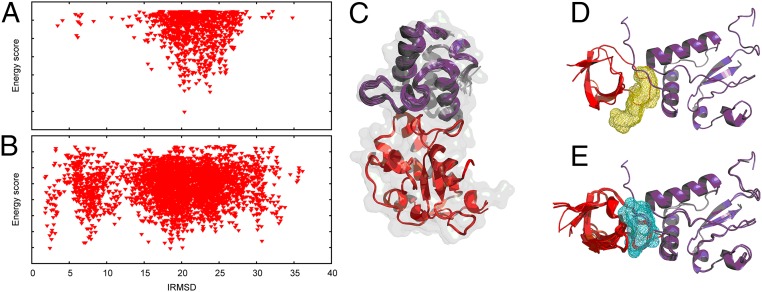
Docking of structural ensembles. (A) Sampling the interaction energy landscape using a single E9 DNase domain structure and the first NMR model of IM9. The docking does not capture any near-native energy minimum. (B) Consensus energy values from the 80 pairwise dockings of four different X-ray structures of the E9 DNase domain to 20 NMR models of the IM9 protein. (C) Cartoon representation of the four E9 DNase domain and 20 IM9 structures used for docking, superimposed on the structure of the native complex (gray shade). (D) Binding site identification for the Nef–Fyn(R96I)SH3 complex obtained by docking the highest sequence identity models alone. (E) Using multiple homology models of the receptor and the ligand to identify the binding site for the Nef–Fyn(R96I) SH3 complex results in a more specific prediction.
Fig. 5.
Fig. 5.
Docking of the ace-PQQATDD peptide to TRAF2. (A) Bound structure of the peptide (red) and the 3.3-Å model, ranked fourth (cyan). (B) Peptide backbone RMSD versus scoring function when docking the most common structural template alone. (C) Peptide backbone RMSD versus scoring function when using all 25 templates. Docking the ensemble substantially improves the results, and yields samples with less than 4.0-Å backbone RMSD.

References

    1. Ritchie DW. Recent progress and future directions in protein-protein docking. Curr Protein Pept Sci. 2008;9(1):1–15. - PubMed
    1. Andrusier N, Mashiach E, Nussinov R, Wolfson HJ. Principles of flexible protein-protein docking. Proteins. 2008;73(2):271–289. - PMC - PubMed
    1. Vajda S, Kozakov D. Convergence and combination of methods in protein–protein docking. Curr Opin Struct Biol. 2009;19(2):164–170. - PMC - PubMed
    1. Smith GR, Sternberg MJE. Prediction of protein–protein interactions by docking methods. Curr Opin Struct Biol. 2002;12(1):38–35. - PubMed
    1. Katchalski-Katzir E, et al. Molecular surface recognition: Determination of geometric fit between proteins and their ligands by correlation techniques. Proc Natl Acad Sci USA. 1992;89(6):2195–2199. - PMC - PubMed

Publication types