


Ischemic Stroke Risk After Acute Coronary Syndrome
- PMID: 27413043
- PMCID: PMC5015356
- DOI: 10.1161/JAHA.115.002590
Ischemic Stroke Risk After Acute Coronary Syndrome
Abstract
Background: Prior studies show an increased risk of ischemic stroke (IS) after myocardial infarction; however, there is limited evidence on long-term risk and whether it is directly related to cardiac injury. We hypothesized that the risk of IS after acute coronary syndrome is significantly higher if there is evidence of cardiac injury, such as ST-segment elevation myocardial infarction (STEMI) or non-STEMI, than when there is no evidence of cardiac injury, such as in unstable angina.
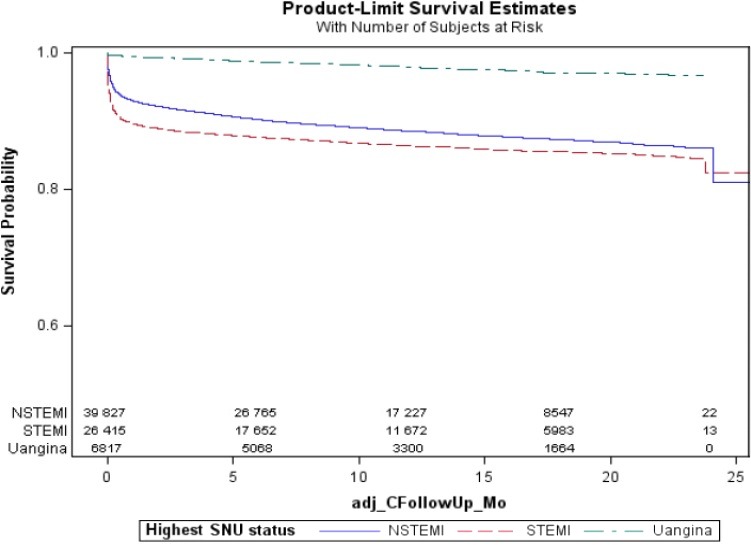
Methods and results: Administrative claims data were obtained from all emergency department encounters and hospitalizations at California's nonfederal acute care hospitals between 2008 and 2011. Patients with STEMI, non-STEMI, and unstable angina were identified using appropriate International Classification of Diseases, Ninth Revision, Clinical Modification codes. The primary outcome was IS during 2 years of follow-up. Unadjusted and adjusted Cox proportional hazards models were used to determine the association between acute coronary syndrome subtype and IS risk. We identified 73 059 patients with a diagnosis of STEMI (n=26 427), non-STEMI (n=39 833), or unstable angina (n=6819) during the study period. In the fully adjusted models that included potential confounders such as atrial fibrillation and congestive heart failure, the risk of IS was higher with STEMI (hazard ratio 4.17, 95% CI 3.00-5.83; P<0.001) and non-STEMI (hazard ratio 3.73, 95% CI 2.68-5.19, P<0.001) compared with unstable angina.
Conclusions: Non-STEMI and STEMI confer an equally increased risk of IS. Studies exploring IS mechanisms in cardiac patients are needed to improve and tailor stroke prevention strategies.
Keywords: angina; cardiac biomarkers; coronary artery disease; embolism; ischemic stroke; myocardial infarction.
© 2016 The Authors. Published on behalf of the American Heart Association, Inc., by Wiley Blackwell.
Figures


References
-
- Mooe T, Eriksson P, Stegmayr B. Ischemic stroke after acute myocardial infarction. A population‐based study. Stroke. 1997;28:762–767. - PubMed
-
- Kupper AJ, Verheugt FW, Peels CH, Galema TW, Roos JP. Left ventricular thrombus incidence and behavior studied by serial two‐dimensional echocardiography in acute anterior myocardial infarction: left ventricular wall motion, systemic embolism and oral anticoagulation. J Am Coll Cardiol. 1989;13:1514–1520. - PubMed
-
- Vaitkus PT, Barnathan ES. Embolic potential, prevention and management of mural thrombus complicating anterior myocardial infarction: a meta‐analysis. J Am Coll Cardiol. 1993;22:1004–1009. - PubMed
-
- Ulvenstam A, Kajermo U, Modica A, Jernberg T, Soderstrom L, Mooe T. Incidence, trends, and predictors of ischemic stroke 1 year after an acute myocardial infarction. Stroke. 2014;45:3263–3268. - PubMed
-
- Kontny F, Dale J, Abildgaard U, Pedersen TR. Randomized trial of low molecular weight heparin (dalteparin) in prevention of left ventricular thrombus formation and arterial embolism after acute anterior myocardial infarction: the Fragmin in Acute Myocardial Infarction (FRAMI) Study. J Am Coll Cardiol. 1997;30:962–969. - PubMed
Publication types
MeSH terms
Grants and funding
LinkOut - more resources
Full Text Sources
Other Literature Sources
Medical
