


Patient portals and personal health information online: perception, access, and use by US adults
- PMID: 27413120
- PMCID: PMC7651932
- DOI: 10.1093/jamia/ocw095
Patient portals and personal health information online: perception, access, and use by US adults
Abstract
Background: Access to online patient portals is key to improving care, but we have limited understanding of patient perceptions of online portals and the characteristics of people who use them.
Methods: Using a national survey of 3677 respondents, we describe perceptions and utilization of online personal health information (PHI) portals.
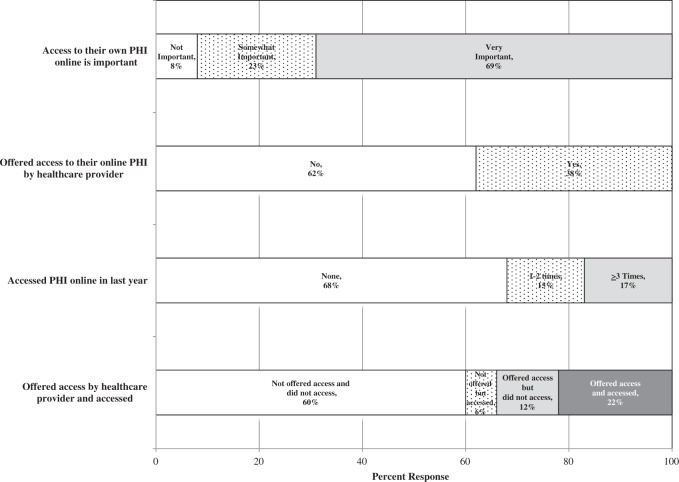
Results: Most respondents (92%) considered online PHI access important, yet only 34% were offered access to online PHI by a health care provider, and just 28% accessed online PHI in the past year. While there were no differences across race or ethnicity in importance of access, black and Hispanic respondents were significantly less likely to be offered access ( P = .006 and <.001, respectively) and less likely to access their online PHI ( P = .041 and <.001, respectively) compared to white and non-Hispanic respondents.
Conclusion: Health care providers are crucial to the adoption and use of online patient portals and should be encouraged to offer consistent access regardless of patient race and ethnicity.
Keywords: digital divide; electronic medical records; patient-physician communication; personal health information.
© The Author 2016. Published by Oxford University Press on behalf of the American Medical Informatics Association. All rights reserved. For Permissions, please email: journals.permissions@oup.com
Figures
References
-
- Honeyman A, Cox B, Fisher B. Potential impacts of patient access to their electronic care records. Inform Prim Care. 2005;131:55–60. - PubMed
-
- Bronson DL, O'Meara K. The impact of shared medical records on smoking awareness and behavior in ambulatory care. J Gen Intern Med. 1986;11:34–37. - PubMed
-
- Greenfield S, Kaplan SH, Ware JE, Jr, Yano EM, Frank HJ. Patients' participation in medical care: effects on blood sugar control and quality of life in diabetes. J Gen Intern Med. 1988;35:448–457. - PubMed
MeSH terms
LinkOut - more resources
Full Text Sources
Other Literature Sources
Miscellaneous
