


Integrating a Resident-Driven Longitudinal Quality Improvement Curriculum Within an Ambulatory Block Schedule
- PMID: 27413445
- PMCID: PMC4936860
- DOI: 10.4300/JGME-D-15-00371.1
Integrating a Resident-Driven Longitudinal Quality Improvement Curriculum Within an Ambulatory Block Schedule
Abstract
Background: Quality improvement (QI) is essential in clinical practice, requiring effective teaching in residency. Barriers include lack of structure, mentorship, and time.
Objective: To develop a longitudinal QI curriculum for an internal medicine residency program with limited faculty resources and evaluate its effectiveness.
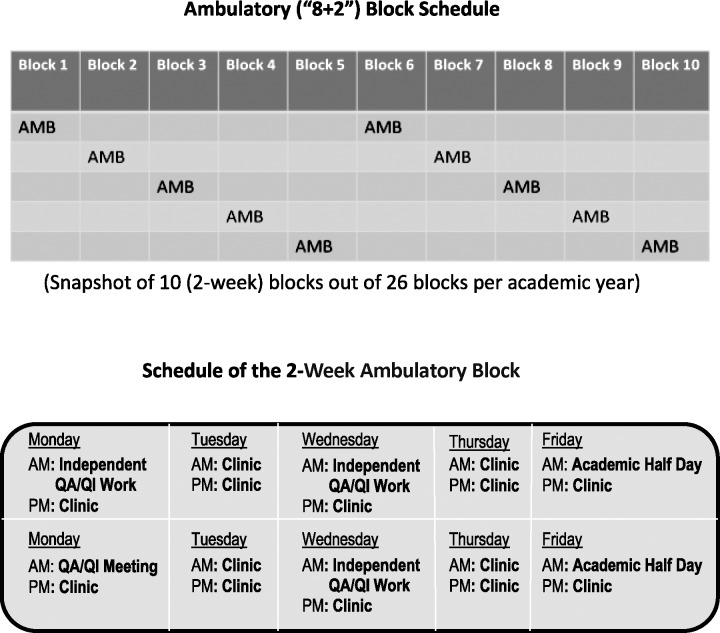
Methods: All medicine residents were provided with dedicated research time every 8 weeks during their ambulatory blocks. Groups of 3 to 5 residents across all postgraduate year levels were formed. Two faculty members and 1 chief resident advised all groups, meeting with each group every 8 weeks, with concrete expectations for each meeting. Residents were required to complete didactic modules from the Institute for Healthcare Improvement. Current residents and alumni were surveyed for feedback.
Results: Over 3 years, all eligible residents (92 residents per year in 2012-2014, 102 in 2014-2015) participated in the curriculum. Residents worked on 54 quality assessment and 18 QI projects, with 6 QI projects showing statistically significant indicator improvements. About 50 mentoring hours per year were contributed by 2 faculty advisors and a chief resident. No other staff or IT support was needed. A total of 69 posters/abstracts were produced, with 13 projects presented at national or regional conferences. Survey respondents found the program useful; most (75% residents, 63% alumni) reported it changed their practice, and 71% of alumni found it useful after residency.
Conclusions: Our longitudinal QI curriculum requires minimal faculty time and resulted in increased QI-related publications and measurable improvements in quality indicators. Alumni reported a positive effect on practice after graduation.
Conflict of interest statement
Conflict of interest: The authors declare they have no competing interests.
Figures
References
-
- Swing SR. The ACGME outcome project: retrospective and prospective. Med Teach. 2007. 29 7: 648– 654. - PubMed
-
- Accreditation Council for Graduate Medical Education. Program requirements for graduate medical education in internal medicine. https://www.acgme.org/acgmeweb/Portals/0/PFAssets/ProgramRequirements/CP.... Accessed March 1, 2016.
-
- Langley GL, Moen R, Nolan KM, Nolan TW, Norman CL, Provost LP. The Improvement Guide: A Practical Approach to Enhancing Organizational Performance. 2nd ed. San Francisco, CA: Jossey-Bass Publishers; 2009.
-
- Runnacles J, Moult B, Lachman P. Developing future clinical leaders for quality improvement: experience from a London children's hospital. BMJ Qual Saf. 2013; 22 11: 956– 963. - PubMed
-
- Patow CA, Karapovich K, Riesenberg LA, Jaeger J, Rosenfield JC, Wittenbreer M, et al. Residents' engagement in quality improvement: a systematic review of the literature. Acad Med. 2009; 84 12: 1757– 1764. - PubMed
MeSH terms
LinkOut - more resources
Full Text Sources
Other Literature Sources
