


To Check or Not to Check? A Qualitative Study on How the Public Decides on Health Checks for Cardiovascular Disease Prevention
- PMID: 27415432
- PMCID: PMC4945067
- DOI: 10.1371/journal.pone.0159438
To Check or Not to Check? A Qualitative Study on How the Public Decides on Health Checks for Cardiovascular Disease Prevention
Erratum in
-
Correction: To Check or Not to Check? A Qualitative Study on How the Public Decides on Health Checks for Cardiovascular Disease Prevention.PLoS One. 2016 Aug 25;11(8):e0162152. doi: 10.1371/journal.pone.0162152. eCollection 2016. PLoS One. 2016. PMID: 27560186 Free PMC article.
Abstract
Background: More than half of the general population does not attend screening for cardiovascular diseases (CVD) hence they are unaware of their risks. The objective of this study was to explore the views and experiences of the public in deciding to undergo health checks for CVD prevention.
Methods: This was a qualitative study utilising the constructivist grounded theory approach. A total of 31 individuals aged 30 years and above from the community were sampled purposively. Eight interviews and six focus groups were involved, using a semi-structured topic guide.
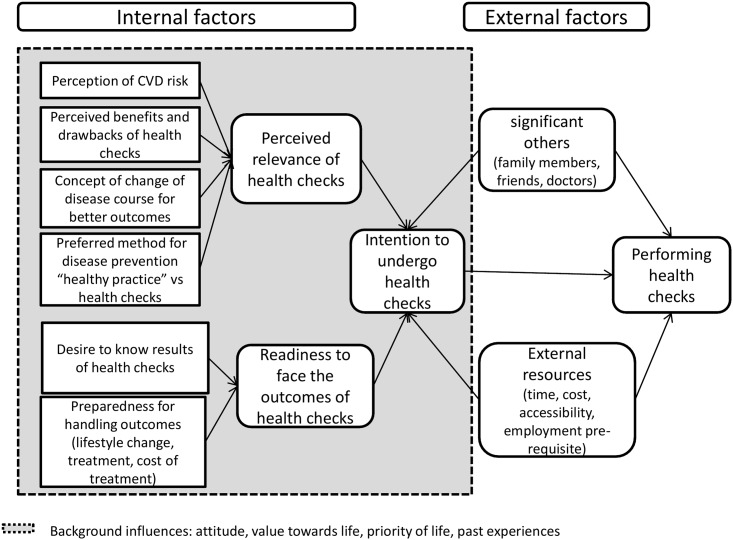
Results: A conceptual framework was developed to explain the public's decision-making process on health check participation for CVD prevention. The intention to participate in health checks was influenced by the interplay between perceived relevance and the individual's readiness to face the outcome of health checks. Health checks were deemed relevant if people perceived themselves to be at risk of CVD and there was an advantage in knowing their cardiovascular status. People were ready to face the outcome of health checks if they wanted to know the results and were prepared to deal with the subsequent management. The decision to participate in health checks was also influenced by external factors such as the views of significant others, and the accessibility and availability of resources including time and finances.
Conclusions: The intention to screen for CVD is motivated by two internal factors: the perceived relevance of the disease and readiness to face screening outcomes. Strategies targeting the internal decision-making process may prove to be key in improving the uptake of screening.
Conflict of interest statement
Figures
References
-
- World Health Organisation. The global burden of disease: 2004 update. Available: http://www.who.int/healthinfo/global_burden_disease/2004_report_update/en/. Published 2008. Accessed 27 July 2015.
-
- World Health Organisation. Projections of mortality and causes of death, 2015 and 2030. Available: http://www.who.int/healthinfo/global_burden_disease/projections/en/index.... Accessed 28 July 2015.
-
- Celermajer DS, Chow CK, Marijon E, Anstey NM, Woo KS. Cardiovascular disease in the developing world: prevalences, patterns, and the potential of early disease detection. J Am Coll Cardiol. 2012; 60(14):1207–16. - PubMed
-
- Critchley J, Liu J, Zhao D, Wei W, Capewell S. Explaining the increase in coronary heart disease mortality in Beijing between 1984 and 1999. Circulation. 2004; 110(10):1236–44. - PubMed
-
- Hata J, Kiyohara Y. Epidemiology of stroke and coronary artery disease in Asia. Circ J. 2013; 77(8):1923–32. - PubMed
MeSH terms
LinkOut - more resources
Full Text Sources
Other Literature Sources
