


Importance of the Evaluation of N-Acetyltransferase Enzyme Activity Prior to 5-Aminosalicylic Acid Medication for Ulcerative Colitis
- PMID: 27416043
- PMCID: PMC4956520
- DOI: 10.1097/MIB.0000000000000823
Importance of the Evaluation of N-Acetyltransferase Enzyme Activity Prior to 5-Aminosalicylic Acid Medication for Ulcerative Colitis
Abstract
Background: 5-aminosalicylic acid (5-ASA) is a classic anti-inflammatory drug for the treatment of ulcerative colitis. N-acetyltransferase (NAT) enzymes convert 5-ASA to its metabolite N-acetyl-5-ASA, and it is unresolved whether 5-ASA or N-acetyl-5-ASA is the effective therapeutic molecule. We previously demonstrated that colonic production of N-acetyl-5-ASA (NAT activity) is decreased in dextran sulfate sodium-induced colitis. Our hypothesis is that 5-ASA is the therapeutic molecule to improve colitis, with the corollary that altered NAT activity affects drug efficacy. Since varying clinical effectiveness of 5-ASA has been reported, we also ask if NAT activity varies with inflammation in pediatric or adult patients.
Methods: Acute colonic inflammation was induced in C57BL/6 NAT wild-type (WT) or knockout mice, using 3.5% dextran sulfate sodium (w/v) concurrent with 5-ASA treatment. Adult and pediatric rectosigmoid biopsies were collected from control or patients with ulcerative colitis. Tissue was analyzed for NAT and myeloperoxidase activity.
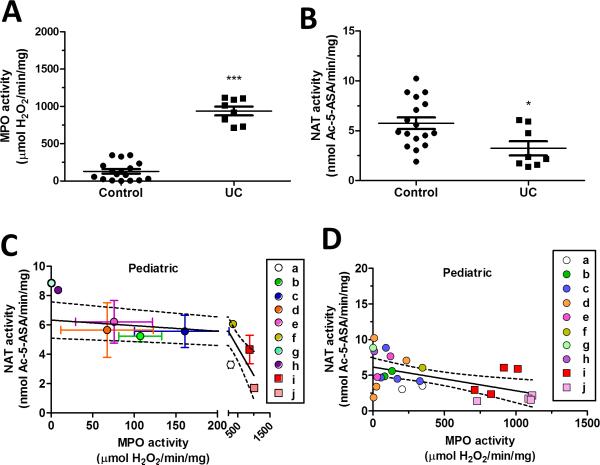
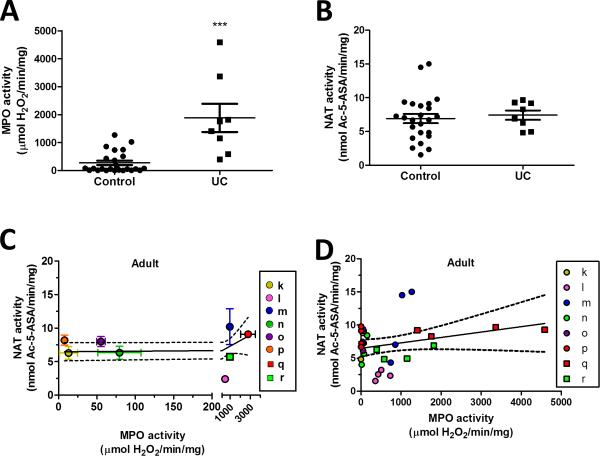
Results: Dextran sulfate sodium-induced colitis was of similar severity in both NAT WT and knockout mice, and NAT activity was significantly decreased in NAT WT mice. In the setting of colitis, 5-ASA significantly restored colon length and decreased myeloperoxidase activity in NAT knockout but not in WT mice. Myeloperoxidase activity negatively correlated with NAT activity in pediatric patients, but correlation was not observed in adult patients.
Conclusions: Inflammation decreases NAT activity in the colon of mice and human pediatric patients. Decreased NAT activity enhances the therapeutic effect of 5-ASA in mice. A NAT activity assay could be useful to help predict the efficacy of 5-ASA therapy.
Figures
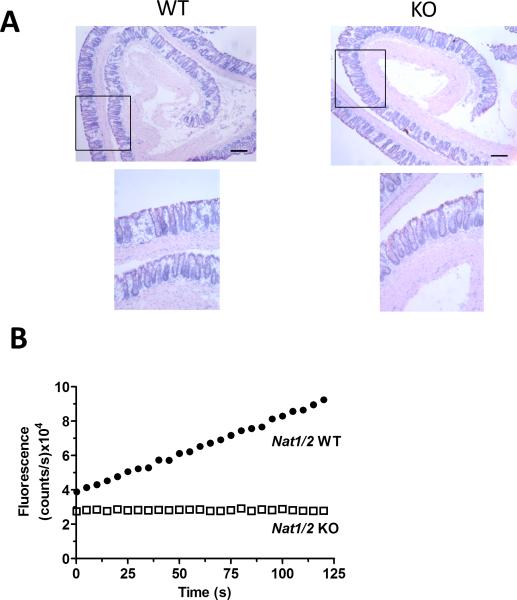
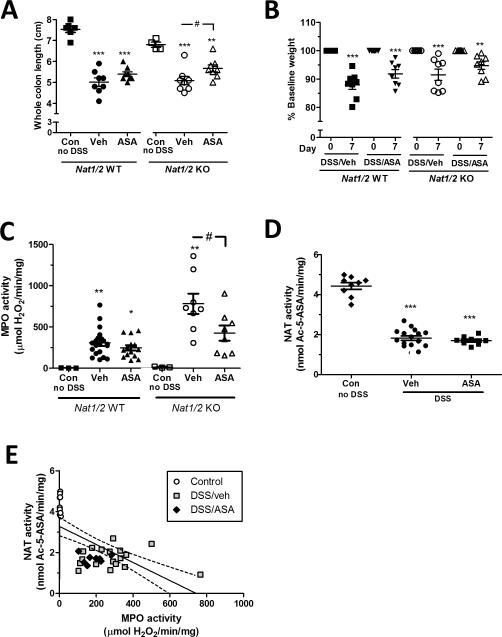
 ), or ASA treated (◆) during DSS. Each point represents one mouse. Linear regression with 95 % confidence levels (dotted line).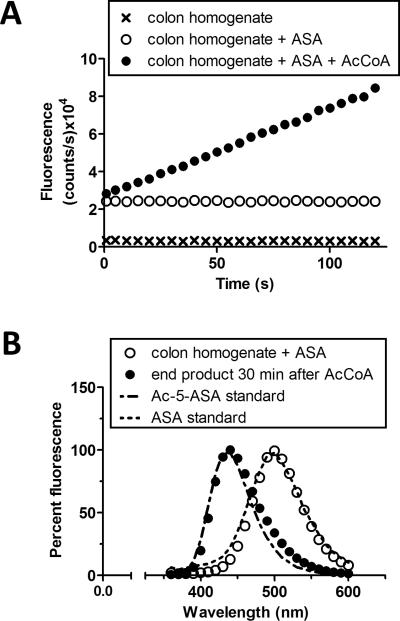
References
-
- Egan LJ, Mays DC, Huntoon CJ, et al. Inhibition of interleukin-1-stimulated NF-kappaB RelA/p65 phosphorylation by mesalamine is accompanied by decreased transcriptional activity. J Biol Chem. 1999;274:26448–26453. - PubMed
-
- Galvez J, Garrido M, Rodriguez-Cabezas ME, et al. The intestinal anti-inflammatory activity of UR-12746S on reactivated experimental colitis is mediated through downregulation of cytokine production. Inflamm Bowel Dis. 2003;9:363–371. - PubMed
-
- Grisham MB, Granger DN. Neutrophil-mediated mucosal injury. Role of reactive oxygen metabolites. Dig Dis Sci. 1988;33:6S–15S. - PubMed
-
- Horvath K, Varga C, Berko A, et al. The involvement of heme oxygenase-1 activity in the therapeutic actions of 5-aminosalicylic acid in rat colitis. Eur J Pharmacol. 2008;581:315–323. - PubMed
Publication types
MeSH terms
Substances
Grants and funding
LinkOut - more resources
Full Text Sources
Other Literature Sources
Medical
Research Materials
