Surveillance Tools Emerging From Search Engines and Social Media Data for Determining Eye Disease Patterns
- PMID: 27416554
- PMCID: PMC5227006
- DOI: 10.1001/jamaophthalmol.2016.2267
Surveillance Tools Emerging From Search Engines and Social Media Data for Determining Eye Disease Patterns
Abstract
Importance: Internet-based search engine and social media data may provide a novel complementary source for better understanding the epidemiologic factors of infectious eye diseases, which could better inform eye health care and disease prevention.
Objective: To assess whether data from internet-based social media and search engines are associated with objective clinic-based diagnoses of conjunctivitis.
Design, setting, and participants: Data from encounters of 4143 patients diagnosed with conjunctivitis from June 3, 2012, to April 26, 2014, at the University of California San Francisco (UCSF) Medical Center, were analyzed using Spearman rank correlation of each weekly observation to compare demographics and seasonality of nonallergic conjunctivitis with allergic conjunctivitis. Data for patient encounters with diagnoses for glaucoma and influenza were also obtained for the same period and compared with conjunctivitis. Temporal patterns of Twitter and Google web search data, geolocated to the United States and associated with these clinical diagnoses, were compared with the clinical encounters. The a priori hypothesis was that weekly internet-based searches and social media posts about conjunctivitis may reflect the true weekly clinical occurrence of conjunctivitis.
Main outcomes and measures: Weekly total clinical diagnoses at UCSF of nonallergic conjunctivitis, allergic conjunctivitis, glaucoma, and influenza were compared using Spearman rank correlation with equivalent weekly data on Tweets related to disease or disease-related keyword searches obtained from Google Trends.
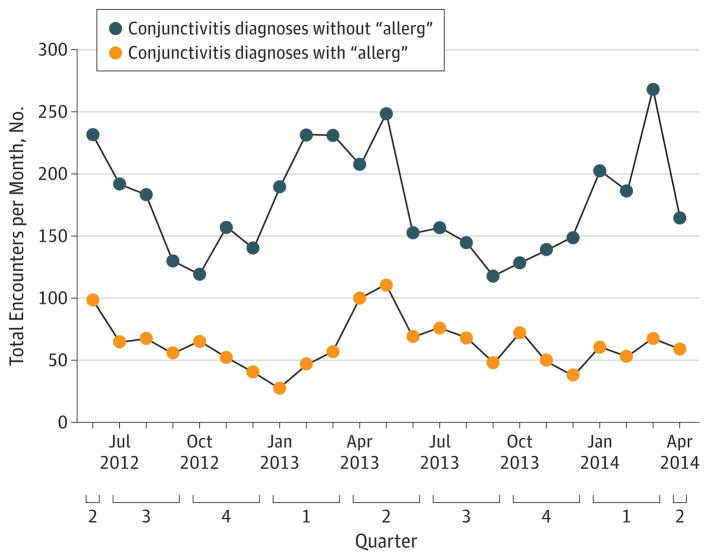
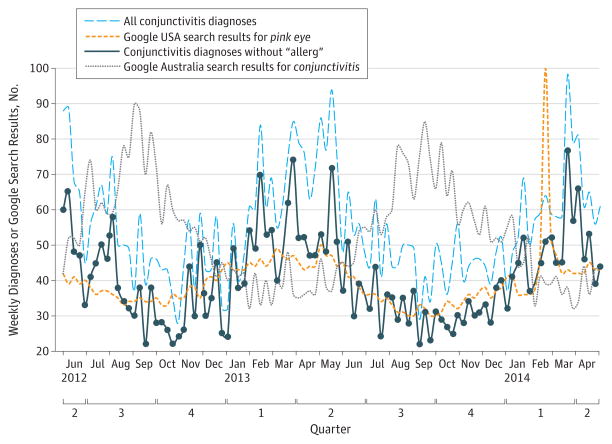
Results: Seasonality of clinical diagnoses of nonallergic conjunctivitis among the 4143 patients (2364 females [57.1%] and 1776 males [42.9%]) with 5816 conjunctivitis encounters at UCSF correlated strongly with results of Google searches in the United States for the term pink eye (ρ, 0.68 [95% CI, 0.52 to 0.78]; P < .001) and correlated moderately with Twitter results about pink eye (ρ, 0.38 [95% CI, 0.16 to 0.56]; P < .001) and with clinical diagnosis of influenza (ρ, 0.33 [95% CI, 0.12 to 0.49]; P < .001), but did not significantly correlate with seasonality of clinical diagnoses of allergic conjunctivitis diagnosis at UCSF (ρ, 0.21 [95% CI, -0.02 to 0.42]; P = .06) or with results of Google searches in the United States for the term eye allergy (ρ, 0.13 [95% CI, -0.06 to 0.32]; P = .19). Seasonality of clinical diagnoses of allergic conjunctivitis at UCSF correlated strongly with results of Google searches in the United States for the term eye allergy (ρ, 0.44 [95% CI, 0.24 to 0.60]; P < .001) and eye drops (ρ, 0.47 [95% CI, 0.27 to 0.62]; P < .001).
Conclusions and relevance: Internet-based search engine and social media data may reflect the occurrence of clinically diagnosed conjunctivitis, suggesting that these data sources can be leveraged to better understand the epidemiologic factors of conjunctivitis.
Conflict of interest statement
Disclosures: All authors have completed and submitted the ICMJE Form for Disclosure of Potential Conflicts of Interest and none were reported.
Figures
Comment in
-
The Utility of "Big Data" and Social Media for Anticipating, Preventing, and Treating Disease.JAMA Ophthalmol. 2016 Sep 1;134(9):1030-1. doi: 10.1001/jamaophthalmol.2016.2287. JAMA Ophthalmol. 2016. PMID: 27416336 No abstract available.
-
Uncertainties in Big Data When Using Internet Surveillance Tools and Social Media for Determining Patterns in Disease Incidence.JAMA Ophthalmol. 2017 Apr 1;135(4):402. doi: 10.1001/jamaophthalmol.2017.0138. JAMA Ophthalmol. 2017. PMID: 28301633 No abstract available.
-
Uncertainties in Big Data When Using Internet Surveillance Tools and Social Media for Determining Patterns in Disease Incidence-Reply.JAMA Ophthalmol. 2017 Apr 1;135(4):402-403. doi: 10.1001/jamaophthalmol.2017.0140. JAMA Ophthalmol. 2017. PMID: 28301641 No abstract available.
References
-
- Singh K, Axelrod S, Bielory L. The epidemiology of ocular and nasal allergy in the United States, 1988–1994. J Allergy Clin Immunol. 2010;126:778–783. e776. - PubMed
-
- Leonardi A, Castegnaro A, Valerio AL, Lazzarini D. Epidemiology of allergic conjunctivitis: clinical appearance and treatment patterns in a population-based study. Curr Opin Allergy Clin Immunol. 2015;15(5):482–488. - PubMed
Publication types
MeSH terms
Grants and funding
LinkOut - more resources
Full Text Sources
Other Literature Sources
Medical
Miscellaneous