. 2016 Jul 15:6:29769.
doi: 10.1038/srep29769.

Evaluation of a Micro-Optical Coherence Tomography for the Corneal Endothelium in an Animal Model

Affiliations

Evaluation of a Micro-Optical Coherence Tomography for the Corneal Endothelium in an Animal Model

Marcus Ang et al. Sci Rep. .

Abstract

Recent developments in optical coherence tomography (OCT) systems for the cornea have limited resolution or acquisition speed. In this study we aim to evaluate the use of a 'micro-OCT' (μOCT ~1 μm axial resolution) compared to existing imaging modalities using animal models of corneal endothelial disease. We used established cryoinjury and bullous keratopathy models in Sprague Dawley rats comparing ex vivo μOCT imaging in normal and diseased eyes to (1) histology; (2) in vivo confocal microscopy (IVCM); and (3) scanning electron microscopy (SEM). Qualitative and quantitative comparisons amongst imaging modalities were performed using mean endothelial cell circularity [(4π × Area)/Perimeter(2)] with coefficient of variation (COV). We found that μOCT imaging was able to delineate endothelial cells (with nuclei), detect inflammatory cells, and corneal layers with histology-like resolution, comparable to existing imaging modalities. The mean endothelial cell circularity score was 0.88 ± 0.03, 0.87 ± 0.04 and 0.88 ± 0.05 (P = 0.216) for the SEM, IVCM and μOCT respectively, with SEM producing homogenous endothelial cell images (COV = 0.028) compared to the IVCM (0.051) and μOCT (0.062). In summary, our preliminary study suggests that the μOCT may be useful for achieving non-contact, histology-like images of the cornea for endothelial cell evaluation, which requires further development for in vivo imaging.


Figures

Figure 1
Figure 1. Endothelial cell circularity score i.e. (4π × Area)/Perimeter2 where a value approaching 1.0 indicated a more circular and hexagonal profile, compared amongst the three imaging techniques using scanning electron microscopy (SEM), vivo confocal microscopy (IVCM), and micro-optical coherence tomography (μOCT); P = 0.216.
Figure 2
Figure 2. Histology images compared to μOCT scan images of the normal mouse cornea.
(A) Cross-sectional histology sections using H&E stain (20x magnification, scale bar = 20 μm). *Indicates Bowman’s layer. Epithelium lies above the Bowman’s layer. Arrow indicates Descemet membrane, corneal stromal layer lies in between. Endothelial cell layer can be seen just below the Descemet membrane. (B) Cross-sectional B-scan μOCT images were able to delineate the corresponsing distinct layers of the cornea with similar resolution to histology images i.e. *Bowman’s layer, collagen fibrils in stroma, Descemet membrane (arrow) and endothelial cell layer below (scale bar = 40 μm). Epithelium lies above the Bowman’s layer. Arrow indicates Descemet membrane, corneal stromal layer lies in between. Endothelial cell layer can be seen just below the Descemet membrane. (C) Endothelial cell layer histology image using Alizarin S Red (20x magnification, scale bar = 20 μm). (D) En face μOCT scan of the normal endothelial cells without artifacts from histology fixing and staining (scale bar = 40 μm) was able to detect the presence of nuclei and villi.
Figure 3
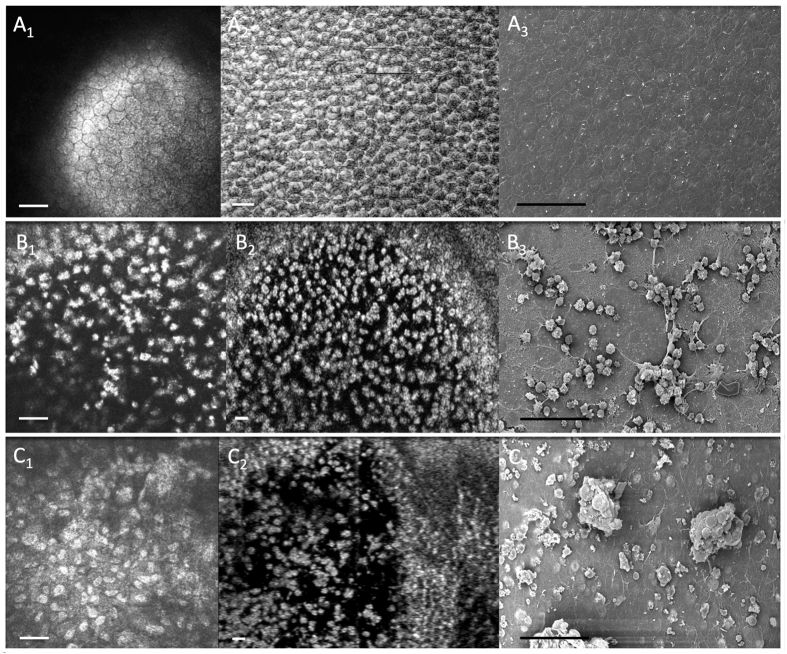
Figure 3
Endothelial cell imaging using in vivo confocal microscopy (left), micro-optical coherence tomography (center) and scanning electron microscopy (right) in control eyes (A), cryoinjury model eyes (B) and benzakolnium chloride injury model (C). A1, B1 and C1: En-face images of rats cornea pre (A1) and post-injury (B1, C1) using In vivo confocal Microscopy (scale bar = 50 μm). A2, B2 and C2: En-face images of rats cornea pre (A2) and post-injury (B2,C2) using micro-OCT (Scale bar = 40 μm). A3, B3, and C3: Cross sectional images of rats cornea Pre (A3) and post-injury (B3,C3) using Scanning Electron Microscopy (2000X magnification) (scale bar = 50 μm).
Figure 4
Figure 4
Slit lamp follow up and Cross sectional images of (A) normal rat cornea (B) Cryo-injury rat cornea (C) Chemical (BAK) injury rat cornea. A1, B1 and C1: Slit lamp examination of rats cornea Pre (A1) and post-injury (B1,C1) (30X magnification). A2, B2 and C2: Cross sectional images of rats cornea Pre (A2) and post-injury (B2,C2) using micro-OCT (Scale bar = 40 μm). A3, B3, and C3: Cross sectional images of rats cornea Pre (A3) and post-injury (B3,C3) using Optovue OCT.

References

    1. Whitcher J. P., Srinivasan M. & Upadhyay M. P. Corneal blindness: a global perspective. Bull World Health Organ 79, 214–221 (2001). - PMC - PubMed
    1. Foster A. & Resnikoff S. The impact of Vision 2020 on global blindness. Eye (Lond) 19, 1133–1135 (2005). - PubMed
    1. Tan D. T., Dart J. K., Holland E. J. & Kinoshita S. Corneal transplantation. Lancet 379, 1749–1761 (2012). - PubMed
    1. Ang M. et al.. Endothelial cell loss and graft survival after Descemet’s stripping automated endothelial keratoplasty and penetrating keratoplasty. Ophthalmology 119, 2239–2244 (2012). - PubMed
    1. Han D. C., Mehta J. S., Por Y. M., Htoon H. M. & Tan D. T. Comparison of outcomes of lamellar keratoplasty and penetrating keratoplasty in keratoconus. Am J Ophthalmol 148, 744–751 e741 (2009). - PubMed

Publication types

MeSH terms