. 2016 Oct;139(1):40-54.
doi: 10.1111/jnc.13738. Epub 2016 Aug 15.

Novel molecular insights into the critical role of sulfatide in myelin maintenance/function

Affiliations

Novel molecular insights into the critical role of sulfatide in myelin maintenance/function

Juan Pablo Palavicini et al. J Neurochem. 2016 Oct.

Abstract

Cerebroside sulfotransferase (CST) catalyzes the production of sulfatide, a major class of myelin-specific lipids. CST knockout (CST(-/-) ) mice in which sulfatide is completely depleted are born healthy, but display myelin abnormalities and progressive tremors starting at 4-6 weeks of age. Although these phenotypes suggest that sulfatide plays a critical role in myelin maintenance/function, the underlying mechanisms remain largely unknown. We analyzed the major CNS myelin proteins and the major lipids enriched in the myelin in a spatiotemporal manner. We found a one-third reduction of the major compact myelin proteins (myelin basic protein, myelin basic protein, and proteolipid protein, PLP) and an equivalent post-developmental loss of myelin lipids, providing the molecular basis behind the thinner myelin sheaths. Our lipidomics data demonstrated that the observed global reduction of myelin lipid content was not because of an increase of lipid degradation but rather to the reduction of their synthesis by oligodendrocytes. We also showed that sulfatide depletion leads to region-specific effects on non-compact myelin, dramatically affecting the paranode (neurofascin 155) and the major inner tongue myelin protein (myelin-associated glycoprotein). Moreover, we demonstrated that sulfatide promotes the interaction between adjacent PLP extracellular domains, evidenced by a progressive decline of high molecular weight PLP complexes in CST(-/-) mice, providing an explanation at a molecular level regarding the uncompacted myelin sheaths. Finally, we proposed that the dramatic losses of neurofascin 155 and PLP interactions are responsible for the progressive tremors and eventual ataxia. In summary, we unraveled novel molecular insights into the critical role of sulfatide in myelin maintenance/function. Cerebroside sulfotransferase (CST) catalyzes the production of sulfatide, a major class of myelin-specific lipids. CST knockout (CST(-/-) ) mice in which sulfatide is completely depleted are born healthy, but display myelin abnormalities We show in our study that sulfatide depletion leads to losses of myelin proteins and lipids, and impairment of myelin functions, unraveling novel molecular insights into the critical role of sulfatide in myelin maintenance/function.

Keywords: cerebroside sulfotransferase; myelin lipidome; myelin-associated glycoprotein; proteolipid protein; shotgun lipidomics; sulfatide.


Conflict of interest statement

disclosure The authors have no conflict of interest to declare.

Figures
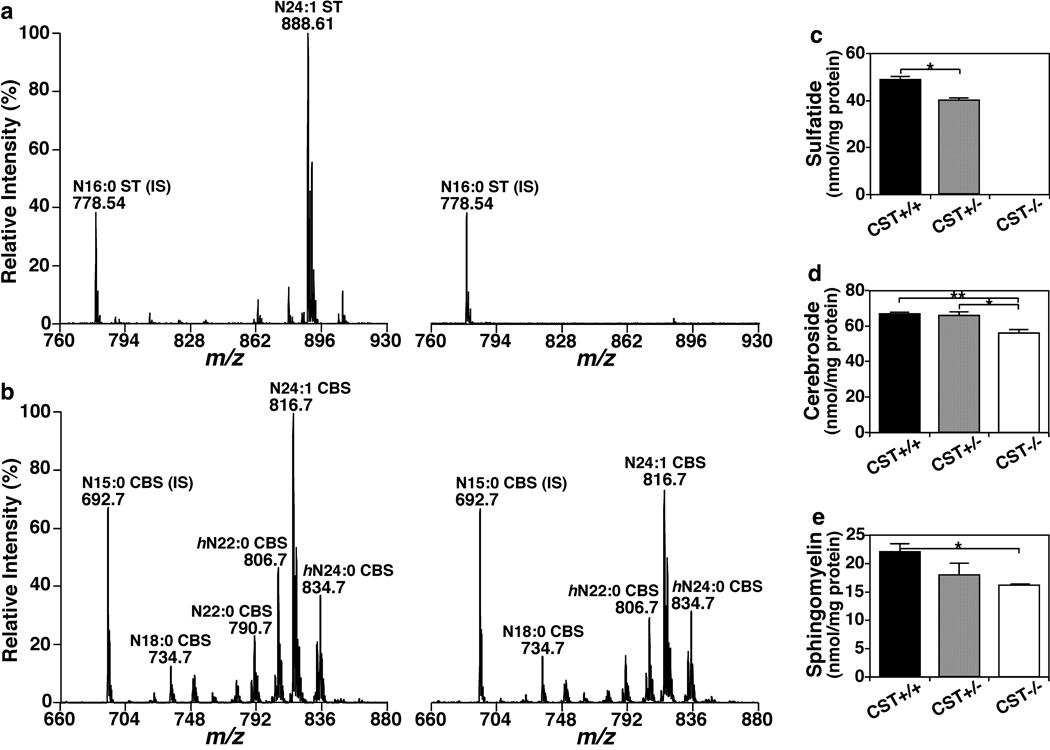
Fig. 1
Fig. 1
The effect of CST disruption on sphingolipid homeostasis in the spinal cord of adult mice. Mouse spinal cords from 3-months old CST male mice were homogenized followed by modified Bligh and Dyer lipid extraction. Representative mass spectra from CST+/+ (left) and CST−/− (right) mice were shown for sulfatides (a) and sphingomyelins (b). Total masses of the major sphingolipid classes present in myelin were quantified by MDMS-SL as described in the section of “Materials and Methods” and plotted. Total sulfatide (c), cerebroside (d), and sphingomyelin (e) contents of CST+/+ (black bars), +/− (gray bars) and −/− (white bars) spinal cords represent the sum of all the individual lipid species detected within each genotype. The data represent means ± SE from at least 4 separate animals. *p < 0.05 and **p < 0.01 as indicated.
Fig. 2
Fig. 2
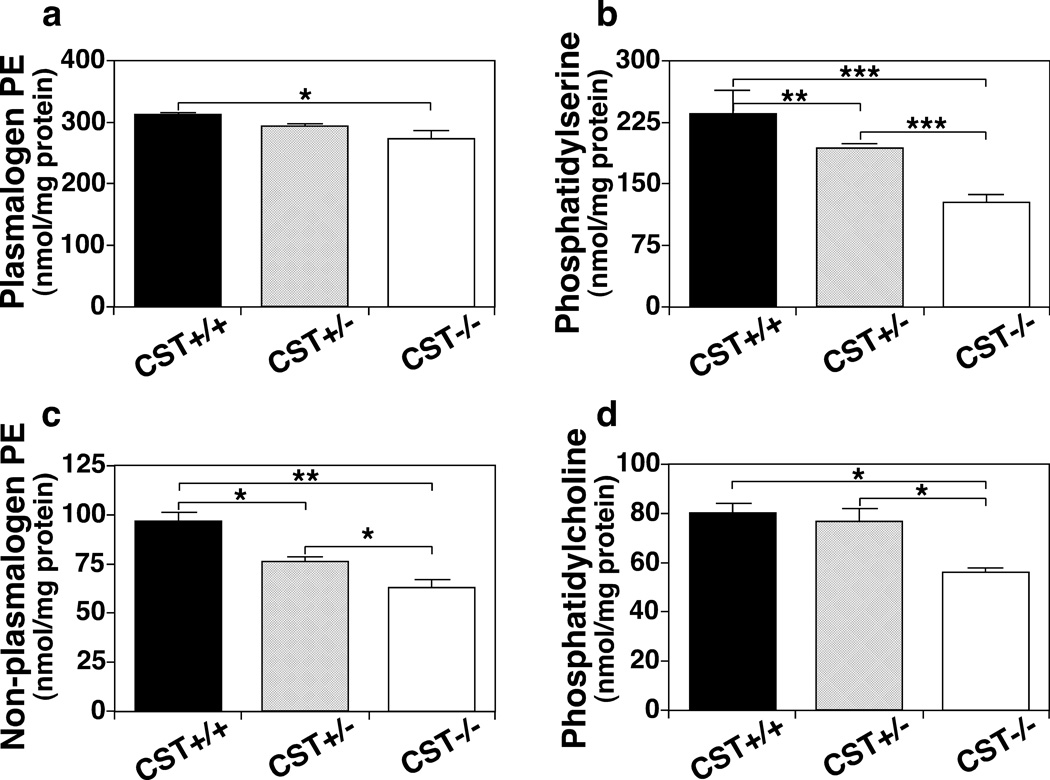
The effect of CST disruption on phospholipid homeostasis in the spinal cord of adult mice. Mouse spinal cords from 3-month old CST male mice were homogenized followed by modified Bligh and Dyer lipid extraction. Total masses for the major phospholipid classes present in myelin were quantified by MDMS-SL as described in the section of “Materials and Methods” and plotted. Total plasmalogen PE (a), phosphatidylserine (b), non-plasmalogen PE (c), and phosphatidylcholine (d) contents of CST+/+ (black bars), +/− (gray bars) and −/− (white bars) spinal cords represent the sum of all the individual lipid species detected within each genotype. The data represent means ± SE from at least 4 separate animals. *p < 0.05, **p < 0.01, and ***p < 0.001 as indicated.
Fig. 3
Fig. 3
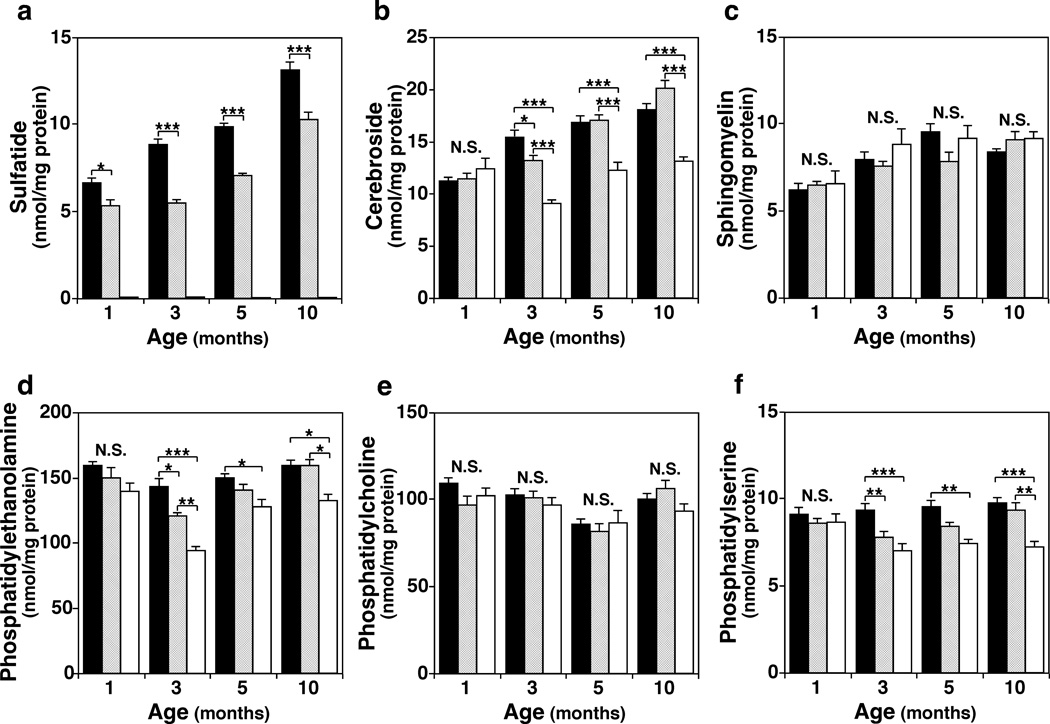
Longitudinal effects of CST disruption on sphingolipid and phospholipid homeostasis in adult mouse brains. Cerebella from 1-, 3-, 5-, and 10-months old CST male mice were homogenized followed by modified Bligh and Dyer lipid extraction. Total masses for the major sphingolipid (a–c) and phospholipid (e–f) classes present in CST+/+ (black bars), +/− (gray bars), and −/− (white bars) cerebella were quantified by MDMS-SL as described in the section of “Materials and Methods” and plotted. The data represent means ± SE from at least 4 separate animals. N.S. no significant difference, *p < 0.05, **p < 0.01, and ***p < 0.001 as indicated.
Fig. 4
Fig. 4
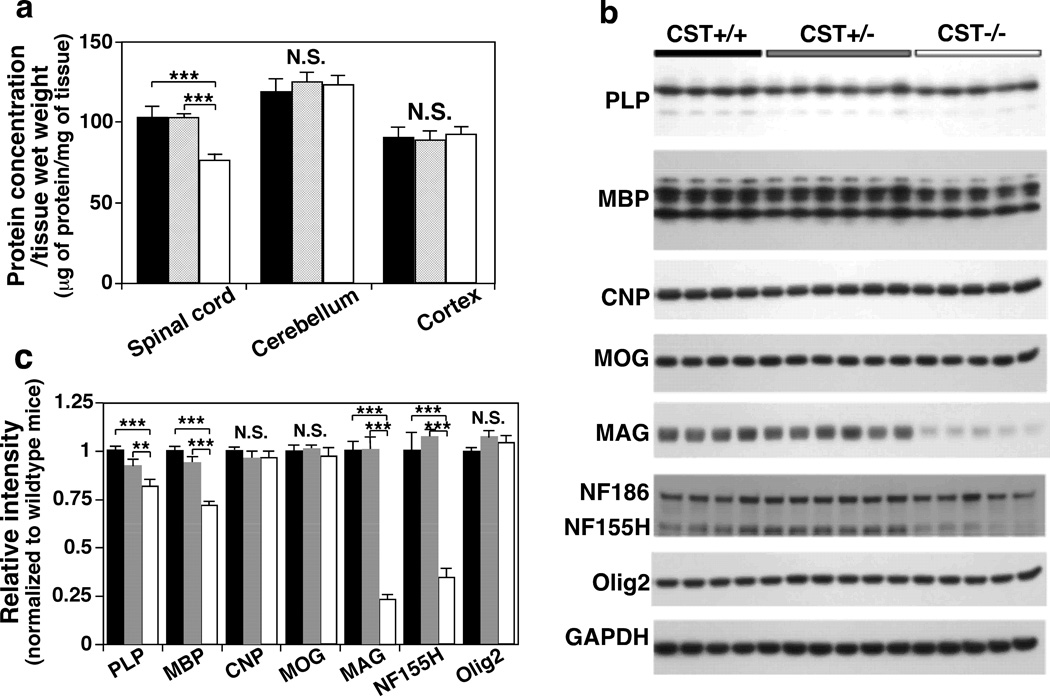
The effect of CST disruption on the levels of major CNS myelin proteins. Mouse spinal cord, cerebellum, and cortical tissue from 3-month old CST+/+ (black bars), +/− (gray bars), and −/− (white bars) male mice were homogenized and its total protein concentration was estimated by BCA protein assay (a). Representative Western blots from cerebellar NP40 supernatants using antibodies against PLP, MBP, CNP, MOG, MAG, NF, GAPDH, and Olig2 (b). Relative intensities were quantified using ImageJ software and normalized to a loading control (GAPDH) (c). The data represent means ± SE from at least 4 separate animals. N.S. denotes no significant difference, *p < 0.05 and ***p < 0.001 as indicated.
Fig. 5
Fig. 5
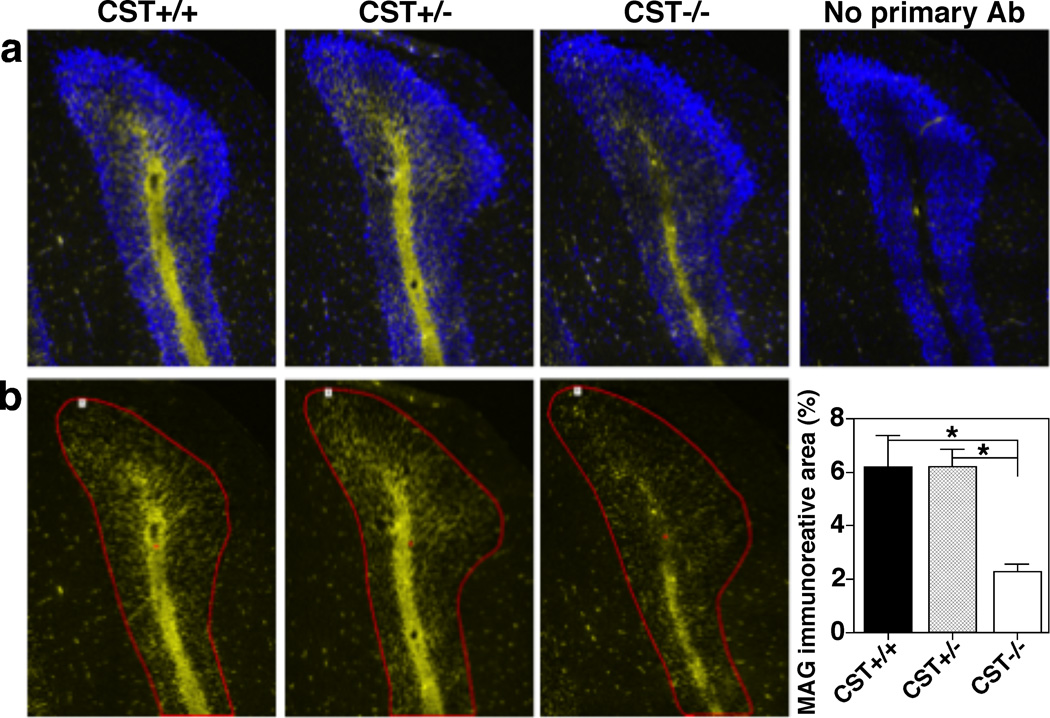
Sulfatide deficiency leads to a dramatic decrease of MAG. CST+/+ (left), +/− (middle), and −/− (right) mouse brains were dissected, fixed in 4% PFA, cryoprotected, frozen, and sectioned coronally (8 µm sections). Representative immunofluorescence images from cerebellar coronal sections (posterior lobe) using anti-MAG antibody (rabbit mAb, Cell Signaling) were shown merged with DAPI (a) and individually (b). Yellow and blue signals represent positive MAG and DAPI staining, respectively. Regions of interest (ROI) were defined within single cerebellar folium using the cerebellar Purkinje layer as its border (ROI 1, red) and the area of immunoreactivity above a threshold was quantified (such threshold was defined based on the control conducted without any primary antibody, shown in the top right). Three equally spaced cerebellar sections were quantified for each individual. The data represent means ± SE from 4 separate animals. *p < 0.05, as indicated.
Fig. 6
Fig. 6
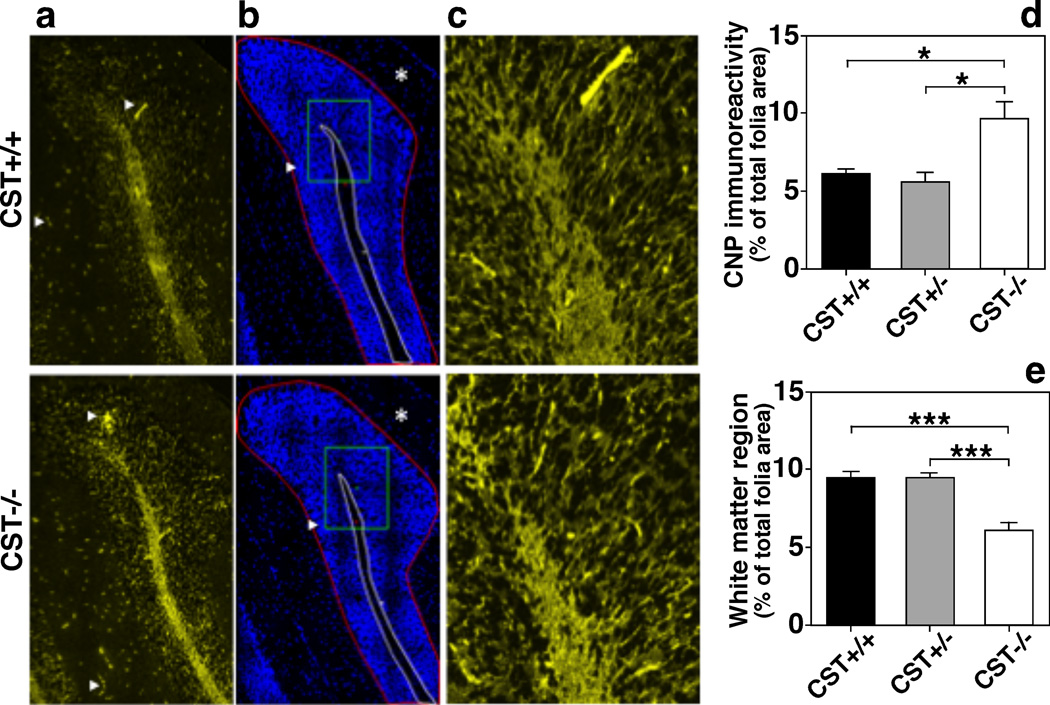
Sulfatide deficiency leads to thinner white matter tracks with a dense population of oligodendrocytes. CST+/+ (top color panels) and −/− (bottom color panels) mouse brains were dissected, fixed in 4% PFA, cryoprotected, frozen, and sectioned coronally (8 µm sections). Representative immunofluorescence images were taken from equivalent cerebellar coronal sections (posterior cerebellar lobe) using anti-CNP (rabbit mAb, Cell Signaling; a and c). DAPI staining (b) is also shown. The images were taken using 40× (a–b) and 60× (c) objectives on a Nikon A1R VAAS inverted confocal. Yellow and blue signals represent positive CNP and DAPI staining, respectively. A non-specific autofluorescence signal was observed in the yellow channel within blood vessels (presumably due to the fact that the animals were not perfused given that their brain tissue was used for multiple purposes) Two regions of interest (ROI) were defined: 1. the area delimited by the Purkinje layer including the granular layer and white matter (ROI1, area defined by red border in b), 2. white matter (ROI2, area defined by white border in b). The area of immunoreactivity above a defined threshold was quantified for CNP (d) using ROI2. White matter area (ROI2) was quantified as a percent of the total folia area (ROI1) (e). Three equally spaced cerebellar sections were quantified for each individual. The data represent means ± SE from 4 separate animals. *p < 0.05, ***p < 0.001 as indicated.
Fig. 7
Fig. 7
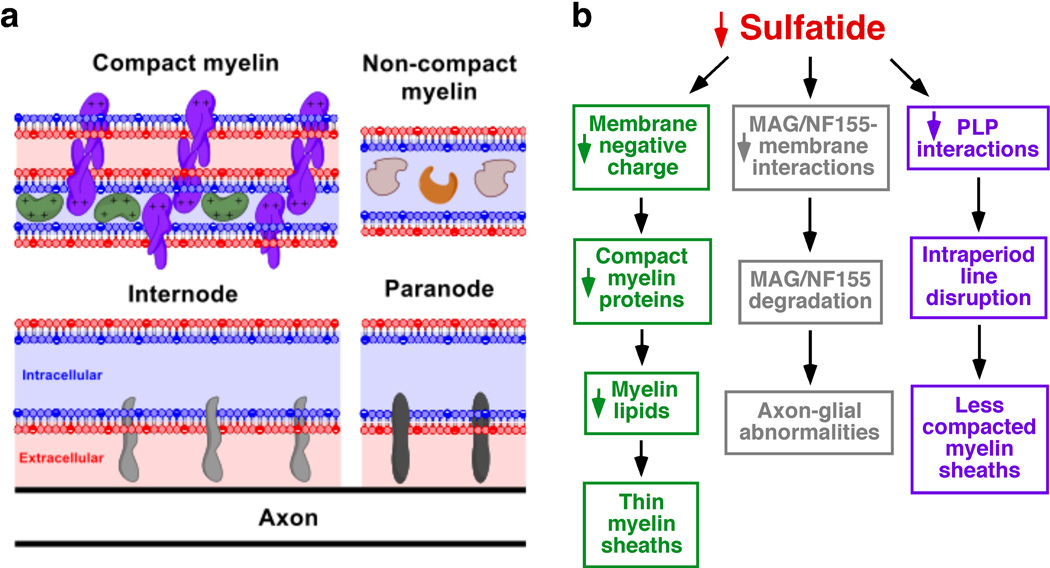
Molecular mechanisms by which sulfatide regulates myelin maintenance and function. (a) Schematic representation of compact and inner tongue myelin membranes. Sulfatide is depicted as filled, negatively charged red circles within the outer membrane leaflet. Negatively charged inner membrane leaflet lipids (e.g., PS) are depicted as filled blue circles within the inner membrane leaflet. Major myelin proteins such as MBP (green), PLP (purple), MAG (light gray), NF155 (dark gray), CNP (brown), and SirT2 (orange) were schematically illustrated. (b) Three major molecular mechanisms by which sulfatide depletion leads to thinner myelin sheaths, axon-glial abnormalities, and less compacted myelin sheaths were summarized.

References

    1. Bansal R, Gard AL, Pfeiffer SE. Stimulation of oligodendrocyte differentiation in culture by growth in the presence of a monoclonal antibody to sulfated glycolipid. J Neurosci Res. 1988;21:260–267. - PubMed
    1. Bansal R, Pfeiffer SE. Reversible inhibition of oligodendrocyte progenitor differentiation by a monoclonal antibody against surface galactolipids. Proc Natl Acad Sci U S A. 1989;86:6181–6185. - PMC - PubMed
    1. Bansal R, Winkler S, Bheddah S. Negative regulation of oligodendrocyte differentiation by galactosphingolipids. J Neurosci. 1999;19:7913–7924. - PMC - PubMed
    1. Bartsch S, Montag D, Schachner M, Bartsch U. Increased number of unmyelinated axons in optic nerves of adult mice deficient in the myelin-associated glycoprotein (MAG) Brain Res. 1997;762:231–234. - PubMed
    1. Benjamins JA, Morell P. Proteins of myelin and their metabolism. Neurochem Res. 1978;3:137–174. - PubMed

Publication types

MeSH terms