


The intestinal barrier as an emerging target in the toxicological assessment of mycotoxins
- PMID: 27417439
- PMCID: PMC5316402
- DOI: 10.1007/s00204-016-1794-8
The intestinal barrier as an emerging target in the toxicological assessment of mycotoxins
Abstract
Mycotoxins, the secondary metabolites of fungal species, are the most frequently occurring natural food contaminants in human and animal diets. Risk assessment of mycotoxins focused as yet on their mutagenic, genotoxic and potential carcinogenic effects. Recently, there is an increasing awareness of the adverse effects of various mycotoxins on vulnerable structures in the intestines. In particular, an impairment of the barrier function of the epithelial lining cells and the sealing tight junction proteins has been noted, as this could result in an increased translocation of luminal antigens and pathogens and an excessive activation of the immune system. The current review aims to provide a summary of the available evidence regarding direct effects of various mycotoxins on the intestinal epithelial barrier. Available data, based on different cellular and animal studies, show that food-associated exposure to certain mycotoxins, especially trichothecenes and patulin, affects the intestinal barrier integrity and can result in an increased translocation of harmful stressors. It is therefore hypothesized that human exposure to certain mycotoxins, particularly deoxynivalenol, as the major trichothecene, may play an important role in etiology of various chronic intestinal inflammatory diseases, such as inflammatory bowel disease, and in the prevalence of food allergies, particularly in children.
Keywords: Intestinal permeability; Mucosal inflammation; Mycotoxins; Tight junction proteins.
Conflict of interest statement
The authors declare that they have no conflict of interest.
Figures
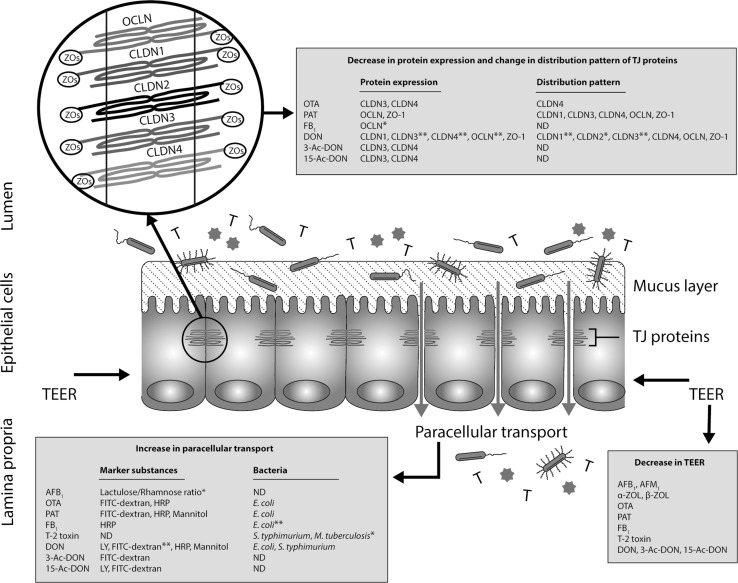
 ,
,  ), food-borne toxins (T) and foreign antigens (
 ). The most prominent examples of food-borne toxins primarily associated with an impairment of the intestinal barrier are mycotoxins. Various mycotoxins have been shown to induce intestinal barrier breakdown demonstrated by a decrease in TEER, an increase in paracellular transport and changes in the expression as well as distribution pattern of different TJ proteins. The data shown in the figure have been demonstrated by in vitro studies unless otherwise stated (*in vivo studies, **in vitro as well as in vivo studies). Abbreviations used: 3-Ac-DON 3-acetyl deoxynivalenol, 15-Ac-DON 15-acetyl deoxynivalenol, AFB
1 aflatoxin B1, AFM
1 aflatoxin M1, α-ZOL alpha-zearalenol, β-ZOL beta-zearalenol, CLDNs claudins, DON deoxynivalenol, E. coli
Escherichia coli, FB
1 fumonisin B1, FITC-dextran fluorescein isothiocyanate-dextran, HRP horseradish peroxidase, LY lucifer yellow, M. tuberculosiss
Mycobacterium tuberculosiss, ND not determined, OCLN occludin, OTA ochratoxin A, PAT patulin, S. typhimurium
Salmonella typhimurium, TEER transepithelial electrical resistance, TJ tight junction, ZOs zonula occludens
). The most prominent examples of food-borne toxins primarily associated with an impairment of the intestinal barrier are mycotoxins. Various mycotoxins have been shown to induce intestinal barrier breakdown demonstrated by a decrease in TEER, an increase in paracellular transport and changes in the expression as well as distribution pattern of different TJ proteins. The data shown in the figure have been demonstrated by in vitro studies unless otherwise stated (*in vivo studies, **in vitro as well as in vivo studies). Abbreviations used: 3-Ac-DON 3-acetyl deoxynivalenol, 15-Ac-DON 15-acetyl deoxynivalenol, AFB
1 aflatoxin B1, AFM
1 aflatoxin M1, α-ZOL alpha-zearalenol, β-ZOL beta-zearalenol, CLDNs claudins, DON deoxynivalenol, E. coli
Escherichia coli, FB
1 fumonisin B1, FITC-dextran fluorescein isothiocyanate-dextran, HRP horseradish peroxidase, LY lucifer yellow, M. tuberculosiss
Mycobacterium tuberculosiss, ND not determined, OCLN occludin, OTA ochratoxin A, PAT patulin, S. typhimurium
Salmonella typhimurium, TEER transepithelial electrical resistance, TJ tight junction, ZOs zonula occludensReferences
-
- Abid-Essefi S, Baudrimont I, Hassen W, Ouanes Z, Mobio TA, Anane R, Creppy EE, Bacha H. DNA fragmentation, apoptosis and cell cycle arrest induced by zearalenone in cultured DOK, Vero and Caco-2 cells: prevention by Vitamin E. Toxicology. 2003;192:237–248. doi: 10.1016/S0300-483X(03)00329-9. - DOI - PubMed
-
- Alassane-Kpembi I, Kolf-Clauw M, Gauthier T, Abrami R, Abiola FA, Oswald IP, Puel O. New insights into mycotoxin mixtures: the toxicity of low doses of Type B trichothecenes on intestinal epithelial cells is synergistic. Toxicol Appl Pharmacol. 2013;272:191–198. doi: 10.1016/j.taap.2013.05.023. - DOI - PubMed
Publication types
MeSH terms
Substances
LinkOut - more resources
Full Text Sources
Other Literature Sources
