Review
. 2017 Jan;101(1):143-150.
doi: 10.1189/jlb.4MR0516-223R. Epub 2016 Jul 14.

Interferon-inducible guanylate-binding proteins at the interface of cell-autonomous immunity and inflammasome activation

Affiliations
Review

Interferon-inducible guanylate-binding proteins at the interface of cell-autonomous immunity and inflammasome activation

Si Ming Man et al. J Leukoc Biol. 2017 Jan.

Abstract

Guanylate-binding proteins (GBPs) are essential components of cell-autonomous immunity. In response to IFN signaling, GBPs are expressed in the cytoplasm of immune and nonimmune cells, where they unleash their antimicrobial activity toward intracellular bacteria, viruses, and parasites. Recent studies have revealed that GBPs are essential for mediating activation of the caspase-1 inflammasome in response to the gram-negative bacteria Salmonella enterica serovar Typhimurium, Francisella novicida, Chlamydia muridarum, Chlamydia trachomatis, Legionella pneumophila, Vibrio cholerae, Enterobacter cloacae, and Citrobacter koseri During infection with vacuolar-restricted gram-negative bacteria, GBPs disrupt the vacuolar membrane to ensure liberation of LPS for cytoplasmic detection by caspase-11 and the noncanonical NLRP3 inflammasome. In response to certain cytosolic bacteria, GBPs liberate microbial DNA for activation of the DNA-sensing AIM2 inflammasome. GBPs also promote the recruitment of antimicrobial proteins, including NADPH oxidase subunits and autophagy-associated proteins to the Mycobacterium-containing vacuole to mediate intracellular bacterial killing. Here, we provide an overview on the emerging relationship between GBPs and activation of the inflammasome in innate immunity to microbial pathogens.

Keywords: GBPs; bacteria; caspase-1; caspase-11; pyroptosis; viruses.


Figures

Figure 1
Figure 1
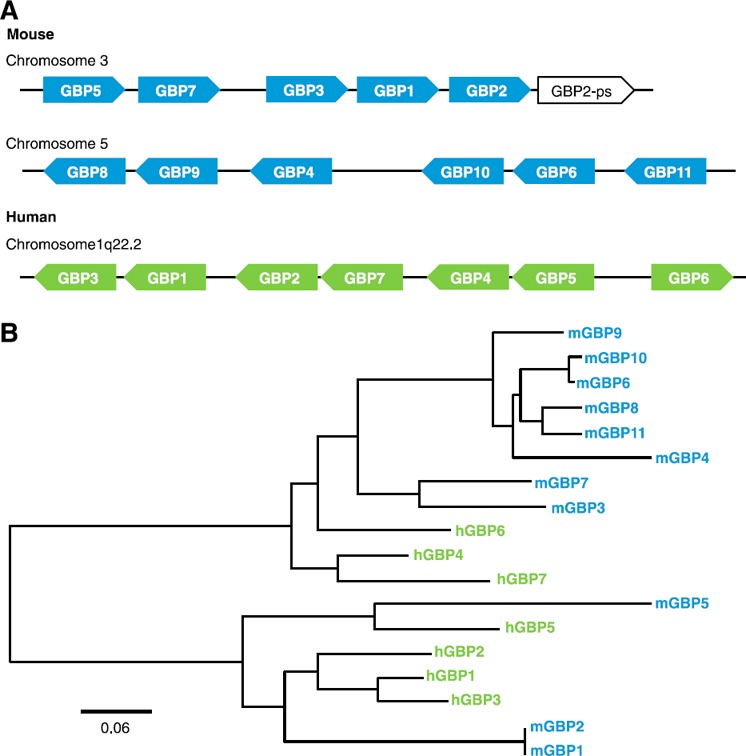
Genomic and phylogenetic organization of GBPs. (A) Mouse and human GBP open‐reading frames organized by chromosome location based on National Center for Biotechnology Information (Bethesda, MD, USA) annotations. (B) A phylogenetic tree was generated by amino acid multiple sequence alignments using the MUSCLE (multiple sequence alignment software) algorithm followed by the PhyML program (phylogeny.fr) with downstream visualization using FigTree version 1.4.2 (http://tree.bio.ed.ac.uk/software/figtree). Scale bar indicates the number of substitutions per site.
Figure 2
Figure 2
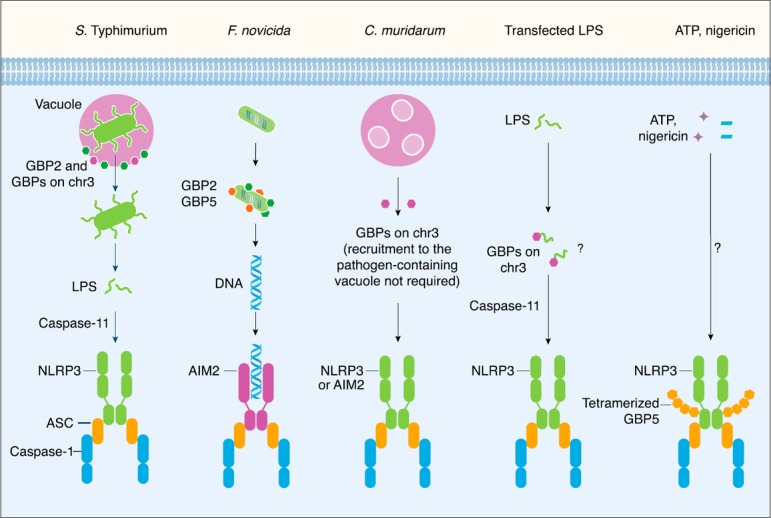
The role of GBPs in the activation of inflammasomes. The gram‐negative bacterium Salmonella Typhimurium normally resides in a vacuole. Mouse GBP2 and other GBP members within the chromosome 3 cluster (GBPs on chr3) are recruited to the vacuole where they induce vacuolar rupture. This process allows the bacteria to become cytosolic, where LPS is sensed by caspase‐11 to drive activation of the noncanonical NLRP3 inflammasome [ 37 ]. However, the gram‐negative bacterium Francisella novicida is a cytosolic pathogen that directly escapes the vacuole and does not activate caspase‐11. Mouse GBP2 and GBP5 directly target the bacteria to induce bacteriolysis and liberate bacterial DNA for sensing by the AIM2 inflammasome [ 38 , 44 ]. Mouse GBPs encoded on chromosome 3 can partially promote pyroptosis in IFN‐γ–primed BMDMs infected with the gram‐negative bacteria Chlamydia trachomatis or Chlamydia muridarum [ 42 ]. Recruitment of GBPs to the pathogen‐containing vacuole is not necessary to drive inflammasome activation in response to C. muridarum infection. There is some evidence to suggest that GBPs encoded on chromosome 3 might also induce pyroptosis in IFN‐γ‐primed BMDMs transfected with LPS [ 41 ]. However, the mechanism regulating this process remains unclear. Human and mouse GBP5 have been shown to undergo tetramerization and to interact with the pyrin domain of NLRP3. Tetramerization of GBP5 might potentiate activation of the NLRP3 inflammasome in response to the soluble NLRP3 activators ATP and nigericin, but not to crystalline NLRP3 activators [ 35 ].

References

    1. McNab, F. , Mayer‐Barber, K. , Sher, A. , Wack, A. , O'Garra, A. (2015) Type I interferons in infectious disease. Nat. Rev. Immunol. 15, 87–103. - PMC - PubMed
    1. Howard, J. C. (2007) Introduction: cell‐autonomous immunity. Microbes Infect. 9, 1633–1635. - PubMed
    1. MacMicking, J. D. (2012) Interferon‐inducible effector mechanisms in cell‐autonomous immunity. Nat. Rev. Immunol. 12, 367–382. - PMC - PubMed
    1. Vestal, D. J. , Jeyaratnam, J. A. (2011) The guanylate‐binding proteins: emerging insights into the biochemical properties and functions of this family of large interferon‐induced guanosine triphosphatase. J. Interferon Cytokine Res. 31, 89–97. - PMC - PubMed
    1. Gupta, S. L. , Rubin, B. Y. , Holmes, S. L. (1979) Interferon action: induction of specific proteins in mouse and human cells by homologous interferons. Proc. Natl. Acad. Sci. U.S.A. 76, 4817–4821. - PMC - PubMed

Publication types