Incidence and origin of histologically confirmed liver metastases: an explorative case-study of 23,154 patients
- PMID: 27421135
- PMCID: PMC5342423
- DOI: 10.18632/oncotarget.10552
Incidence and origin of histologically confirmed liver metastases: an explorative case-study of 23,154 patients
Abstract
Background: The liver is a common metastatic site for a large variety of primary tumors. For both patients with known and unknown primary tumors it is important to understand metastatic patterns to provide tailored therapies.
Objective: To perform a nationwide exploration of the origins of histological confirmed liver metastases.
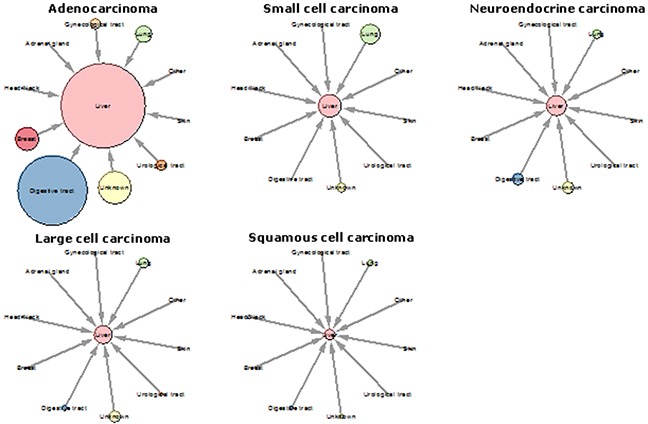
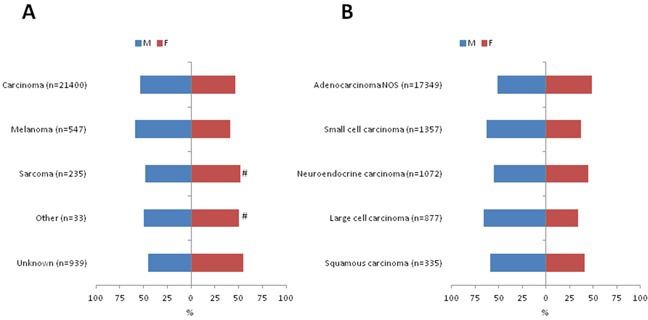
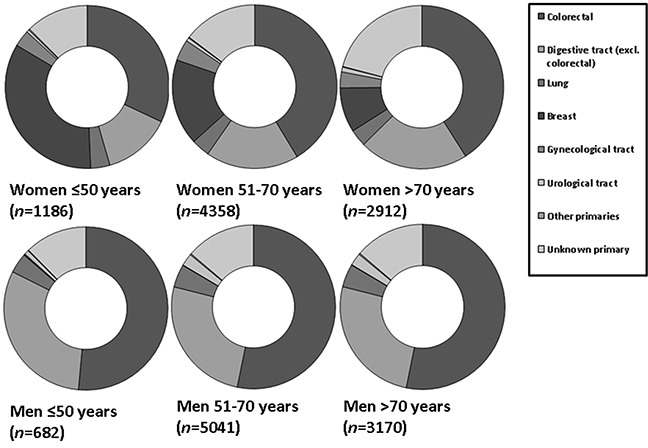
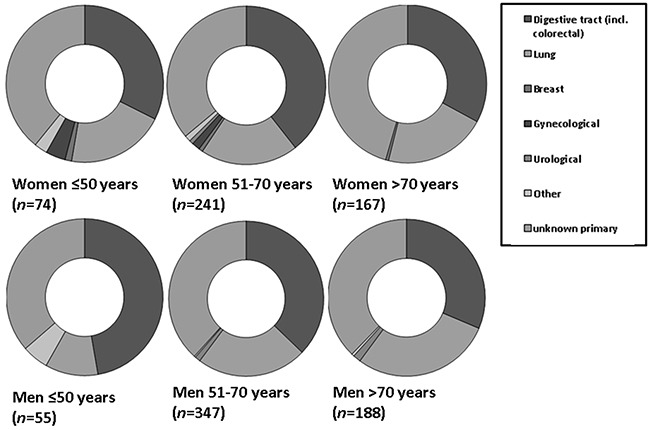
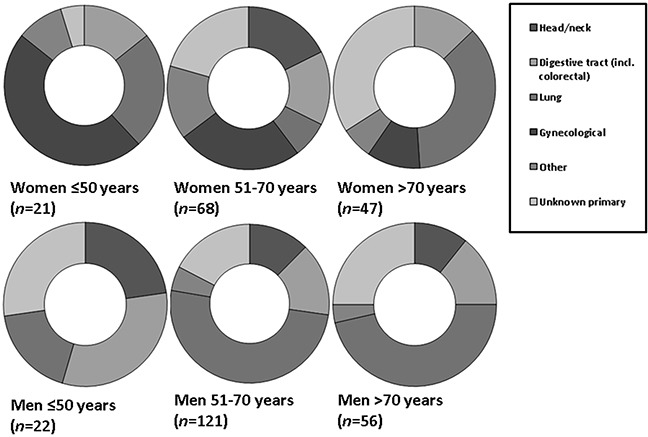
Results: A total of 23,154 patients were identified. The majority of liver metastases were carcinomas (n=21,400; 92%) of which adenocarcinoma was the most frequent subtype (n=17,349; 75%). Most common primary tumors in patients with adenocarcinoma were from colorectal (n=8,004), pancreatic (n=1,755) or breast origin (n=1,415). In women of 50 years and younger, metastatic adenocarcinoma originated more frequently from breast cancer, while in women older than 70 years liver metastases originated more frequently from gastrointestinal tumors. Liver metastases in men older than 70 years originated often from squamous cell lung carcinoma. An unknown primary tumor was detected in 4,209 (18%) patients, although tumor type could be determined in 3,855 (92%) of them.
Methods: Data were collected using the nationwide network and registry of histo- and cytopathology in the Netherlands (PALGA). All histological confirmed liver metastases between January 2001 and December 2010 were evaluated for tumor type, origin of the primary tumor and were correlated with patient characteristics (age, gender).
Conclusion: The current study provides an overview of the origins of liver metastases in a series of 23,154 patients.
Keywords: colorectal liver metastases; histology; incidences; liver metastases; non-colorectal liver metastases.
Conflict of interest statement
The authors declare no conflicts of interest.
Figures
References
-
- Weiss L. Comments on hematogenous metastatic patterns in humans as revealed by autopsy. Clin Exp Metastasis. 1992;10:191–199. - PubMed
-
- Paget S. The distribution of secondary growths in cancer of the breast. 1889. Cancer Metastasis Rev. 1989;8:98–101. - PubMed
-
- Prescher G, Bornfeld N, Hirche H, Horsthemke B, Jockel KH, Becher R. Prognostic implications of monosomy 3 in uveal melanoma. Lancet. 1996;347:1222–1225. - PubMed
-
- Kennecke H, Yerushalmi R, Woods R, Cheang MC, Voduc D, Speers CH, Nielsen TO, Gelmon K. Metastatic behavior of breast cancer subtypes. J Clin Oncol. 2010;28:3271–3277. - PubMed
MeSH terms
LinkOut - more resources
Full Text Sources
Other Literature Sources
Medical