Review
. 2016 Sep;20(9):701-714.
doi: 10.1016/j.tics.2016.06.012. Epub 2016 Jul 13.

Neurobiological Basis of Language Learning Difficulties

Affiliations
Review

Neurobiological Basis of Language Learning Difficulties

Saloni Krishnan et al. Trends Cogn Sci. 2016 Sep.

Abstract

In this paper we highlight why there is a need to examine subcortical learning systems in children with language impairment and dyslexia, rather than focusing solely on cortical areas relevant for language. First, behavioural studies find that children with these neurodevelopmental disorders perform less well than peers on procedural learning tasks that depend on corticostriatal learning circuits. Second, fMRI studies in neurotypical adults implicate corticostriatal and hippocampal systems in language learning. Finally, structural and functional abnormalities are seen in the striatum in children with language disorders. Studying corticostriatal networks in developmental language disorders could offer us insights into their neurobiological basis and elucidate possible modes of compensation for intervention.

Keywords: development; disorder; dyslexia; procedural learning; specific language impairment; striatum; subcortical.


Figures

Figure 1
Figure 1
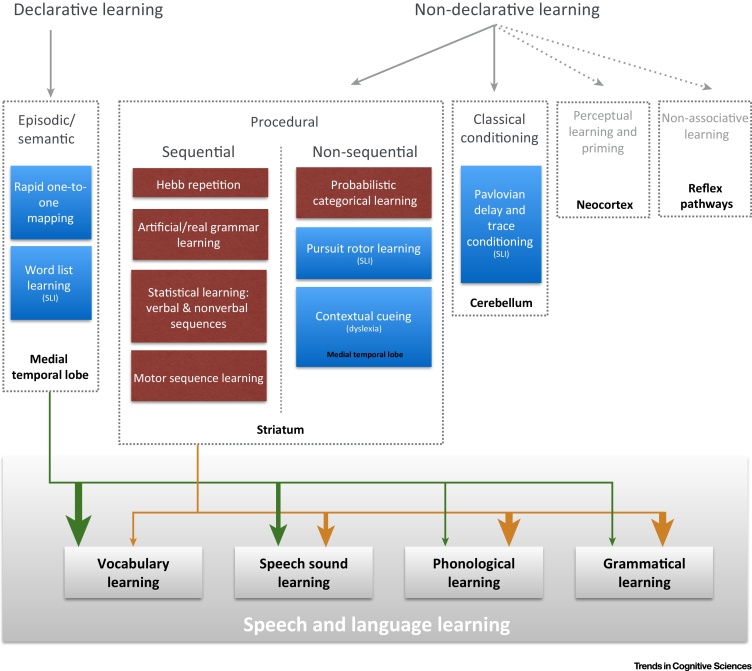
Contribution of Learning and Memory Systems to Language Learning Difficulties. The top panel of the figure shows different aspects of declarative and non-declarative learning systems . Boxes indicate the types of tasks that have been used to assess each of these forms of learning in children with language and reading disorders (some aspects of non-declarative learning were beyond the scope of this review, these are indicated by dashed arrows). Task boxes are coloured in blue if no learning impairment (with reference to learning rates, rather than overall performance) was observed when controlling for age, IQ, and working memory in children with language or reading disorders, and coloured in red if children with specific language impairment (SLI) or dyslexia did not learn as well as their typically developing peers. Children with language learning difficulties perform poorly on procedural learning tasks, particularly those that are sequential or involve complex categorical learning. The brain structures thought to be especially important for each form of learning are indicated in black text (as shown in [102]). However, these regions are not isolated during nor solely responsive for such learning; instead, they should be considered as key hubs within an interconnected learning system. The bottom panel shows the hypothesised contribution of these learning systems to different aspects of language learning, emphasising the interactions between declarative (green lines) and procedural learning systems (orange lines). The weight of the arrows represents the potential strength of the contribution, with thicker arrows denoting greater contribution – these are illustrative and drawn on the basis of studies reviewed in Neurobiological Systems Involved in Language Learning.
Figure 2
Figure 2
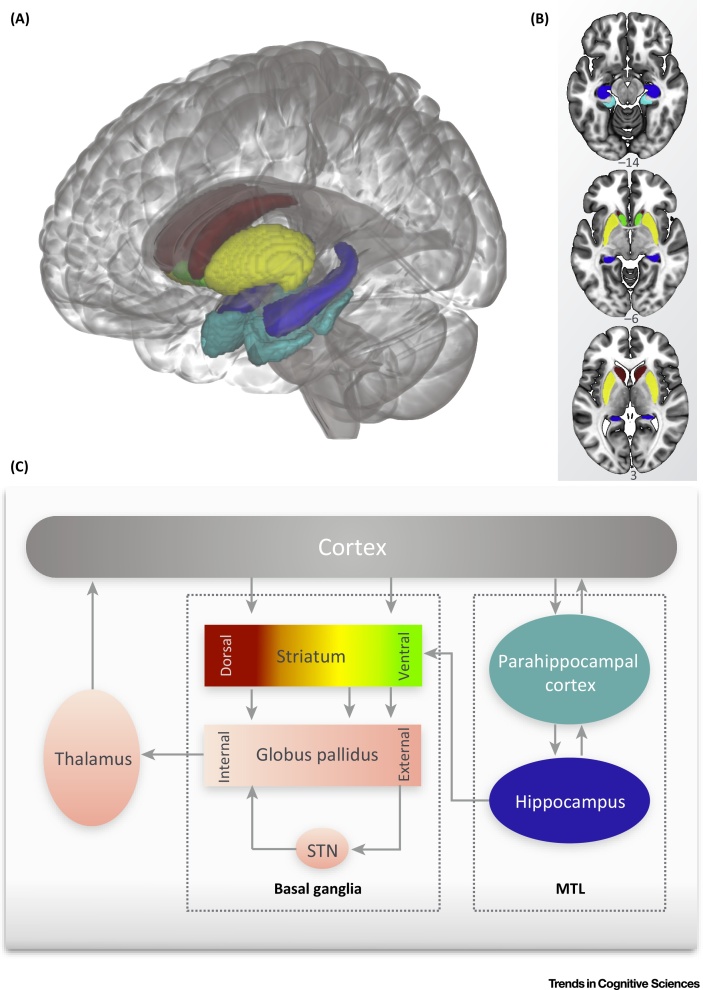
Corticostriatal and Hippocampal Learning Systems and Connections. (A) 3D representation of the striatum and medial temporal lobe (MTL) shown within a glass brain. The coloured areas on the image correspond to the labels in the schematic below. Blue, hippocampus; cyan, parahippocampal gyrus (anterior and posterior regions); green, nucleus accumbens which is part of the ventral striatum; red, caudate nucleus; yellow, putamen (the dorsal striatum includes the caudate nucleus and the putamen). (B) The striatum and MTL shown on 2D axial slices. Colours correspond to those in the 3D representation. (C) Schematic representation of the connections between the cortex, basal ganglia, and the MTL. The nuclei not shown in the 3D representation are coloured pink.

References

    1. Kan P.F., Windsor J. Word learning in children with primary language impairment: a meta-analysis. J. Speech Lang. Hear. Res. 2010;53:739. - PubMed
    1. Hsu H.J., Bishop D.V. Training understanding of reversible sentences: a study comparing language-impaired children with age-matched and grammar-matched controls. Peer J. 2014;2:e656. - PMC - PubMed
    1. Ullman M.T., Pierpont E.I. Specific language impairment is not specific to language: the procedural deficit hypothesis. Cortex. 2005;41:399–433. - PubMed
    1. Pinker S., Ullman M.T. The past and future of the past tense. Trends Cogn. Sci. 2002;6:456–463. - PubMed
    1. Lum J.A.G. Procedural learning deficits in specific language impairment (SLI): a meta-analysis of serial reaction time task performance. Cortex. 2014;51:1–10. - PMC - PubMed

LinkOut - more resources