


Associations between Sleep, Cortisol Regulation, and Diet: Possible Implications for the Risk of Alzheimer Disease
- PMID: 27422503
- PMCID: PMC4942871
- DOI: 10.3945/an.115.011775
Associations between Sleep, Cortisol Regulation, and Diet: Possible Implications for the Risk of Alzheimer Disease
Abstract
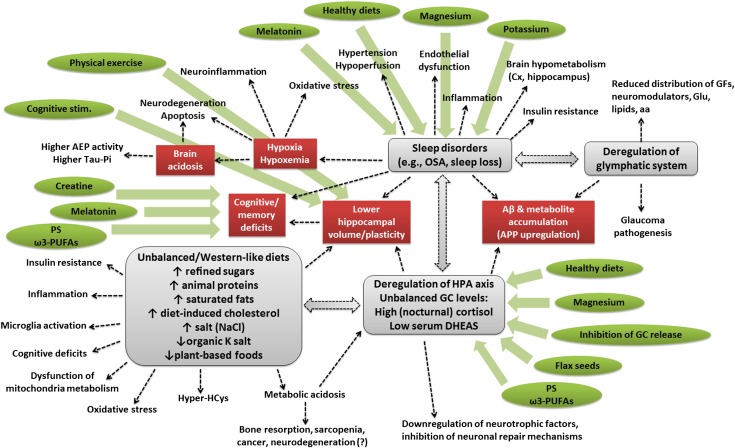
Accumulation of proteinaceous amyloid β plaques and tau oligomers may occur several years before the onset of Alzheimer disease (AD). Under normal circumstances, misfolded proteins get cleared by proteasome degradation, autophagy, and the recently discovered brain glymphatic system, an astroglial-mediated interstitial fluid bulk flow. It has been shown that the activity of the glymphatic system is higher during sleep and disengaged or low during wakefulness. As a consequence, poor sleep quality, which is associated with dementia, might negatively affect glymphatic system activity, thus contributing to amyloid accumulation. The diet is another important factor to consider in the regulation of this complex network. Diets characterized by high intakes of refined sugars, salt, animal-derived proteins and fats and by low intakes of fruit and vegetables are associated with a higher risk of AD and can perturb the circadian modulation of cortisol secretion, which is associated with poor sleep quality. For this reason, diets and nutritional interventions aimed at restoring cortisol concentrations may ease sleep disorders and may facilitate brain clearance, consequentially reducing the risk of cognitive impairment and dementia. Here, we describe the associations that exist between sleep, cortisol regulation, and diet and their possible implications for the risk of cognitive impairment and AD.
Keywords: Alzheimer disease; Western diet; acidosis; cortisol; glymphatic system; hippocampus; nutritional interventions; sleep; supplements.
© 2016 American Society for Nutrition.
Conflict of interest statement
Author disclosures: F Pistollato, S Sumalla Cano, I Elío, M Masias Vergara, F Giampieri, and M Battino, no conflicts of interest.
Figures
References
-
- Alzheimer’s Disease International [Internet]. World Alzheimer Report; 2009 [cited 2015 Mar 19]. Available from: http://www.alz.co.uk/research/files/WorldAlzheimerReport.pdf.
-
- Alzheimer’s Association [Internet]. Alzheimer’s Disease Facts and Figures; 2013 [cited 2015 Mar 19]. Available from: http://www.alz.org/downloads/facts_figures_2013.pdf.
-
- Daulatzai MA. Quintessential risk factors: their role in promoting cognitive dysfunction and Alzheimer’s disease. Neurochem Res 2012;37:2627–58. - PubMed
-
- Selkoe DJ. Resolving controversies on the path to Alzheimer’s therapeutics. Nat Med 2011;17:1060–5. - PubMed
-
- Kevei É, Hoppe T. Ubiquitin sets the timer: impacts on aging and longevity. Nat Struct Mol Biol 2014;21:290–2. - PubMed
Publication types
MeSH terms
Substances
LinkOut - more resources
Full Text Sources
Other Literature Sources
Medical
Research Materials
