. 2016 Sep 1;311(3):H713-24.
doi: 10.1152/ajpheart.00142.2016. Epub 2016 Jul 15.

Reversible redox modifications of ryanodine receptor ameliorate ventricular arrhythmias in the ischemic-reperfused heart

Affiliations

Reversible redox modifications of ryanodine receptor ameliorate ventricular arrhythmias in the ischemic-reperfused heart

Romina Becerra et al. Am J Physiol Heart Circ Physiol. .

Abstract

Previous results from our laboratory showed that phosphorylation of ryanodine receptor 2 (RyR2) by Ca(2+) calmodulin-dependent kinase II (CaMKII) was a critical but not the unique event responsible for the production of reperfusion-induced arrhythmogenesis, suggesting the existence of other mechanisms cooperating in an additive way to produce these rhythm alterations. Oxidative stress is a prominent feature of ischemia/reperfusion injury. Both CaMKII and RyR2 are proteins susceptible to alteration by redox modifications. This study was designed to elucidate whether CaMKII and RyR2 redox changes occur during reperfusion and whether these changes are involved in the genesis of arrhythmias. Langendorff-perfused hearts from rats or transgenic mice with genetic ablation of CaMKII phosphorylation site on RyR2 (S2814A) were subjected to ischemia-reperfusion in the presence or absence of a free radical scavenger (mercaptopropionylglycine, MPG) or inhibitors of NADPH oxidase and nitric oxide synthase. Left ventricular contractile parameters and monophasic action potentials were recorded. Oxidation and phosphorylation of CaMKII and RyR2 were assessed. Increased oxidation of CaMKII during reperfusion had no consequences on the level of RyR2 phosphorylation. Avoiding the reperfusion-induced thiol oxidation of RyR2 with MPG produced a reduction in the number of arrhythmias and did not modify the contractile recovery. Conversely, selective prevention of S-nitrosylation and S-glutathionylation of RyR2 was associated with higher numbers of arrhythmias and impaired contractility. In S2814A mice, treatment with MPG further reduced the incidence of arrhythmias. Taken together, the results suggest that redox modification of RyR2 synergistically with CaMKII phosphorylation modulates reperfusion arrhythmias.

Keywords: arrhythmias; ischemia/reperfusion; redox modifications; ryanodine receptor type 2.


Figures

Fig. 1.
Fig. 1.
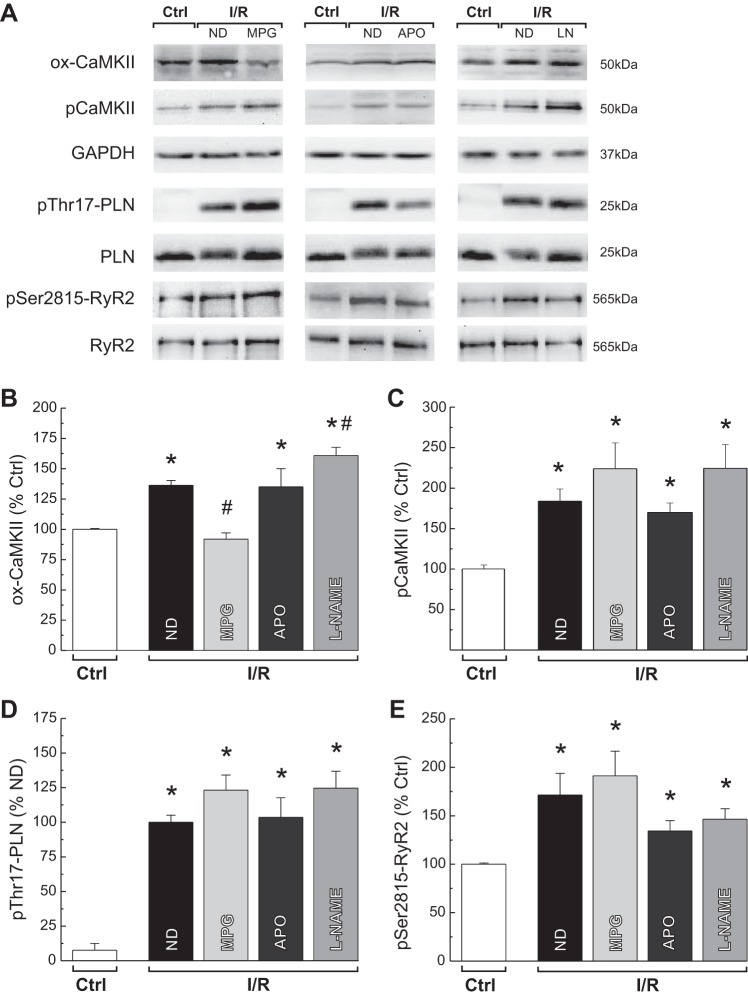
Reperfusion-induced increase in Ca2+ calmodulin-dependent kinase II (CaMKII) activity is independent of its oxidation state. Typical blots (A) and overall results of experiments showing oxidation (ox-CaMKII, B) and autophosphorylation of CaMKII (pCaMKII, C) and phosphorylation of its 2 substrates, Thr17 site of phospholamban (PLN) (D) and Ser2815 of ryanodine receptor 2 (RyR2) (E), at the onset of ischemia/reperfusion (I/R) in the absence (ND) or presence of different antioxidants are shown. Reperfusion-induced increase in ox-CaMKII was only abolished by mercaptopropionylglycine (MPG) treatment. MPG, apocynin (APO), or NG-nitro-l-arginine methyl ester (l-NAME) (LN) were not able to prevent the CaMKII-dependent increase in protein phosphorylations. The data represent means ± SE (n = 5–13 hearts). *P < 0.05 with respect to control values (Ctrl). #P < 0.05 with respect to reperfusion with no drug ND.
Fig. 2.
Fig. 2.
Reperfusion increases the S-glutathionylation and S-nitrosylation of RyR2. Typical blots and overall results of experiments showing the S-glutathionylation (A) and S-nitrosylation (B) of RyR2 in hearts subjected to I/R in the absence (ND) or presence of MPG are shown. Reperfusion-induced increase in S-glutathionylation and S-nitrosylation of RyR2 was prevented by MPG. The data represent means ± SE (n = 7–13 hearts). *P < 0.05 with respect to Ctrl. #P < 0.05 with respect to reperfusion with ND. GSH, glutathione; SNO, nitrosocysteine.
Fig. 3.
Fig. 3.
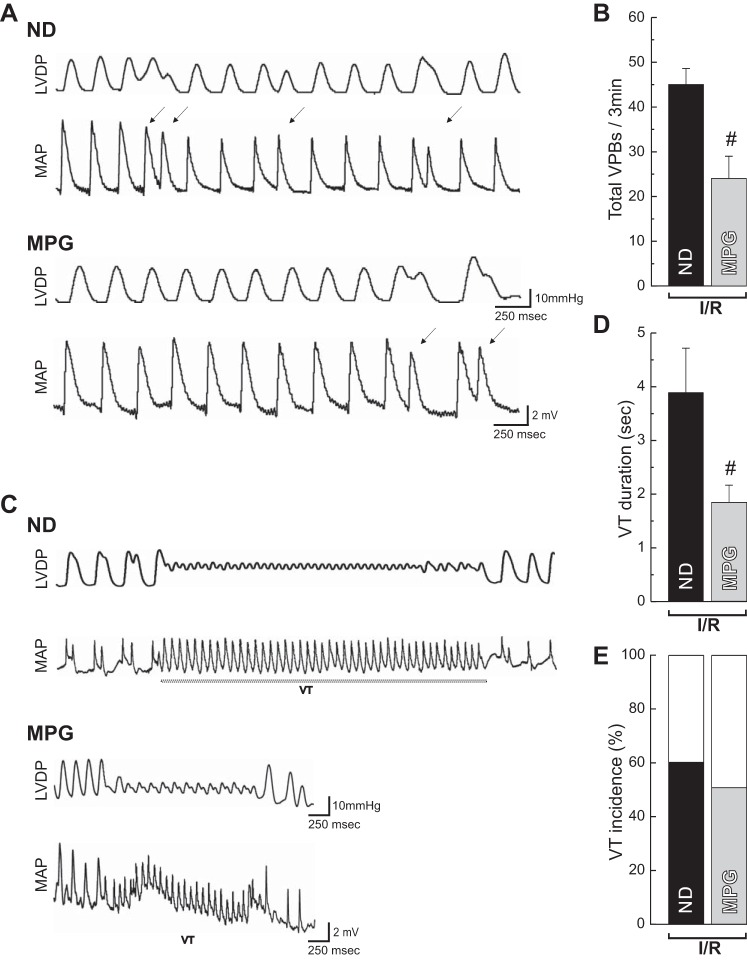
MPG reduces the severity of reperfusion arrhythmias. Representative simultaneous recordings of mechanical (left ventricular developed pressure, LVDP) and electrical activity (monophasic action potential, MAP) showing ventricular premature beats (VPBs) (A) and ventricular tachycardia (VT) (C) during the early reperfusion in the absence (ND) or the presence of MPG are shown. Overall results of total VPBs (B) and VT, duration, and incidence (D and E) in the first 3 min of reperfusion are shown. The antioxidant MPG decreased the number of total VPBs (Mann-Whitney test) and the duration of VT episodes. The data represent means ± SE (n = 5–14 hearts). #P < 0.05 with respect to reperfusion with ND.
Fig. 4.
Fig. 4.
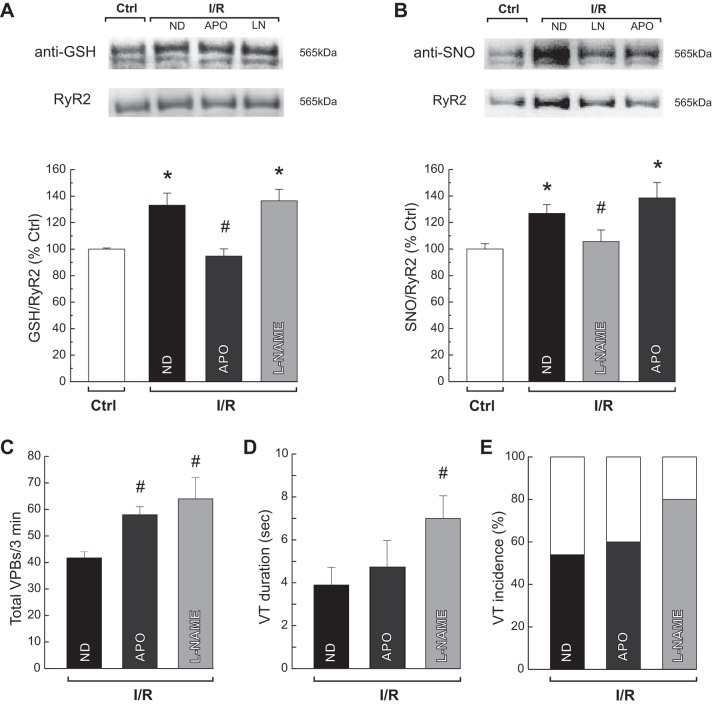
Inhibition of specific oxidative/nitrosative changes of RyR2 increases reperfusion arrhythmias. Typical blots and overall results of experiments show the reperfusion-induced increase in S-glutathionylation (A), S-nitrosylation of RyR2 (B), total VPBs (C), VT, and duration and incidence (D and E) in the first 3 min of reperfusion in the absence (ND) or the presence of APO and l-NAME. APO selectively abolished the S-glutathionylation of RyR2, and l-NAME did the same with the S-nitrosylation of RyR2. Both drugs augmented the number of VPBs (Mann-Whitney test) and showed a tendency to increase the duration and incidence of VT. The data represent means ± SE (n = 4–11 hearts). *P < 0.05 with respect to I/R. #P < 0.05 with respect to reperfusion with ND.
Fig. 5.
Fig. 5.
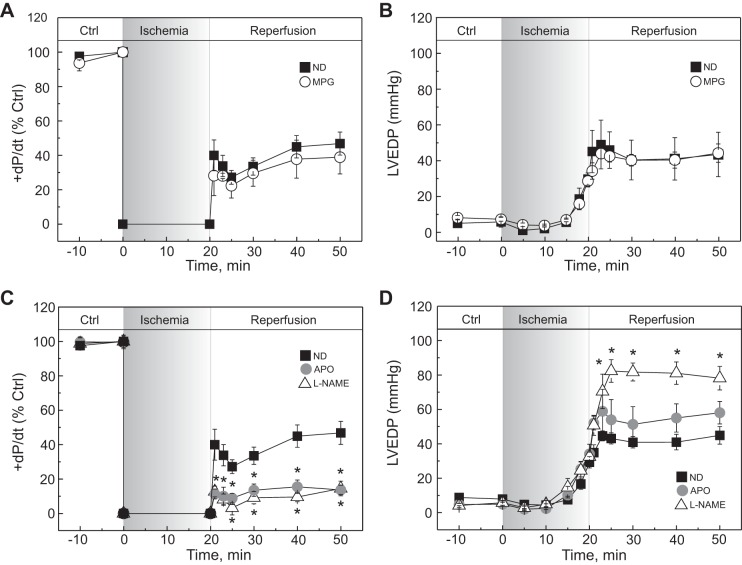
Differential effects of the antioxidants on the contractile recovery during reperfusion. Time courses are shown of maximal rate of pressure development (+dP/dt, A and C) and left ventricular end-diastolic pressure (LVEDP) (B and D) of rat hearts submitted to I/R protocols in the absence (ND) or presence of MPG (A and B), APO, and l-NAME (C and D). Hearts treated with MPG showed a similar recovery pattern to ND. The presence of APO or l-NAME deteriorated the contractility with respect to ND and further increased LVEDP. The data represent means ± SE (n = 4–11 hearts). *P < 0.05 with respect to ND.
Fig. 6.
Fig. 6.
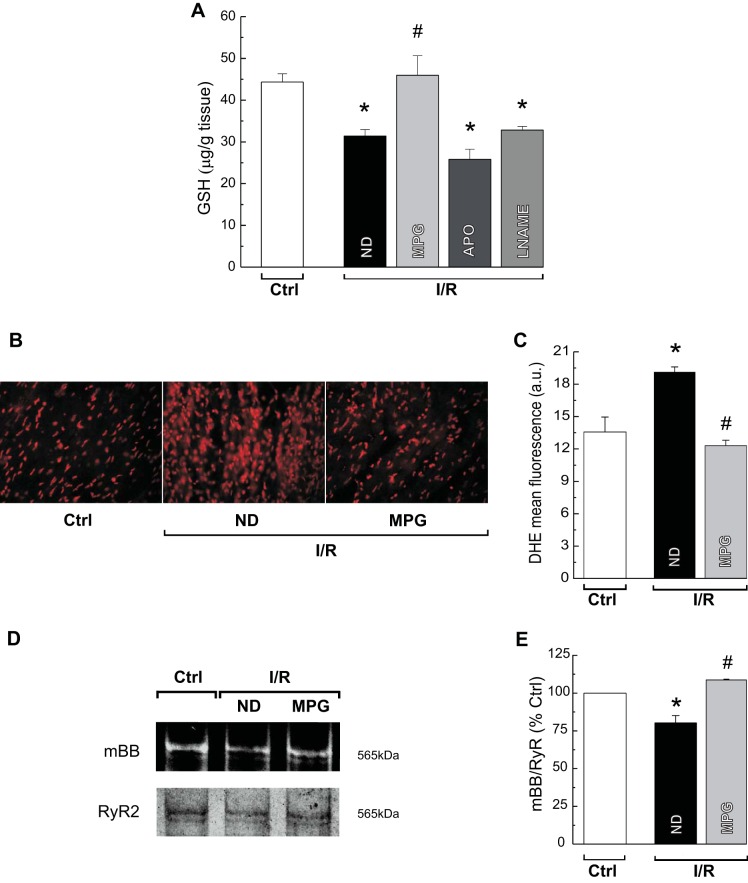
Effects of the antioxidants on reduced GSH content, reactive oxygen species (ROS) formation, and RyR2 free thiol content during reperfusion. Average levels of reduced form of GSH measured in tissue homogenates from Ctrl or I/R rat hearts in the absence (ND) or presence of MPG, APO, or l-NAME are shown. Only MPG treatment restored GSH levels to Ctrl values (A). Representative images (B) and overall results (C) of dihydroethidium (DHE) staining for ROS production in Ctrl and I/R hearts without (ND) or with MPG treatment are shown. MPG reduces ROS production to Ctrl levels. Representative (monobromobimane, mBB) fluorescence intensity and Coomassie blue-stained gels of RyR2 (D) and average results of free thiol content on RyR2 (E) in Ctrl and I/R hearts in the absence (ND) or presence of MPG are shown. Content of free thiols decreases in I/R, and it is restored by treatment with MPG. The data represent means ± SE (n = 3–6 hearts). *P < 0.05 with respect to Ctrl. #P < 0.05 with respect to reperfusion with ND.
Fig. 7.
Fig. 7.
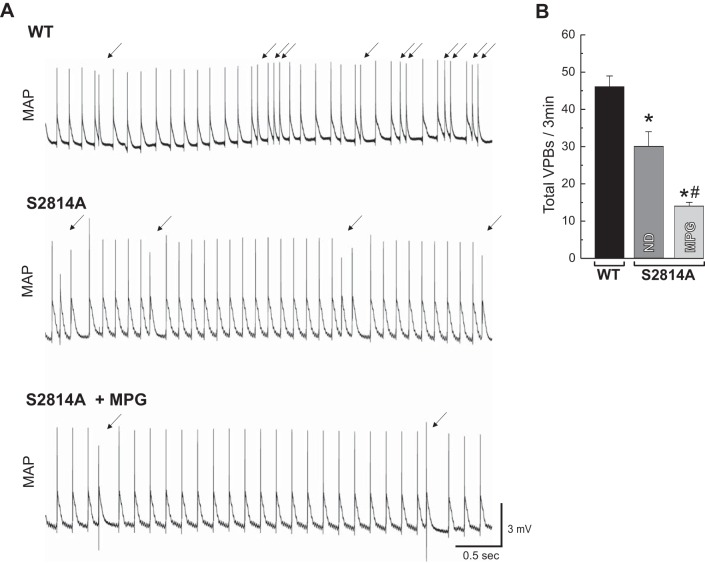
CaMKII-dependent phosphorylation of RyR2-Ser2814 site and redox changes are critical for generation of reperfusion arrhythmias. Representative recordings of electrical activity (MAP) showing VPBs (arrows) during early reperfusion in WT mice or mice with genetic mutation of Ser2814 site of RyR2 (S2814A) in the absence or presence of MPG (A) and overall results of total VPBs in the first 3 min of reperfusion (B) are shown. There was a significant decrease in VPBs in RyR2-S2814A mice relative to WT, but the treatment with MPG declined them further. The data represent means ± SE (n = 3–8 hearts). *P < 0.05 with respect to WT. #P < 0.05 with respect to S2814A without MPG.

References

    1. Belevych AE, Terentyev D, Terentyeva R, Nishijima Y, Sridhar A, Hamlin RL, Carnes CA, Györke S. The relationship between arrhythmogenesis and impaired contractility in heart failure: Role of altered ryanodine receptor function. Cardiovasc Res 90: 493–502, 2011. - PMC - PubMed
    1. Bell JR, Raaijmakers AJ, Curl CL, Reichelt ME, Harding TW, Bei A, Ng DC, Erickson JR, Vila Petroff M, Harrap SB, Delbridge LM. Cardiac CaMKIIδ splice variants exhibit target signaling specificity and confer sex-selective arrhythmogenic actions in the ischemic-reperfused heart. Int J Cardiol 181: 288–296, 2015. - PubMed
    1. Carmeliet E. Cardiac ionic currents and acute ischemia: From channels to arrhythmias. Physiol Rev 79: 917–1017, 1999. - PubMed
    1. Chelu MG, Sarma S, Sood S, Wang S, van Oort RJ, Skapura DG, Li N, Santonastasi M, Müller FU, Schmitz W, Schotten U, Anderson ME, Valderrábano M, Dobrev D, Wehrens XH. Calmodulin kinase II-mediated sarcoplasmic reticulum Ca2+ leak promotes atrial fibrillation in mice. J Clin Invest 119: 1940–1951, 2009. - PMC - PubMed
    1. Curran J, Tang L, Roof SR, Velmurugan S, Millard A, Shonts S, Wang H, Santiago D, Ahmad U, Perryman M, Bers DM, Mohler PJ, Ziolo MT, Shannon TR. Nitric oxide-dependent activation of CaMKII increases diastolic sarcoplasmic reticulum calcium release in cardiac myocytes in response to adrenergic stimulation. PLoS One 9 e87495, 2014. - PMC - PubMed

Publication types

MeSH terms

LinkOut - more resources