


Urinary antimony and leukocyte telomere length: An analysis of NHANES 1999-2002
- PMID: 27423705
- PMCID: PMC5685488
- DOI: 10.1016/j.envres.2016.06.044
Urinary antimony and leukocyte telomere length: An analysis of NHANES 1999-2002
Abstract
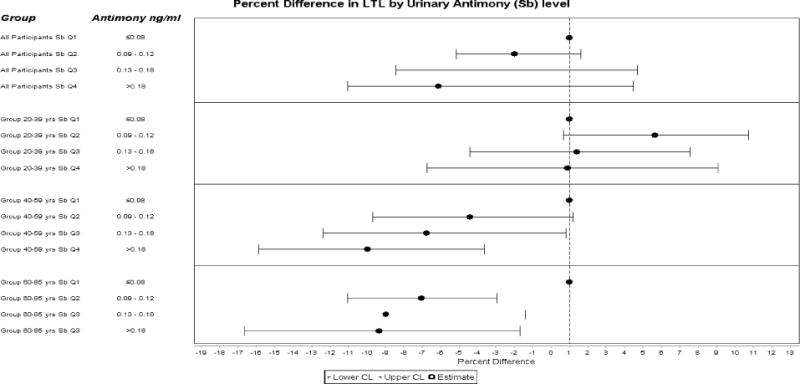
Telomeres are repetitive DNA sequences (TTAGGG) at the end of chromosomes. Cells with critically short telomeres enter replicative senescence and apoptosis. Several in vitro studies report that antimony causes cell apoptosis in human leukocyte cell lines. The goal of this analysis was to investigate whether there is an association between antimony exposure and leukocyte telomere length (LTL) among US adults aged 20 and older based on the National Health and Nutrition Examination Survey (NHANES) 1999-2002. We used multivariate linear regression to analyze the association of urinary antimony with LTL. LTL was log-natural transformed and the results were re-transformed and presented as percent differences. After adjustment for potential confounders, individuals in the 3rd and 4th quartiles of urinary antimony had statistically significantly shorter LTL (-4.78%, 95% CI: -8.42,-0.90; and -6.11%, 95% CI: -11.04,-1.00, respectively) compared to the lowest referent quartile, with evidence of a dose-response relationship (p-value for trend =0.03). Shorter LTL with antimony was driven by middle aged (40-59 years) and older (60-85 years) adult groups. The association may be biologically plausible because of reported oxidative stress and apoptosis effects of antimony on blood cells, effects known to shorten telomere length.
Keywords: Aging; Antimony; Heavy metals; Leukocyte telomere length; NHANES.
Published by Elsevier Inc.
Conflict of interest statement
Competing Financial Interests: The authors declare they have no actual or potential competing financial interests.
Figures
References
-
- ATSDR. Agency for Toxic Substances and Disease Registry. Toxicological Profile for Antimony. Atlanta, GA: US Department of Health and Human Services, Public Health Service; 1992.
-
- Aubert G, Lansdorp PM. Telomeres and aging. Physiological reviews. 2008;88:557–579. - PubMed
MeSH terms
Substances
Grants and funding
LinkOut - more resources
Full Text Sources
Other Literature Sources
