


Religious beliefs and mammography intention: findings from a qualitative study of a diverse group of American Muslim women
- PMID: 27424488
- PMCID: PMC5539910
- DOI: 10.1002/pon.4216
Religious beliefs and mammography intention: findings from a qualitative study of a diverse group of American Muslim women
Abstract
Objective: Studies suggest that American Muslim women underutilize mammography. While religion has a strong influence upon Muslim health behaviors, scant research has examined how religion-related beliefs inform Muslim women's intention for mammography. Our study identifies and examines such beliefs.
Methods: Muslim women aged 40 years and older sampled from mosques participated in focus groups and individual interviews. Drawing upon the theory of planned behavior, interviews elicited salient behavioral, normative, and control beliefs regarding mammography and the influence of Islam upon screening intention.
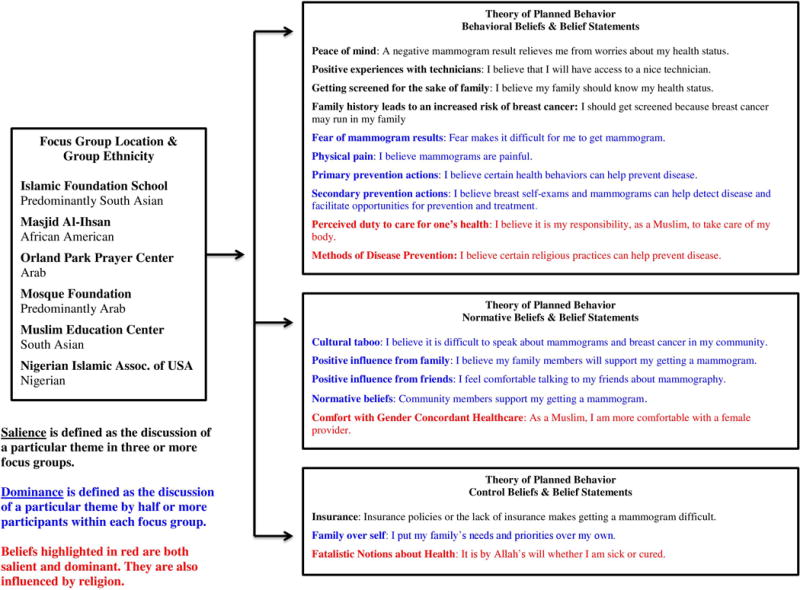
Results: Fifty women participated in 6 focus groups and 19 in semistructured interviews, with near-equal numbers of African American, South Asian, and Arab Muslims. Forty-two percent of participants had not had a mammogram within the past 2 years. Across differences in race/ethnicity and mammography status, women voiced four religion-related salient beliefs that inform mammography intention: (1) the perceived duty to care for one's health, (2) religious practices as methods of disease prevention, (3) fatalistic notions about health, and (4) comfort with gender concordant health care.
Conclusions: Religious beliefs influence decisions to pursue mammography across the ethnic/racial diversity of Muslim women. Notions about duty to God and the stewardship of one's body appear to enhance mammography intention. Theocentric notions of cure and illness and varied views regarding personal agency also inform decisional frames that impact mammography intention. Given the salience of religion among our participants, religiously tailored messages in interventions have the potential to enhance cancer screening.
Keywords: Islam; breast cancer screening; cancer; fatalism; oncology; theory of planned behavior.
Copyright © 2016 John Wiley & Sons, Ltd.
References
-
- American Cancer Society. American Cancer Society Guidelines for the Early Detection of Cancer [Internet] 2014 Available from: http://www.cancer.org/healthy/findcancerearly/cancerscreeningguidelines/... [Accessed January 12, 2016]
-
- Pace LE, Keating NL. A systematic assessment of benefits and risks to guide breast cancer screening decisions. JAMA [Internet] 2014;311(13):1327–35. Available from: http://www.ncbi.nlm.nih.gov/pubmed/2469160810.1001/jama.2014.1398. - PubMed
-
- Miller JW, King JB, Joseph DA, Richardson LC. Breast cancer screening among adult women–Behavioral Risk Factor Surveillance System, United States, 2010. MMWR Morb Mortal Wkly Rep [Internet] 2012;61(Suppl):46–50. pii. Available from: http://www.ncbi.nlm.nih.gov/entrez/query.fcgi?cmd=Retrieve&db=PubMed&dop.... - PubMed
MeSH terms
Grants and funding
LinkOut - more resources
Full Text Sources
Other Literature Sources
Medical
Miscellaneous
