


Case-control study evaluating competing risk factors for angioedema in a high-risk population
- PMID: 27426939
- PMCID: PMC4955864
- DOI: 10.1002/lary.25821
Case-control study evaluating competing risk factors for angioedema in a high-risk population
Abstract
Objectives/hypothesis: Black race is a risk factor for angioedema. The primary aim was to examine the relationship between race-ethnicity and risk factors for angioedema.
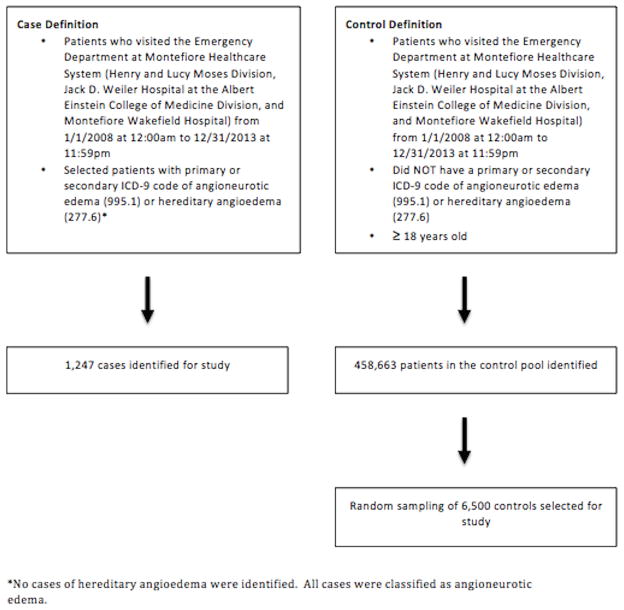
Study design: Using a retrospective case-control study design, data was extracted with the Clinical Looking Glass utility, a data collection and management tool that captures data from electronic medical record systems within the Montefiore Healthcare System. Cases were emergency department (ED) visits with primary or secondary International Classification of Diseases, Ninth Revision, code diagnoses of angioedema in adults aged ≥ 18 years from January 2008 to December 2013 at three Montefiore centers in Bronx, New York. Controls were a random sampling of adult ED visits during the same period.
Methods: In primary analyses, angiotensin-converting enzyme inhibitor (ACE-I) and black race were evaluated for synergy. The influence of different risk factors in the development of angioedema was evaluated using logistic regression models. Finally, race-ethnicity was further explored by evaluating for effect modification by stratification of models by race-ethnicity categories.
Results: There were 1,247 cases and 6,500 controls randomly selected from a larger control pool. ACE-I use (odds ratio [OR] 3.70, 95% confidence interval [CI] 2.98, 4.60), hypertension (OR 1.88, 95% CI 1.55, 2.29), and black race (OR 2.25, 95% CI 1.86, 2.72) were the strongest risk factors. ACE-I use and black race were not synergistic (OR 1.10, 95% CI 0.80, 1.51). Race-ethnicity was an effect modifier for certain risk factors.
Conclusion: Race-ethnicity acts as an effect modifier for particular angioedema risk factors. The two strongest risk factors, ACE-I use and black race, were not synergistic.
Level of evidence: 3b. Laryngoscope, 126:1823-1830, 2016.
Keywords: Angioedema; race; risk factors.
© 2016 The American Laryngological, Rhinological and Otological Society, Inc.
Conflict of interest statement
No financial or other conflicts of interest to disclose
Figures
References
-
- Weinberger PM, Terris DJ. Otolaryngology—Head & neck surgery. In: Doherty GM, editor. CURRENT Diagnosis & Treatment: Surgery. 13. Chapter 15. New York, NY: The McGraw-Hill Companies; 2010.
-
- Gupta SK, Postma GN, Koufman JA. Laryngitis. In: Bailey BJ, Johnson JT, Newlands SD, editors. Head & Neck Surgery - Otolaryngology. 3. I. Philadelphia, PA: Lippincott Williams & Wilkins; 2001. pp. 829–836.
-
- Zuberbier T, Grattan C, Maurer M. Urticaria and Angioedema. Berlin: Springer; 2010.
-
- Kaplan AP, Ghebrehiwet B. The plasma bradykinin-forming pathways and its interrelationships with complement. Mol Immunol. 2010;47:2161–2169. - PubMed
-
- Nussberger J, Cugno M, Amstutz C, Cicardi M, Pellacani A, Agostoni A. Plasma bradykinin in angio-oedema. Lancet. 1998;351:1693–1697. - PubMed
MeSH terms
Substances
Grants and funding
LinkOut - more resources
Full Text Sources
Other Literature Sources
Research Materials
Miscellaneous
