


Regulation of membrane traffic by Rab GEF and GAP cascades
- PMID: 27427966
- PMCID: PMC5129893
- DOI: 10.1080/21541248.2016.1213781
Regulation of membrane traffic by Rab GEF and GAP cascades
Abstract
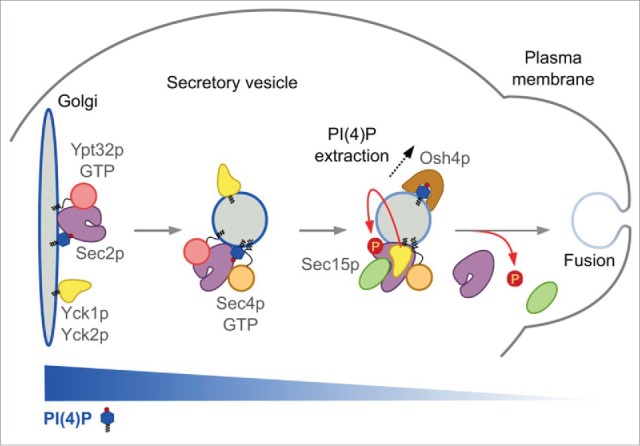
ASBTRACT Rab GTPases serve as master regulators of membrane traffic, each typically controlling several different aspects of a specific stage of membrane traffic by recruiting diverse effector proteins such as cytoskeletal motors, vesicle tethering proteins and regulators of SNARE complex assembly. Rabs, in turn, are regulated by specific guanine nucleotide exchange factors (GEFs), which catalyze the displacement of GDP and binding of GTP, as well as GTPase activating proteins (GAPs) that stimulate the slow intrinsic rate of GTP hydrolysis. Here I review our studies on the final stages of the yeast secretory pathway that have led us to propose that adjacent Rabs on a pathway are networked to one another through their regulators; specifically we have shown that the Rab, Ypt32, in its GTP-bound form recruits both Sec2, the GEF that activates the downstream Rab, Sec4, as well as Gyp1, the GAP that inactivates the upstream Rab, Ypt1. The postulated effect of these counter-current cascades is a programmed series of abrupt Rab transitions that lead to critical changes in the functional identity of the membrane as it flows along the exocytic pathway. Phosphoinositides also play key roles in the temporal and spatial regulation of membrane traffic. The Golgi pool of phosphatidylinositol 4-phosphate (PI(4)P) works in concert with Ypt32 to initially recruit Sec2, yet a subsequent drop in PI(4)P levels directs a regulatory switch in Sec2 function in which it binds to the Sec4 effector Sec15 generating a positive feedback loop. PI(4)P distribution together with Sec2 phosphorylation by a casein kinase determines when and where each regulatory circuit is used.
Keywords: GAP cascade; GEF cascade; GTPase activating protein; Rab; exchange factor; membrane traffic.
Figures
References
-
- Grosshans BL, Ortiz D, Novick P. Rabs and their effectors: achieving specificity in membrane traffic. Proc Natl Acad Sci U S A 2006; 103(32):11821-7; PMID:16882731; http://dx.doi.org/10.1073/pnas.0601617103 - DOI - PMC - PubMed
-
- Jedd G, Mulholland J, Segev N. Two new Ypt GTPases are required for exit from the yeast trans-Golgi compartment. J Cell Biol 1997; 137(3):563-80; PMID:9151665; http://dx.doi.org/10.1083/jcb.137.3.563 - DOI - PMC - PubMed
-
- Jin Y, Sultana A, Gandhi P, Franklin E, Hamamoto S, Khan AR, Munson M, Schekman R, Weisman LS. Myosin V transports secretory vesicles via a Rab GTPase cascade and interaction with the exocyst complex. Dev Cell 2011; 21(6):1156-70; PMID:22172676; http://dx.doi.org/10.1016/j.devcel.2011.10.009 - DOI - PMC - PubMed
-
- Govindan B, Bowser R, Novick P. The role of Myo2, a yeast class V myosin, in vesicular transport. J Cell Biol 1995; 128(6):1055-68; PMID:7896871; http://dx.doi.org/10.1083/jcb.128.6.1055 - DOI - PMC - PubMed
Publication types
MeSH terms
Substances
Grants and funding
LinkOut - more resources
Full Text Sources
Other Literature Sources
Molecular Biology Databases
Research Materials
Miscellaneous
