


Neuromuscular Strain Increases Symptom Intensity in Chronic Fatigue Syndrome
- PMID: 27428358
- PMCID: PMC4948885
- DOI: 10.1371/journal.pone.0159386
Neuromuscular Strain Increases Symptom Intensity in Chronic Fatigue Syndrome
Abstract
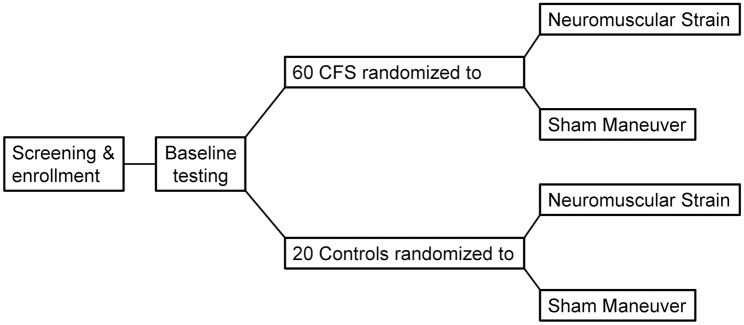
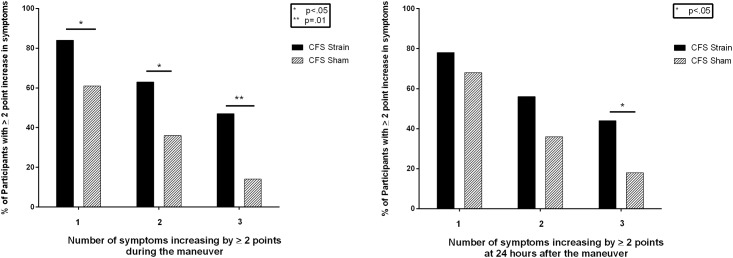
Chronic fatigue syndrome (CFS) is a complex, multisystem disorder that can be disabling. CFS symptoms can be provoked by increased physical or cognitive activity, and by orthostatic stress. In preliminary work, we noted that CFS symptoms also could be provoked by application of longitudinal neural and soft tissue strain to the limbs and spine of affected individuals. In this study we measured the responses to a straight leg raise neuromuscular strain maneuver in individuals with CFS and healthy controls. We randomly assigned 60 individuals with CFS and 20 healthy controls to either a 15 minute period of passive supine straight leg raise (true neuromuscular strain) or a sham straight leg raise. The primary outcome measure was the symptom intensity difference between the scores during and 24 hours after the study maneuver compared to baseline. Fatigue, body pain, lightheadedness, concentration difficulties, and headache scores were measured individually on a 0-10 scale, and summed to create a composite symptom score. Compared to individuals with CFS in the sham strain group, those with CFS in the true strain group reported significantly increased body pain (P = 0.04) and concentration difficulties (P = 0.02) as well as increased composite symptom scores (all P = 0.03) during the maneuver. After 24 hours, the symptom intensity differences were significantly greater for the CFS true strain group for the individual symptom of lightheadedness (P = 0.001) and for the composite symptom score (P = 0.005). During and 24 hours after the exposure to the true strain maneuver, those with CFS had significantly higher individual and composite symptom intensity changes compared to the healthy controls. We conclude that a longitudinal strain applied to the nerves and soft tissues of the lower limb is capable of increasing symptom intensity in individuals with CFS for up to 24 hours. These findings support our preliminary observations that increased mechanical sensitivity may be a contributor to the provocation of symptoms in this disorder.
Conflict of interest statement
Figures
References
-
- Fukuda K, Straus SE, Hickie I, Sharpe M, Dobbins JG, Komaroff A, et al. Chronic fatigue syndrome: a comprehensive approach to its definition and study. Ann Int Med. 1994;121: 953–959. - PubMed
-
- Committee on the Diagnostic Criteria for Myalgic Encephalomyelitis/Chronic Fatigue Syndrome. Beyond Myalgic Encephalomyelitis/Chronic Fatigue Syndrome: Redefining an Illness. Institute of Medicine. Washington, D.C.: The National Academies Press; February 10, 2015. - PubMed
-
- Komaroff AL, Fagioli LR, Doolittle TH, Gandek B, Gleit MA, Guerriero RT, et al. Health status in patients with chronic fatigue syndrome and in general population and disease comparison groups. Am J Med. 1992;101: 281–290. - PubMed
-
- LaManca JJ, Sisto SA, DeLuca J, Johnson SK, Lange G, Pareja J, et al. Influence of exhaustive treadmill exercise on cognitive functioning in chronic fatigue syndrome. Am J Med. 1998;105(3A); 59S–65S. - PubMed
MeSH terms
Grants and funding
LinkOut - more resources
Full Text Sources
Other Literature Sources
Medical
