


Design programmes to maximise participant engagement: a predictive study of programme and participant characteristics associated with engagement in paediatric weight management
- PMID: 27430218
- PMCID: PMC4949908
- DOI: 10.1186/s12966-016-0399-1
Design programmes to maximise participant engagement: a predictive study of programme and participant characteristics associated with engagement in paediatric weight management
Abstract
Background: Approximately 50% of paediatric weight management (WM) programme attendees do not complete their respective programmes. High attrition rates compromise both programme effectiveness and cost-efficiency. Past research has examined pre-intervention participant characteristics associated with programme (non-)completion, however study samples are often small and not representative of multiple demographics. Moreover, the association between programme characteristics and participant engagement is not well known. This study examined participant and programme characteristics associated with engagement in a large, government funded, paediatric WM programme. Engagement was defined as the family's level of participation in the WM programme.
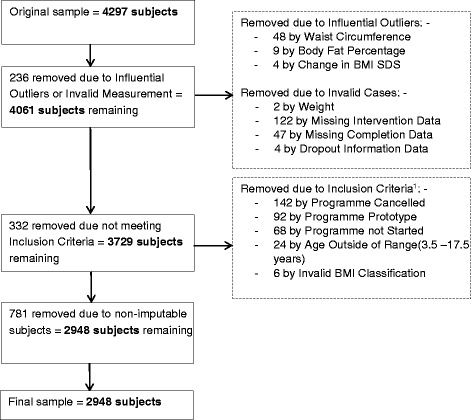
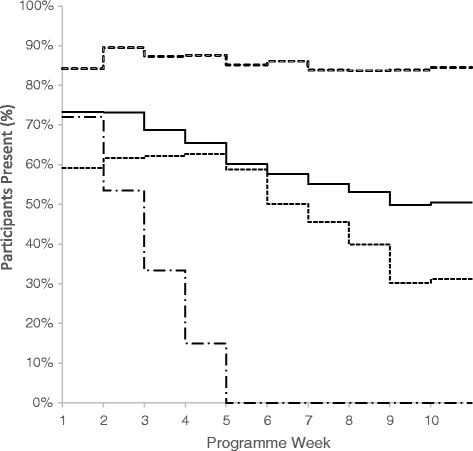
Methods: Secondary data analysis of 2948 participants (Age: 10.44 ± 2.80 years, BMI: 25.99 ± 5.79 kg/m(2), Standardised BMI [BMI SDS]: 2.48 ± 0.87 units, White Ethnicity: 70.52%) was undertaken. Participants attended a MoreLife programme (nationwide WM provider) between 2009 and 2014. Participants were classified into one of five engagement groups: Initiators, Late Dropouts, Low- or High- Sporadic Attenders, or Completers. Five binary multivariable logistic regression models were performed to identify participant (n = 11) and programmatic (n = 6) characteristics associated with an engagement group. Programme completion was classified as ≥70% attendance.
Results: Programme characteristics were stronger predictors of programme engagement than participant characteristics; particularly small group size, winter/autumn delivery periods and earlier programme years (proxy for scalability). Conversely, participant characteristics were weak predictors of programme engagement. Predictors varied between engagement groups (e.g. Completers, Initiators, Sporadic Attenders). 47.1% of participants completed the MoreLife programme (mean attendance: 59.4 ± 26.7%, mean BMI SDS change: -0.15 ± 0.22 units), and 21% of those who signed onto the programme did not attend a session.
Conclusions: As WM services scale up, the efficacy and fidelity of programmes may be reduced due to increased demand and lower financial resource. Further, limiting WM programme groups to no more than 20 participants could result in greater engagement. Baseline participant characteristics are poor and inconsistent predictors of programme engagement. Thus, future research should evaluate participant motives, expectations, and barriers to attending a WM programme to enhance our understanding of participant WM engagement. Finally, we suggest that session-by-session attendance is recorded as a minimum requirement to improve reporting transparency and enhance external validity of study findings.
Keywords: Attendance; Attrition; Engagement; Family; Obesity; Paediatric; Weight management programme.
Figures
References
-
- Health and Social Care Information Centre . Office of National Statistics. Leeds: Health and Social Care Information Centre; 2013. National Child Measurement Programme: England, 2012/13 School Year.
-
- NICE. Costing report - Managing overweight and obesity among children and young people: lifestyle weight management services. In: National Institute for Health and Care Excellence (ed). Manchester: National Institute for Health and Care Excellence; 2013. p. 1–28.
-
- Butland B, Jebb S, Kopelman P, McPherson K, Thomas S, Mardell J, et al. Government Office for Science. Foresight: London; 2007. Tackling obesities: future choices – project report; pp. 1–164.
MeSH terms
LinkOut - more resources
Full Text Sources
Other Literature Sources
Medical
Research Materials
Miscellaneous
