Plasma lipid levels predict dysglycemia in a biracial cohort of nondiabetic subjects: Potential mechanisms
- PMID: 27430991
- PMCID: PMC5068467
- DOI: 10.1177/1535370216659946
Plasma lipid levels predict dysglycemia in a biracial cohort of nondiabetic subjects: Potential mechanisms
Abstract
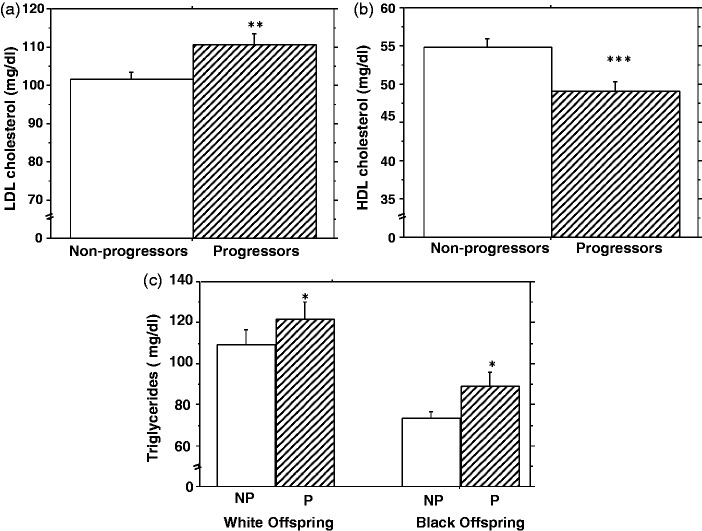
Dyslipidemia and dysglycemia are etiologically associated, but the direction, chronology, and mechanisms of the association are not fully understood. We, therefore, analyzed data from 335 healthy adults (184 black, 151 white) enrolled in the Pathobiology of Prediabetes in A Biracial Cohort study. Subjects underwent oral glucose tolerance test (OGTT) and were enrolled if they had normal fasting and 2-h plasma glucose levels. Assessments during year 1 included anthropometry, fasting lipid profile, insulin sensitivity, and insulin secretion. Thereafter, OGTT was assessed annually for 5.5 years. The primary outcome was occurrence of prediabetes (impaired fasting glucose or impaired glucose tolerance) or diabetes. During a mean follow-up of 2.62 years, 110 participants (32.8%) developed prediabetes (N = 100) or diabetes (N = 10). In multivariate logistic regression models, higher baseline low-density lipoprotein (LDL) cholesterol and triglyceride levels and lower HDL cholesterol levels significantly increased the risk of incident prediabetes. The combined relative risk (95% confidence interval [CI]) of prediabetes for participants with lower baseline HDL cholesterol (10th vs. 90th percentile), higher LDL cholesterol (90th vs. 10th percentile) and high triglycerides levels (90th vs. 10th percentile) was 4.12 (95% CI 1.61-10.56), P = 0.0032. At baseline, lipid values showed significant associations with measures of adiposity, glycemia, insulin sensitivity, and secretion. In both ethnic groups, waist circumference correlated positively with triglycerides and inversely with HDL cholesterol levels (P = 0.0004-<0.0001); fasting plasma glucose correlated positively with triglycerides and LDL cholesterol levels and inversely with HDL cholesterol levels (P = 0.006-<0.0001); insulin sensitivity correlated positively with HDL cholesterol and inversely with triglyceride levels (P < 0.0001), and insulin secretion correlated positively with triglycerides (P = 0.01) and inversely with HDL cholesterol (P < 0.0001). We conclude that a baseline lipidemic signature identifies normoglycemic individuals at high risk for future glycemic progression, via congruent associations with adiposity and glucoregulatory mechanisms. These findings suggest that early lifestyle intervention could ameliorate progressive dyslipidemia and dysglycemia.
Keywords: High-density lipoprotein cholesterol; impaired fasting glucose; low-density lipoprotein cholesterol; prospective study; race/ethnicity; triglycerides.
© 2016 by the Society for Experimental Biology and Medicine.
Figures
References
-
- Schmidt MI, Duncan BB, Bang H, Pankow JS, Ballantyne CM, Golden SH, Folsom AR, Chambless LE. Atherosclerosis Risk in Communities Investigators. Identifying individuals at high risk for diabetes: the Atherosclerosis Risk in Communities study. Diabetes Care 2005; 28: 2013–18. - PubMed
-
- Wilson PW, Meigs JB, Sullivan L, Fox CS, Nathan DM, D’Agostino RB., Sr Prediction of incident diabetes mellitus in middle-aged adults: the Framingham Offspring Study. Arch Intern Med 2007; 167: 1068–74. - PubMed
MeSH terms
Substances
Grants and funding
LinkOut - more resources
Full Text Sources
Other Literature Sources
Medical