


Nitro-oleic acid inhibits vascular endothelial inflammatory responses and the endothelial-mesenchymal transition
- PMID: 27431604
- PMCID: PMC5010974
- DOI: 10.1016/j.bbagen.2016.07.010
Nitro-oleic acid inhibits vascular endothelial inflammatory responses and the endothelial-mesenchymal transition
Abstract
Background: Inflammatory-mediated pathological processes in the endothelium arise as a consequence of the dysregulation of vascular homeostasis. Of particular importance are mediators produced by stimulated monocytes/macrophages inducing activation of endothelial cells (ECs). This is manifested by excessive soluble pro-inflammatory mediator production and cell surface adhesion molecule expression. Nitro-fatty acids are endogenous products of metabolic and inflammatory reactions that display immuno-regulatory potential and may represent a novel therapeutic strategy to treat inflammatory diseases. The purpose of our study was to characterize the effects of nitro-oleic acid (OA-NO2) on inflammatory responses and the endothelial-mesenchymal transition (EndMT) in ECs that is a consequence of the altered healing phase of the immune response.
Methods: The effect of OA-NO2 on inflammatory responses and EndMT was determined in murine macrophages and murine and human ECs using Western blotting, ELISA, immunostaining, and functional assays.
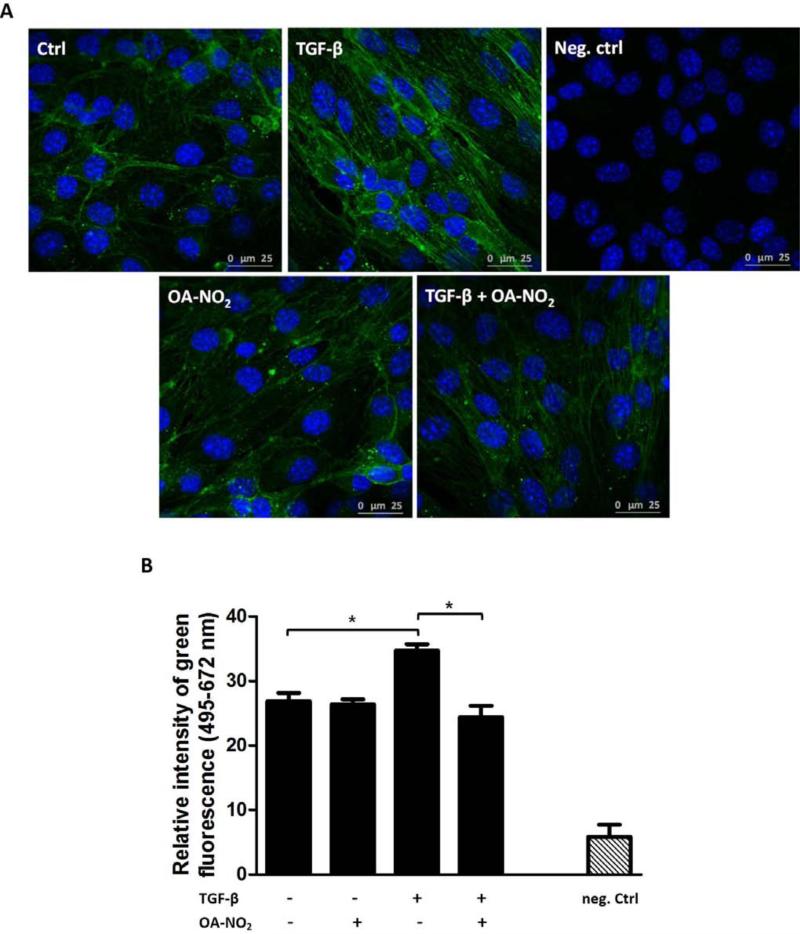
Results: OA-NO2 limited the activation of macrophages and ECs by reducing pro-inflammatory cytokine production and adhesion molecule expression through its modulation of STAT, MAPK and NF-κB-regulated signaling. OA-NO2 also decreased transforming growth factor-β-stimulated EndMT and pro-fibrotic phenotype of ECs. These effects are related to the downregulation of Smad2/3.
Conclusions: The study shows the pleiotropic effect of OA-NO2 on regulating EC-macrophage interactions during the immune response and suggests a role for OA-NO2 in the regulation of vascular endothelial immune and fibrotic responses arising during chronic inflammation.
General significance: These findings propose the OA-NO2 may be useful as a novel therapeutic agent for treatment of cardiovascular disorders associated with dysregulation of the endothelial immune response.
Keywords: Endothelial cells; Endothelial-mesenchymal transition; Macrophages; Nitro-fatty acids; Nitro-oleic acid; Vascular inflammation.
Copyright © 2016 Elsevier B.V. All rights reserved.
Figures




References
-
- Popa C, Netea MG, van Riel PL, van der Meer JW, Stalenhoef AF. The role of TNF-alpha in chronic inflammatory conditions, intermediary metabolism, and cardiovascular risk. Journal of lipid research. 2007;48:751–762. - PubMed
-
- Ambrozova G, Martiskova H, Koudelka A, Ravekes T, Rudolph TK, Klinke A, Rudolph V, Freeman BA, Woodcock SR, Kubala L, Pekarova M. Nitro-oleic acid modulates classical and regulatory activation of macrophages and their involvement in pro-fibrotic responses. Free radical biology & medicine. 2015 - PMC - PubMed
-
- Lawson C, Wolf S. ICAM-1 signaling in endothelial cells. Pharmacological reports : PR. 2009;61:22–32. - PubMed
Publication types
MeSH terms
Substances
Grants and funding
LinkOut - more resources
Full Text Sources
Other Literature Sources
