


Review
doi: 10.1007/s00439-016-1713-3.
Epub 2016 Jul 18.
The present and future of genome editing in cancer research
Affiliations
- PMID: 27432158
- PMCID: PMC5512423
- DOI: 10.1007/s00439-016-1713-3
Item in Clipboard
Review
The present and future of genome editing in cancer research
Hum Genet.
2016 Sep.
Abstract
The widespread use of high-throughput genome sequencing methods is profoundly changing the way we understand, classify, and treat human cancers. To make sense of the deluge of sequencing data generated in the clinic, more effective and rapid assessments of the functional relevance of newly discovered cancer-associated mutations are urgently needed. In this review, we discuss how genome editing technologies are responding to this major challenge. Largely focusing on CRISPR-based methods, we will highlight their potential to accelerate discovery, discuss their current limitations, and speculate about future applications.
Figures
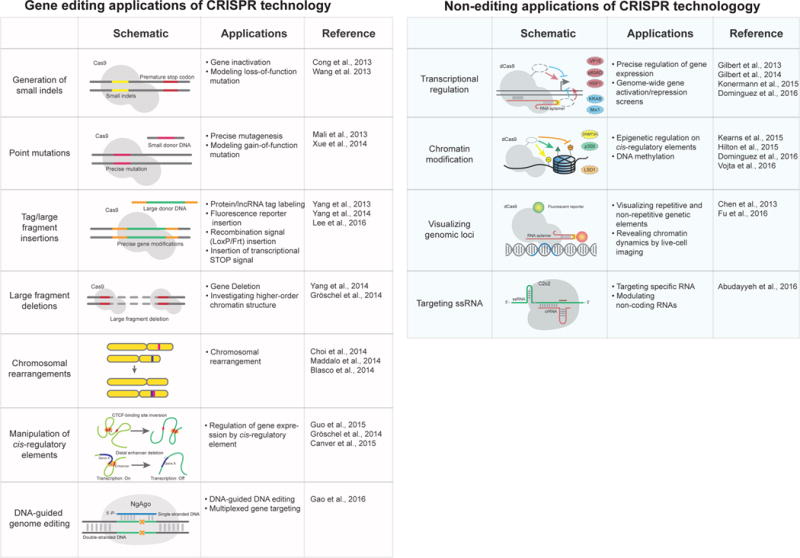
Applications of programmable nucleases of potential relevance to cancer research are shown. The left panel illustrates applications resulting in genetic changes in the recipient cell, while the right panel lists applications that do not modify its genome.
References
-
- Bhaya D, Davison M, Barrangou R. CRISPR-Cas Systems in Bacteria and Archaea: Versatile Small RNAs for Adaptive Defense and Regulation. Annual Review of Genetics. 2011;45:273–297. - PubMed
-
- Blasco Rafael B, Karaca E, Ambrogio C, Cheong TC, Karayol E, Minero Valerio G, Voena C, Chiarle R. Simple and Rapid In Vivo Generation of Chromosomal Rearrangements using CRISPR/Cas9 Technology. Cell Reports. 2014;9:1219–1227. - PubMed
Publication types
MeSH terms
Grants and funding
LinkOut - more resources
Full Text Sources
Other Literature Sources
