


Temporomandibular joint effusion and its relationship with perceived disability assessed using musculoskeletal ultrasound and a patient-reported disability index
- PMID: 27433242
- PMCID: PMC4760576
- DOI: 10.1177/1742271X14568608
Temporomandibular joint effusion and its relationship with perceived disability assessed using musculoskeletal ultrasound and a patient-reported disability index
Abstract
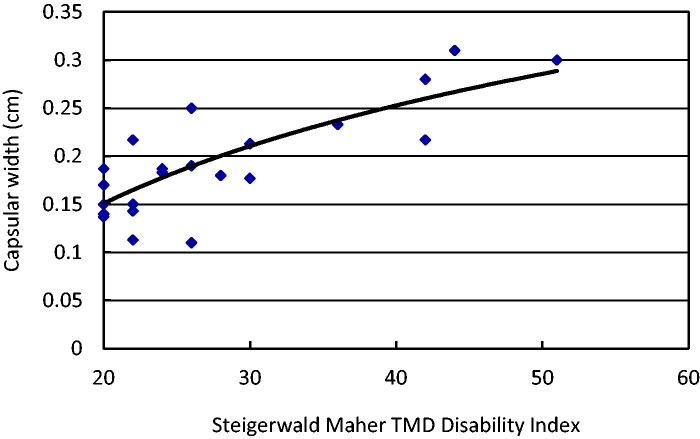
The relationship between effusion of the temporomandibular joint (TMJ) and patient-reported disability is poorly researched. This pilot study explored the link between TMJ inflammation as measured by ultrasound and patient disability assessed by the Steigerwald Maher TMD Disability Index (SMTDI). The study design used a prospective correlational approach involving a sample with TMJ dysfunction (TMD). Twenty-four patients were recruited from the European School of Osteopathy and a Kent dental practice. Participants completed the SMTDI to determine the level of TMD (symptomatic score >20). A SonoSite SLA "Hockey Stick" [13-6 MHz] musculo-skeletal transducer was placed over the TMJ in a transverse direction and effusion was calculated indirectly by measuring capsular width. An upper left quadrant protocol was used throughout. A regression analysis was run with participants' gender, age and capsular width as predictor variables modelled against reported SMTDI. Larger capsular widths were found to be significant predictors of SMTDI scores (r = 0.803, p < 0.0001). The patient profile matched with the previous studies and the TMD sufferer population, indicating external validity. Results suggest that the SMTDI could be integrated into practice life as a quick, accessible and easy tool to monitor patients' progress and assess levels of inflammation, without the need for repetitive imaging. The study design proved reproducible and a larger scale study is indicated.
Keywords: Musculoskeletal ultrasound; effusion; quality of life; questionnaire; temporomandibular joint; ultrasound.
Figures


References
-
- Dworkin SF. Temporomandibular Disorder (TMD) pain–related disability found related to depression, nonspecific physical symptoms, and pain duration at 3 international sites. J Evid Based Dent Pract 2011; 11: 143–4. - PubMed
-
- Tasali N, Cubuk R, Aricak M, et al. Temporomandibular joint (TMJ) pain revisited with dynamic contrast-enhanced magnetic resonance imaging (DCE-MRI). Eur J Radiol 2012; 81: 603–8. - PubMed
-
- Bas B, Yilmaz N, Gökce E, et al. Ultrasound assessment of increased capsular width in temporomandibular joint internal derangements: relationship with joint pain and magnetic resonance grading of joint effusion. Oral Surg Oral Med Oral Pathol Oral Radiol Endodontol 2011; 112: 112–7. - PubMed
-
- Jank S, Zangerl A, Kloss FR, et al. High resolution ultrasound investigation of the TMJ in patients with chronic polyarthritis. Intern J Oral Maxillofac Surg 2011; 40: 45–9. - PubMed
-
- Barros VDM, Seraidarian PI, Cortes MI, et al. The impact of orofacial pain on the quality of life of patients with temporomandibular disorder. J Orofac Pain 2009; 23: 28–37. - PubMed
LinkOut - more resources
Full Text Sources