Whole-Genome Sequencing Detection of Ongoing Listeria Contamination at a Restaurant, Rhode Island, USA, 2014
- PMID: 27434089
- PMCID: PMC4982169
- DOI: 10.3201/eid2208.151917
Whole-Genome Sequencing Detection of Ongoing Listeria Contamination at a Restaurant, Rhode Island, USA, 2014
Abstract
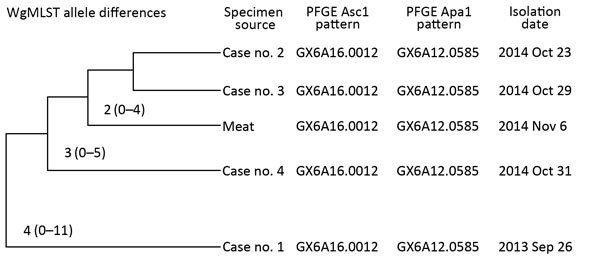
In November 2014, the Rhode Island Department of Health investigated a cluster of 3 listeriosis cases. Using whole-genome sequencing to support epidemiologic, laboratory, and environmental investigations, the department identified 1 restaurant as the likely source of the outbreak and also linked the establishment to a listeriosis case that occurred in 2013.
Keywords: PFGE; WGS; bacteria; bacterial pathogen; contamination source; environmental contamination; environmental investigation; epidemiologic investigation; food processing; food service establishments; foodborne infections; listeria; listeriosis; outbreak; pulsed-field gel electrophoresis; whole-genome sequencing.
Figures
References
-
- United States Department of Agriculture, Food Safety and Inspection Service. Best practices guidance for controlling Listeria monocytogenes in retail delicatessens. June 2015. [cited 2016 Feb 1]. http://www.fsis.usda.gov/wps/wcm/connect/29d51258-0651-469b-99b8-e986bae...
-
- Centers for Disease Control and Prevention. Advanced molecular detection (AMD). AMD projects: learning from Listeria [cited 2015 Oct 23]. http://www.cdc.gov/amd/project-summaries/listeria.html
-
- Jackson B, Jackson K, Tarr C, Evans P, Klimke W, Kubota K, et al. Improving detection and investigation of listeriosis outbreaks using real-time whole-genome sequencing. Presented at: IDWeek 2014; Philadelphia, PA, USA; 2014 Oct 8–12.
MeSH terms
LinkOut - more resources
Full Text Sources
Other Literature Sources
Medical
Molecular Biology Databases