


Screening of Living Kidney Donors for Genetic Diseases Using a Comprehensive Genetic Testing Strategy
- PMID: 27434427
- PMCID: PMC5297870
- DOI: 10.1111/ajt.13970
Screening of Living Kidney Donors for Genetic Diseases Using a Comprehensive Genetic Testing Strategy
Abstract
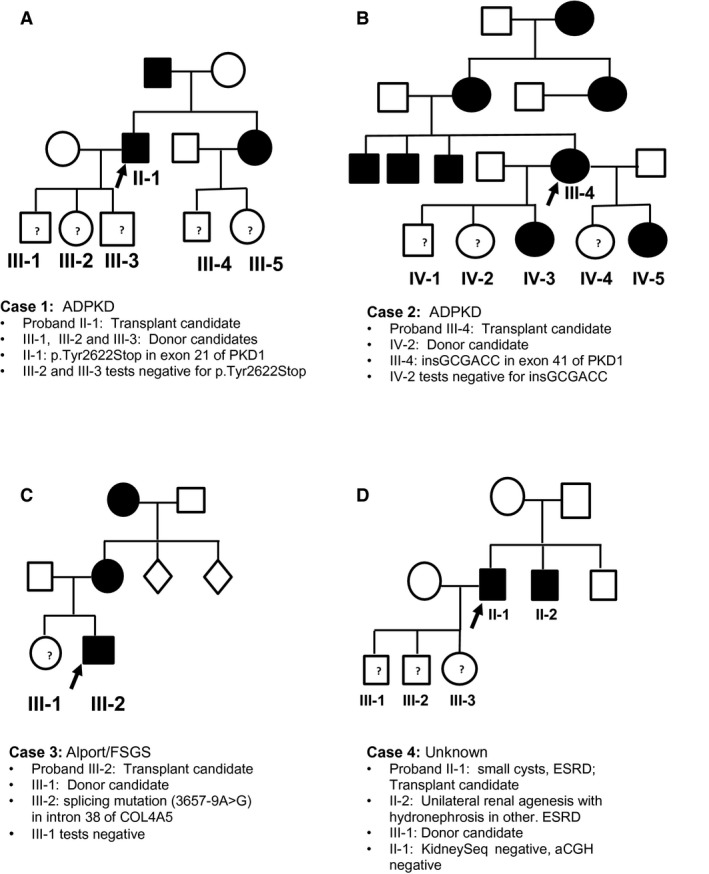
Related living kidney donors (LKDs) are at higher risk of end-stage renal disease (ESRD) compared with unrelated LKDs. A genetic panel was developed to screen 115 genes associated with renal diseases. We used this panel to screen six negative controls, four transplant candidates with presumed genetic renal disease and six related LKDs. After removing common variants, pathogenicity was predicted using six algorithms to score genetic variants based on conservation and function. All variants were evaluated in the context of patient phenotype and clinical data. We identified causal variants in three of the four transplant candidates. Two patients with a family history of autosomal dominant polycystic kidney disease segregated variants in PKD1. These findings excluded genetic risk in three of four relatives accepted as potential LKDs. A third patient with an atypical history for Alport syndrome had a splice site mutation in COL4A5. This pathogenic variant was excluded in a sibling accepted as an LKD. In another patient with a strong family history of ESRD, a negative genetic screen combined with negative comparative genomic hybridization in the recipient facilitated counseling of the related donor. This genetic renal disease panel will allow rapid, efficient and cost-effective evaluation of related LKDs.
Keywords: clinical decision-making; clinical research/practice; diagnostic techniques and imaging; donors and donation: living; genetics; kidney transplantation/nephrology; kidney transplantation: living donor; translational research/science.
© 2016 The Authors. American Journal of Transplantation published by Wiley Periodicals, Inc. on behalf of American Society of Transplant Surgeons.
Figures
References
-
- Lamb KE, Lodhi S, Meier‐Kriesche HU. Long‐term renal allograft survival in the United States: A critical reappraisal. Am J Transplant 2011; 11: 450–462. - PubMed
-
- Hariharan S, Johnson CP, Bresnahan BA, Taranto SE, McIntosh MJ, Stablein D. Improved graft survival after renal transplantation in the United States, 1988 to 1996. N Engl J Med 2000; 342: 605–612. - PubMed
-
- Mjøen G, Hallan S, Hartmann A, et al. Long‐term risks for kidney donors. Kidney Int 2014; 86: 162–167. - PubMed
Publication types
MeSH terms
Substances
Associated data
- Actions
- Actions
- Actions
- Actions
- Actions
- Actions
- Actions
- Actions
- Actions
- Actions
- Actions
- Actions
- Actions
- Actions
- Actions
- Actions
- Actions
- Actions
- Actions
- Actions
- Actions
- Actions
- Actions
- Actions
- Actions
- Actions
- Actions
- Actions
- Actions
- Actions
- Actions
- Actions
- Actions
- Actions
- Actions
- Actions
- Actions
- Actions
- Actions
- Actions
- Actions
- Actions
- Actions
- Actions
- Actions
- Actions
- Actions
- Actions
- Actions
- Actions
- Actions
- Actions
- Actions
- Actions
- Actions
- Actions
- Actions
- Actions
- Actions
- Actions
- Actions
- Actions
- Actions
- Actions
- Actions
- Actions
- Actions
- Actions
- Actions
- Actions
- Actions
- Actions
- Actions
- Actions
- Actions
- Actions
- Actions
- Actions
- Actions
- Actions
- Actions
- Actions
- Actions
- Actions
- Actions
- Actions
- Actions
- Actions
- Actions
- Actions
- Actions
- Actions
- Actions
- Actions
- Actions
- Actions
- Actions
- Actions
- Actions
- Actions
- Actions
- Actions
- Actions
- Actions
- Actions
- Actions
- Actions
- Actions
- Actions
- Actions
- Actions
- Actions
- Actions
- Actions
- Actions
LinkOut - more resources
Full Text Sources
Other Literature Sources
Medical
