


Medial Prefrontal Cortical Dopamine Responses During Operant Self-Administration of Sweetened Ethanol
- PMID: 27435872
- PMCID: PMC5573256
- DOI: 10.1111/acer.13141
Medial Prefrontal Cortical Dopamine Responses During Operant Self-Administration of Sweetened Ethanol
Abstract
Background: Medial prefrontal cortex (mPFC) dysfunction is present in heavy alcohol consumers. Dopamine signaling in mPFC is associated with executive functioning and affects drinking behavior; however, direct measurement of extracellular mPFC dopamine during appetitive and consummatory ethanol (EtOH) self-administration behavior has not been reported.
Methods: We used in vivo microdialysis in freely behaving, adult, male, Long Evans rats to determine extracellular dopamine concentration in the mPFC during operant self-administration of an EtOH-plus-sucrose or sucrose solution. The model separated appetitive/seeking from consummatory phases of the operant session. Dopamine was also monitored in an untrained handling control group, and dialysate EtOH was measured in the EtOH-drinking group.
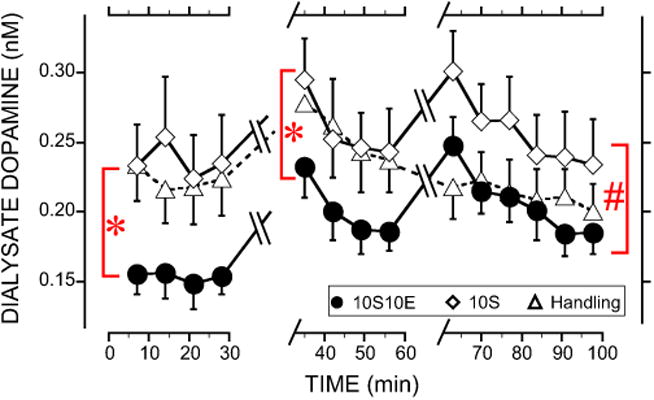
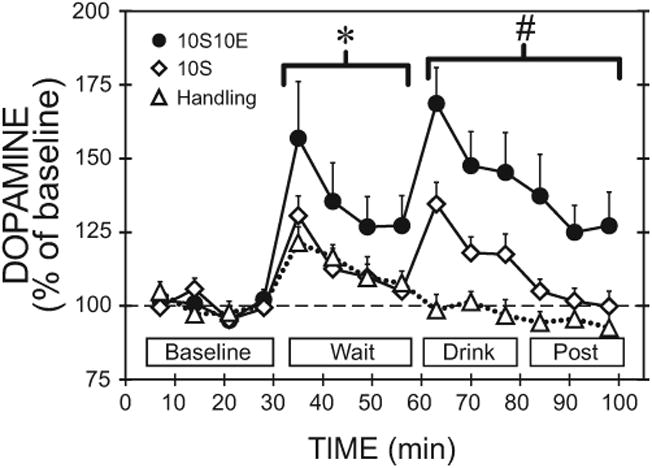
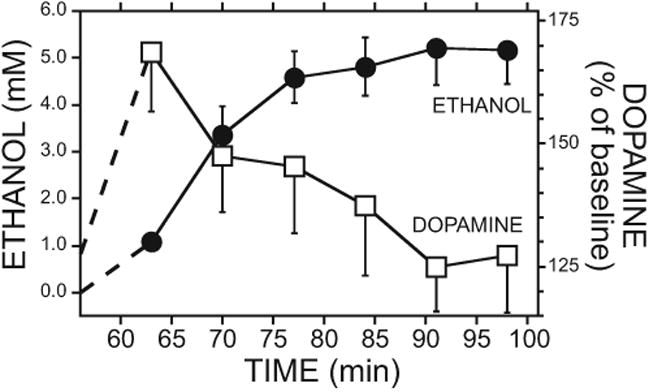
Results: Home cage baseline dopamine was lower in rats that experienced a week of drinking sweetened EtOH compared with sucrose-drinking and handling controls. Transfer into the operant chamber and the initiation of consumption stimulated a relatively higher change in dopamine over baseline in the sweetened EtOH group compared with sucrose and handling controls. However, all groups show a dopamine response during transfer into the operant chamber, and the sucrose group had a relatively higher change in dopamine over baseline during initiation of consumption compared with handling controls. The time courses of dopamine and EtOH in the mPFC differ in the EtOH-consuming rats.
Conclusions: Differences in extracellular mPFC dopamine between EtOH drinkers compared with control groups suggest that mPFC dopamine is involved in the mechanism of operant self-administration of sweetened EtOH and sucrose. Furthermore, the increase in dopamine during consumption is consistent with a role of mPFC dopamine in reward prediction.
Keywords: Appetitive; Consumption; Ethanol; Ethanol-Seeking; Mesocortical; Operant Self-Administration.
Copyright © 2016 by the Research Society on Alcoholism.
Conflict of interest statement
Conflict of interest: The authors have no conflict of interests.
Figures
References
-
- Bassareo V, Tanda G, Petromilli P, Giua C, Di Chiara G. Non-psychostimulant drugs of abuse and anxiogenic drugs activate with differential selectivity dopamine transmission in the nucleus accumbens and in the medial prefrontal cortex of the rat. Psychopharmacology. 1996;124:293–299. - PubMed
-
- Bechara A, Damasio H. Decision-making and addiction (part I): impaired activation of somatic states in substance dependent individuals when pondering decisions with negative future consequences. Neuropsychologia. 2002;40:1675–1689. - PubMed
-
- Bechara A, Van Der Linden M. Decision-making and impulse control after frontal lobe injuries. Curr Opin Neurol. 2005;18:734–739. - PubMed
Publication types
MeSH terms
Substances
Grants and funding
LinkOut - more resources
Full Text Sources
Other Literature Sources
