. 2016 May 5;7(7):692-6.
doi: 10.1021/acsmedchemlett.6b00120. eCollection 2016 Jul 14.

Charged Nonclassical Antifolates with Activity Against Gram-Positive and Gram-Negative Pathogens

Affiliations

Charged Nonclassical Antifolates with Activity Against Gram-Positive and Gram-Negative Pathogens

Eric Scocchera et al. ACS Med Chem Lett. .

Abstract

Although classical, negatively charged antifolates such as methotrexate possess high affinity for the dihydrofolate reductase (DHFR) enzyme, they are unable to penetrate the bacterial cell wall, rendering them poor antibacterial agents. Herein, we report a new class of charged propargyl-linked antifolates that capture some of the key contacts common to the classical antifolates while maintaining the ability to passively diffuse across the bacterial cell wall. Eight synthesized compounds exhibit extraordinary potency against Gram-positive S. aureus with limited toxicity against mammalian cells and good metabolic profile. High resolution crystal structures of two of the compounds reveal extensive interactions between the carboxylate and active site residues through a highly organized water network.

Keywords: Dihydrofolate reductase; Escherichia coli; MRSA; Staphylococcus aureus; antifolate; methotrexate; trimethoprim.


Conflict of interest statement

The authors declare no competing financial interest.

Figures
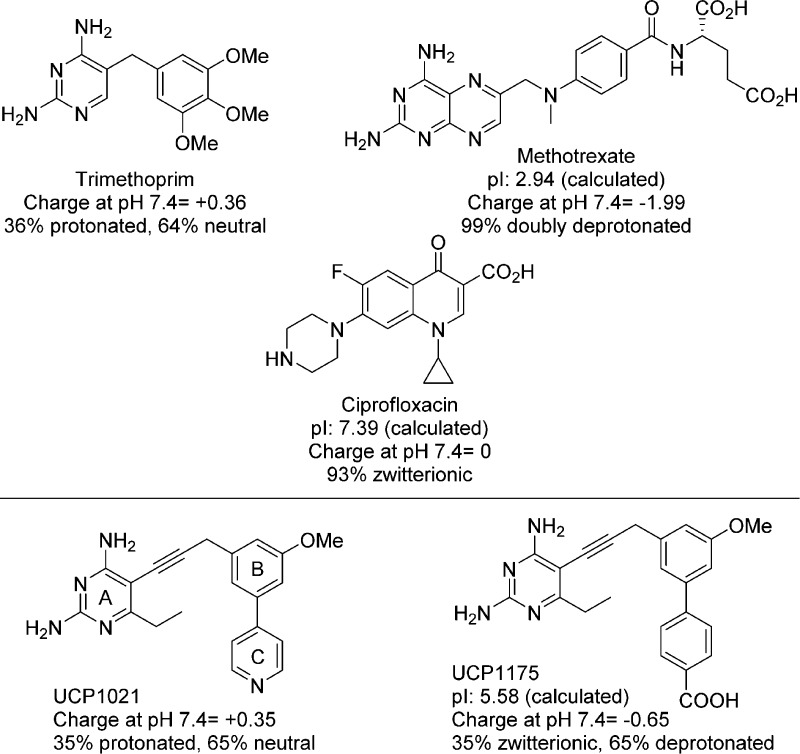
Figure 1
Figure 1
Antibacterial agents effective against Gram-positive or Gram-negative bacteria with relevant physiological properties. A previous PLA (UCP1021) is compared to a PLA-COOH.
Scheme 1
Scheme 1. Synthesis of Unbranched and Asymmetric PLAs
Reagents and conditions. Unbranched Synthesis: (a) Ar–B(OH)2 or Ar–Br, Pd(PPh3)4, Cs2CO3, dioxane/H2O, 90 °C; (b) methoxymethyl triphenylphosphonium chloride, NaOtBu, THF, 0 °C; (c) NaI, TMSCl, MeCN, −20 °C; (d) dimethyl(1-diazo-2-oxopropyl)phosphonate, K2CO3, MeOH; (e) iodoethyl diaminopyrimidine, Pd(PPh3)2Cl2, CuI, KOAc, DMF, 50 °C; (f) TFA, DCM. Asymmetric Synthesis: (a) PdCl2(PPh3)2, 4-methoxycarbonylphenylboronic acid, dioxane/H2O, 90 °C; (b) 10% Pd/C, Et3SiH, DCM; (c) nonaflyl fluoride, P1-t-Bu-tris(tetramethylene) phosphazene base, DMF, −15 °C to rt; (d) iodoethyl diaminopyrimidine, Pd(PPh3)2Cl2, CuI, KOAc, DMF, 50 °C; (e) LiOH, THF·H2O, 32 °C.
Figure 2
Figure 2
Crystal structures of inhibitors 3c (PDB ID: 5HF0) and 3d (PDB ID: 5HF2) with SaDHFR and NADPH. (A) Compound 3c (dark green) and a mixture of β-NADPH (salmon) and α-NADPH (yellow) and SaDHFR (green). (B) Compound 3d (dark purple), α-NADPH, and SaDHFR (purple). (C) Overlay of compounds 3c and 3d. (D) β-NADPH and α-NADPH. Red spheres represent ordered water molecules observed in the structure.

References

    1. Hagner N.; Joerger M. Cancer chemotherapy: targeting folic acid synthesis. Cancer Manage. Res. 2010, 2, 293–301. 10.2147/CMAR.S10043. - DOI - PMC - PubMed
    1. Zhou W.; Scocchera E.; Wright D.; Anderson A. Antifolates as effective antimicrobial agents: new generations of trimethoprim analogs. MedChemComm 2013, 4, 908–915. 10.1039/c3md00104k. - DOI
    1. Bennett B.; Wan Q.; Ahmad M.; Langan P.; Dealwis C. X-ray structure of the ternary MTX.NADPH complex of the anthrax dihydrofolate reductase: a pharmacophore for dual-site inhibitor design. J. Struct. Biol. 2009, 166, 162–171. 10.1016/j.jsb.2009.01.001. - DOI - PMC - PubMed
    1. Sawaya M.; Kraut J. Loop and subdomain movements in the mechanism of Escherichia coli dihydrofolate reductase: crystallographic evidence. Biochemistry 1997, 36, 586–603. 10.1021/bi962337c. - DOI - PubMed
    1. Li R.; Sirawaraporn R.; Chitnumsub P.; Sirawaraporn W.; Wooden J.; Athappilly F.; Turley S.; Hol W. Three-dimensional structure of M. tuberculosis dihydrofolate reductase reveals opportunities for the design of novel tuberculosis drugs. J. Mol. Biol. 2000, 295, 307–323. 10.1006/jmbi.1999.3328. - DOI - PubMed
