


Racial/Ethnic Differences in Sleep Disorders and Reporting of Trouble Sleeping Among Women of Childbearing Age in the United States
- PMID: 27439422
- PMCID: PMC5250592
- DOI: 10.1007/s10995-016-2115-9
Racial/Ethnic Differences in Sleep Disorders and Reporting of Trouble Sleeping Among Women of Childbearing Age in the United States
Abstract
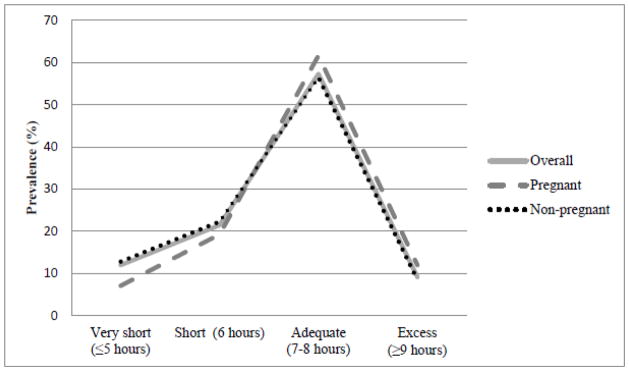
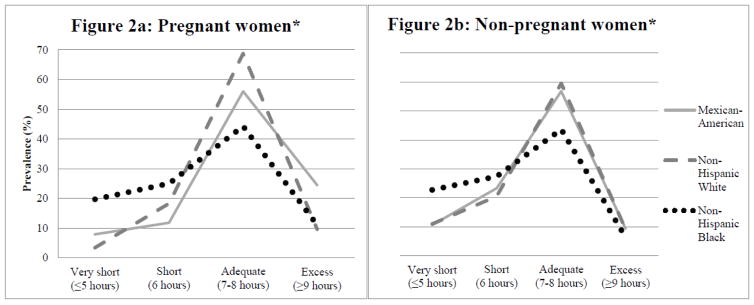
Objectives Whether racial/ethnic differences in prevalence/reporting of sleep disorders exist in pregnant women/women of child-bearing age is unknown. Study objectives were to estimate prevalence of sleep disorders and to examine racial/ethnic differences in sleep disorders, reporting of sleep issues, and amount of sleep among women of child-bearing age (15-44 years) in the US. Methods Through a secondary analysis of the National Health and Nutrition Examination Survey 2005-2010 (3175 non-pregnant, 432 pregnant women in main analysis), prevalence of sleep disorders, reporting of sleep disorders to a physician/health professional, and amount of sleep were estimated overall, by pregnancy status, and by race/ethnicity stratified by pregnancy status. Racial/ethnic differences in reporting of trouble sleeping by pregnancy status were examined using univariate and multivariate logistic regression. Results Prevalence of diagnosed sleep disorders among women of childbearing age was 4.9 % [3.9 % pregnant; 5.1 % non-pregnant (p < 0.01)]. Significantly fewer pregnant and non-pregnant minority women reported adequate sleep (7-8 h) than non-Hispanic white (white) women (p < 0.05). Among non-pregnant women, odds of report of trouble sleeping were significantly higher for white compared to black (aOR 0.47 [95 % CI 0.36, 0.61]) or Mexican-American women (aOR 0.29 [95 % CI 0.21, 0.41]); non-pregnant minority women were also significantly less likely to report trouble sleeping than white women when controlling for amount of sleep. Among pregnant women, these same trends were found. Discussion Compared to white women, minority women, despite reporting less adequate sleep, are less likely to report trouble sleeping, providing evidence of an important health disparity.
Keywords: Health disparities; National health and nutrition examination survey (NHANES); Pregnancy; Sleep disorders.
Conflict of interest statement
The authors declare that they have no conflict of interest.
Figures
References
-
- Adenekan B, Pandey A, McKenzie S, Zizi F, Casimir GJ, Jean-Louis G. Sleep in America: Role of racial/ethnic differences. Sleep Medicine Reviews. 2013;17(4):255–262. http://dx.doi.org/10.1016/j.smrv.2012.07.002. - DOI - PMC - PubMed
-
- Altevogt BM, Colten HR. Sleep disorders and sleep deprivation: An unmet public health problem. National Academies Press; 2006. - PubMed
-
- Baker FC, Wolfson AR, Lee KA. Association of sociodemographic, lifestyle, and health factors with sleep quality and daytime sleepiness in women: Findings from the 2007 National Sleep Foundation "Sleep in America Poll". Journal of Women's Health (2002) 2009;18(6):841–849. doi: 10.1089/jwh.2008.0986. - DOI - PubMed
MeSH terms
Grants and funding
LinkOut - more resources
Full Text Sources
Other Literature Sources
Medical
