. 2016 Sep 1;116(3):1488-97.
doi: 10.1152/jn.00404.2016. Epub 2016 Jul 20.

Understanding location- and feature-based processing along the human intraparietal sulcus

Affiliations

Understanding location- and feature-based processing along the human intraparietal sulcus

Katherine C Bettencourt et al. J Neurophysiol. .

Abstract

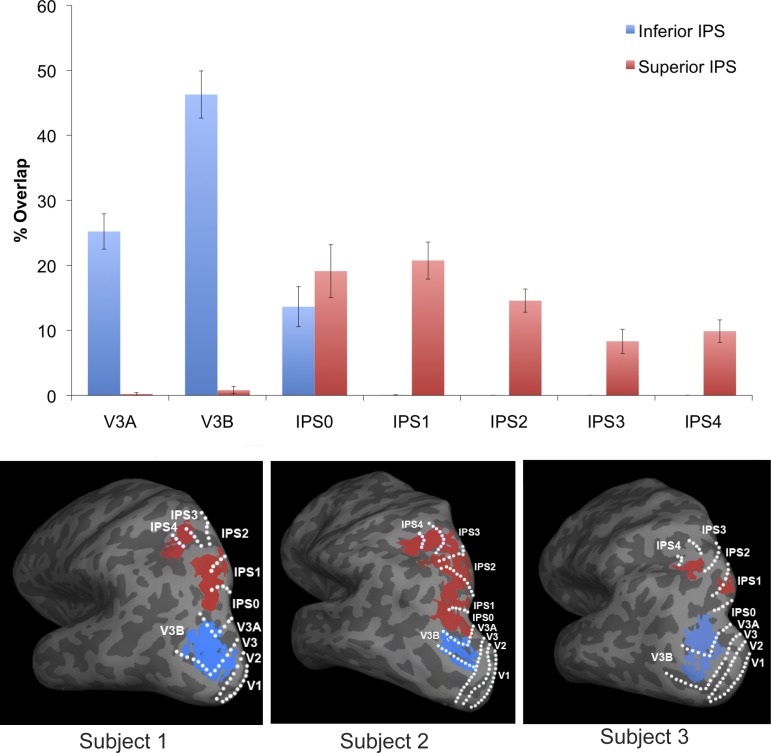
Based on different cognitive tasks and mapping methods, the human intraparietal sulcus (IPS) has been subdivided according to multiple different organizational schemes. The presence of topographically organized regions throughout IPS indicates a strong location-based processing in this brain region. However, visual short-term memory (VSTM) studies have shown that while a region in the inferior IPS region (inferior IPS) is involved in object individuation and selection based on location, a region in the superior IPS (superior IPS) primarily encodes and stores object featural information. Here, we determined the localization of these two VSTM IPS regions with respect to the topographic IPS regions in individual participants and the role of different IPS regions in location- and feature-based processing. Anatomically, inferior IPS showed an 85.2% overlap with topographic IPS regions, with the greatest overlap seen in V3A and V3B, and superior IPS showed a 73.6% overall overlap, with the greatest overlap seen in IPS0-2. Functionally, there appeared to be a partial overlap between IPS regions involved in location- and feature-based processing, with more inferior and medial regions showing a stronger location-based processing and more superior and lateral regions showing a stronger feature-based processing. Together, these results suggest that understanding the multiplex nature of IPS in visual cognition may not be reduced to examining the functions of the different IPS topographic regions, but rather, it can only be accomplished by understanding how regions identified by different tasks and methods may colocalize with each other.

Keywords: IPS; fMRI; vision.


Figures

Fig. 1.
Fig. 1.
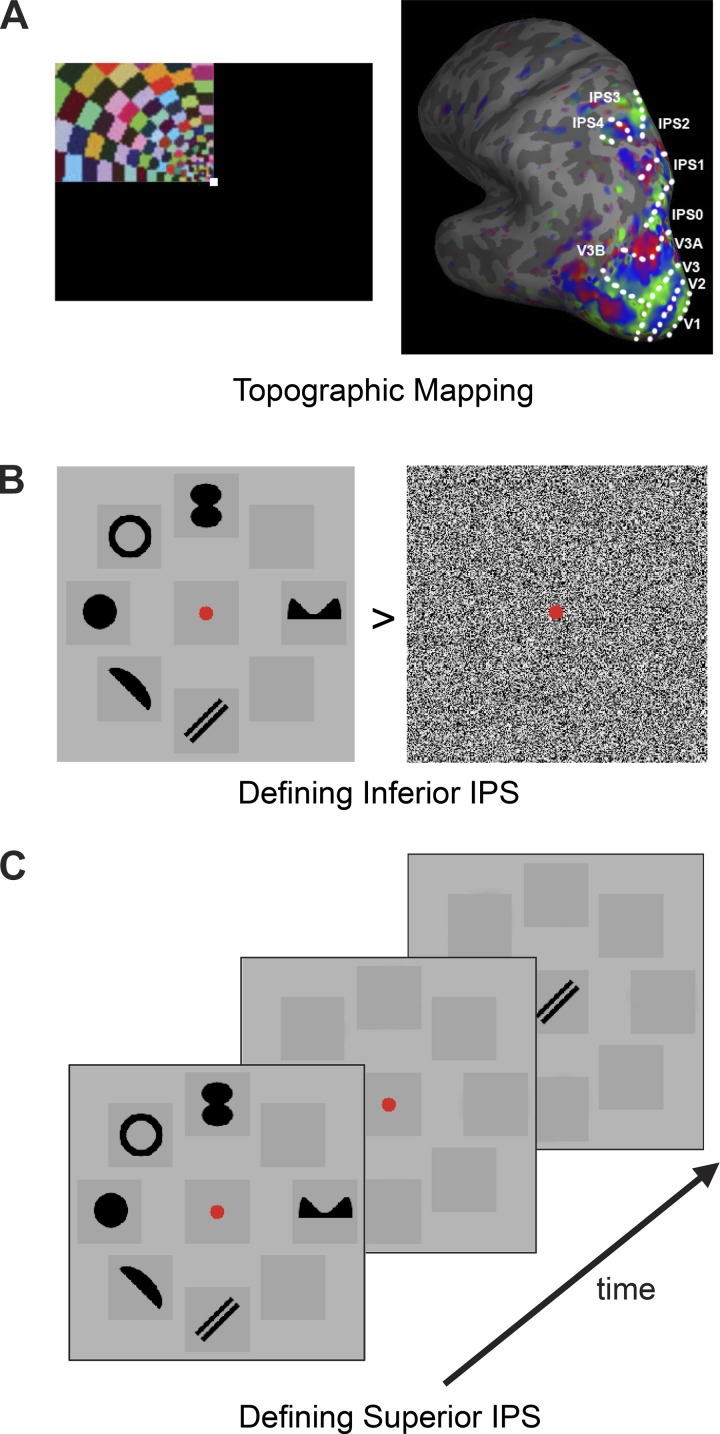
Defining topographic intraparietal sulcus (IPS) regions (A), inferior IPS (B), and superior IPS (C). To define topographic IPS regions, rotating polar angel wedge stimuli were used. The resulting representative IPS topographic regions obtained were shown. To define inferior IPS, observers viewed blocks of shape and noise stimuli and performed a jitter detection task on the stimuli. Inferior IPS was defined as a region in the inferior part of IPS showing strong responses to the shape than to the noise stimuli. To define superior IPS, observers viewed either 1, 2, 3, 4, or 6 black target shapes presented around fixation and, after a brief delay, judged whether the probe shown at fixation matched one of the target shapes. Superior IPS was defined as a region in the superior part of IPS that tracked observers' behavioral performance across the different set sizes.
Fig. 2.
Fig. 2.
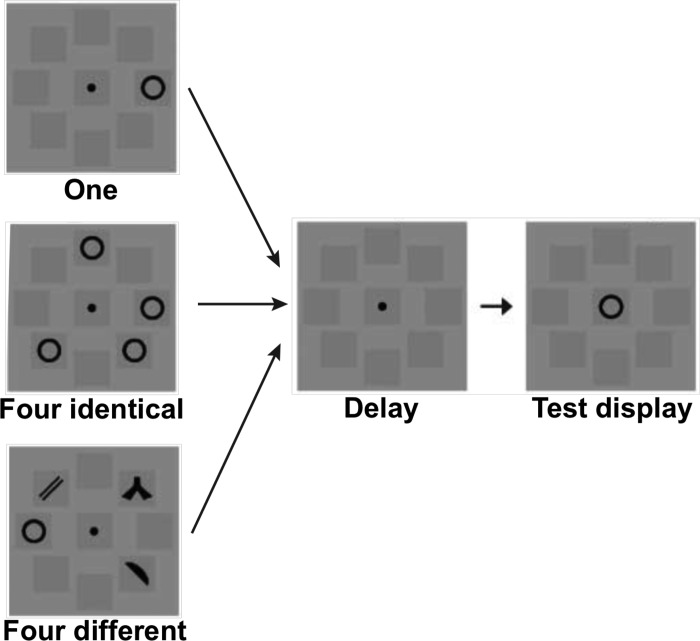
Stimuli and task used in the main visual short-term memory (VSTM) experimental paradigm. Observers viewed either 1, 4 identical, or 4 different black target shapes shown around the fixation and, after a brief delay, judged whether the probe shape shown at fixation matched one of the target shapes. The 1 and 4 identical conditions were matched in the amount of feature information shown but different in the number of spatial locations shown, whereas the 4 identical and 4 different conditions were matched in the number of spatial locations shown but different in the amount of feature information shown.
Fig. 3.
Fig. 3.
The amount of anatomical overlap between inferior/superior IPS regions and the IPS topographic regions, in the average of all participants (top) and in 3 representative participants (bottom). While inferior IPS had the greatest overlap with V3B, superior IPS had the greatest overlap with IPS0, IPS1, and IPS2. Error bars indicate means ± SE.
Fig. 4.
Fig. 4.
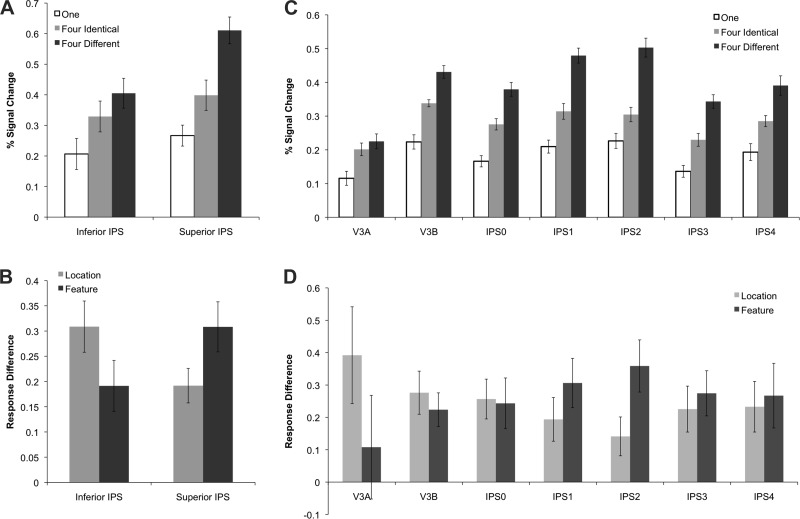
Activity for each condition in the main VSTM experiment in superior and inferior IPS (A), along with the normalized response difference (see materials and methods) showing location-based processing (4 identical objects minus 1 object) and featural-based processing (4 different objects minus 4 identical objects) (B). The same is also shown for the IPS topographic regions (C and D). The strength of location-based processing was stronger in inferior than superior IPS, and the reverse was true for feature-based processing. Similarly, along the IPS topographic regions, there seemed to be a shift in the balance of location vs feature-based processing from a location bias in the lower IPS regions V3A, V3B, and IPS0 to a feature bias in higher IPS regions IPS1 and IPS2. Error bars indicate means ± SE.
Fig. 5.
Fig. 5.
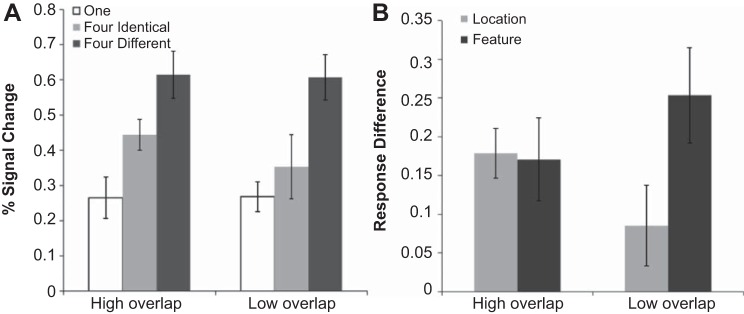
Superior IPS responses for the group of participants showing a higher degree of overlap with the IPS topographic regions and those showing a lower degree of overlap with the IPS topographic regions (A), along with the amount of location- and feature-based processing (see materials and methods) in both groups (B). Individuals with a lower degree of overlap showed little location-based processing, but a significant amount of feature-based processing, whereas those with a higher degree of overlap showed an equal amount of location- and feature-based processing. Error bars indicate means ± SE.

References

    1. Arcaro MJ, Pinsk MA, Li X, Kastner S. Visuotopic organization of macaque posterior parietal cortex: an fMRI study. J Neurosci 31: 2064–2078, 2011. - PMC - PubMed
    1. Bettencourt KC, Xu Y. Decoding under distraction reveals distinct occipital and parietal contributions to visual short-term memory representation. Nat Neurosci 19: 150–157, 2016. - PMC - PubMed
    1. Brainard DH. The psychophysics toolbox. Spat Vis 10: 433–436, 1997. - PubMed
    1. Bressler DW, Silver MA. Spatial attention improves reliability of fMRI retinotopic mapping signals in occipital and parietal cortex. Neuroimage 53: 526–533, 2010. - PMC - PubMed
    1. Corbetta M, Shulman GL. Control of goal-directed and stimulus-driven attention in the brain. Nat Rev Neurosci 3: 201–215, 2002. - PubMed

Publication types

LinkOut - more resources