


K+ channel mechanisms underlying cholinergic cutaneous vasodilation and sweating in young humans: roles of KCa, KATP, and KV channels?
- PMID: 27440718
- PMCID: PMC5142229
- DOI: 10.1152/ajpregu.00249.2016
K+ channel mechanisms underlying cholinergic cutaneous vasodilation and sweating in young humans: roles of KCa, KATP, and KV channels?
Abstract
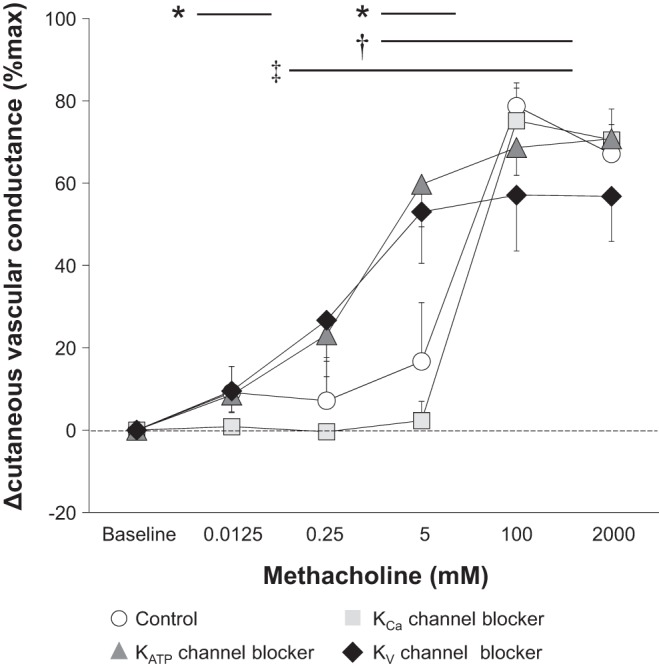
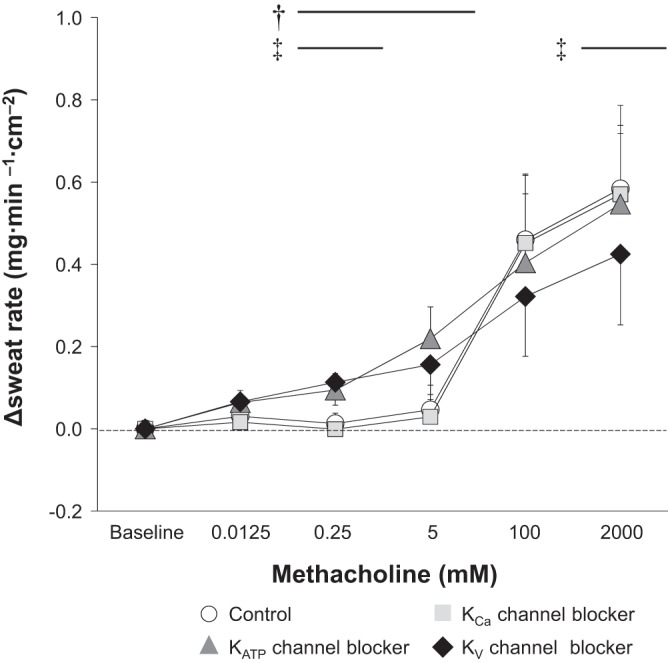
Acetylcholine released from cholinergic nerves is involved in heat loss responses of cutaneous vasodilation and sweating. K(+) channels are thought to play a role in regulating cholinergic cutaneous vasodilation and sweating, though which K(+) channels are involved in their regulation remains unclear. We evaluated the hypotheses that 1) Ca(2+)-activated K(+) (KCa), ATP-sensitive K(+) (KATP), and voltage-gated K(+) (KV) channels all contribute to cholinergic cutaneous vasodilation; and 2) KV channels, but not KCa and KATP channels, contribute to cholinergic sweating. In 13 young adults (24 ± 5 years), cutaneous vascular conductance (CVC) and sweat rate were evaluated at intradermal microdialysis sites that were continuously perfused with: 1) lactated Ringer (Control), 2) 50 mM tetraethylammonium (KCa channel blocker), 3) 5 mM glybenclamide (KATP channel blocker), and 4) 10 mM 4-aminopyridine (KV channel blocker). At all sites, cholinergic cutaneous vasodilation and sweating were induced by coadministration of methacholine (0.0125, 0.25, 5, 100, and 2,000 mM, each for 25 min). The methacholine-induced increase in CVC was lower with the KCa channel blocker relative to Control at 0.0125 (1 ± 1 vs. 9 ± 6%max) and 5 (2 ± 5 vs. 17 ± 14%max) mM methacholine, whereas it was lower in the presence of KATP (69 ± 7%max) and KV (57 ± 14%max) channel blocker compared with Control (79 ± 6%max) at 100 mM methacholine. Furthermore, methacholine-induced sweating was lower at the KV channel blocker site (0.42 ± 0.17 mg·min(-1)·cm(-2)) compared with Control (0.58 ± 0.15 mg·min(-1)·cm(-2)) at 2,000 mM methacholine. In conclusion, we show that KCa, KATP, and KV channels play a role in cholinergic cutaneous vasodilation, whereas only KV channels contribute to cholinergic sweating in normothermic resting humans.
Keywords: hyperpolarization; potassium channel; sweat secretion; thermoregulation.
Copyright © 2016 the American Physiological Society.
Figures



References
-
- Bae H, Lee HJ, Kim K, Kim JH, Kim T, Ko JH, Bang H, Lim I. The stimulating effects of nitric oxide on intermediate conductance Ca2+-activated K+ channels in human dermal fibroblasts through PKG pathways but not the PKA pathways. Chin J Physiol 57: 137–151, 2014. - PubMed
-
- Buono MJ, Gonzalez G, Guest S, Hare A, Numan T, Tabor B, White A. The role of in vivo beta-adrenergic stimulation on sweat production during exercise. Auton Neurosci 155: 91–93, 2010. - PubMed
Publication types
MeSH terms
Substances
LinkOut - more resources
Full Text Sources
Other Literature Sources
Miscellaneous
