


Increased Operative Time for Benign Cranial Nerve Tumor Resection Correlates with Increased Morbidity Postoperatively
- PMID: 27441161
- PMCID: PMC4949053
- DOI: 10.1055/s-0036-1572508
Increased Operative Time for Benign Cranial Nerve Tumor Resection Correlates with Increased Morbidity Postoperatively
Abstract
Objectives: Operative time, previously identified as a risk factor for postoperative morbidity, is examined in patients undergoing benign cranial nerve tumor resection.
Design/setting/participants: This retrospective cohort analysis included patients enrolled in the ACS-NSQIP registry from 2007 through 2013 with a diagnosis of a benign cranial nerve neoplasm.
Main outcome measures: Primary outcomes included postoperative morbidity and mortality. Readmission and reoperation served as secondary outcomes.
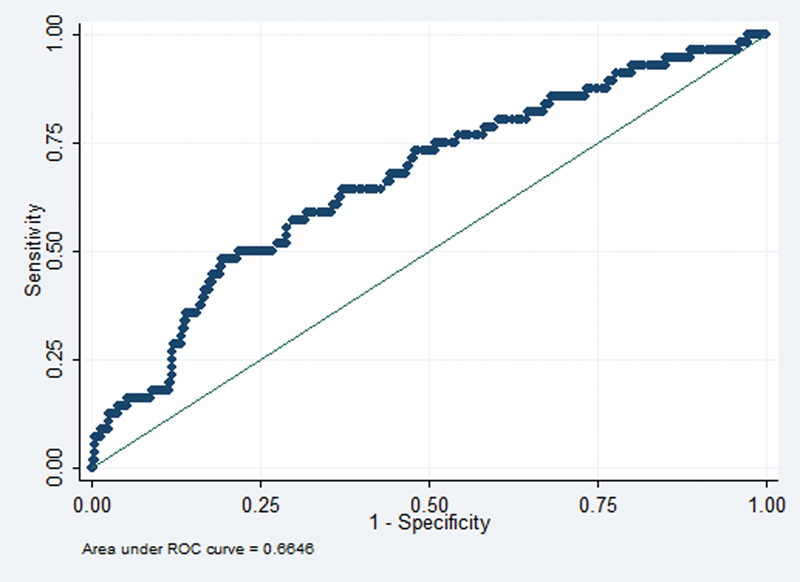
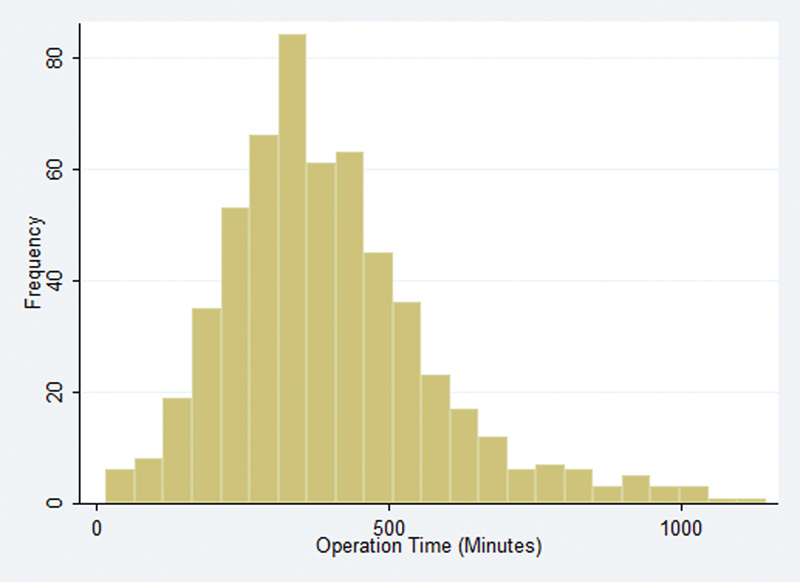
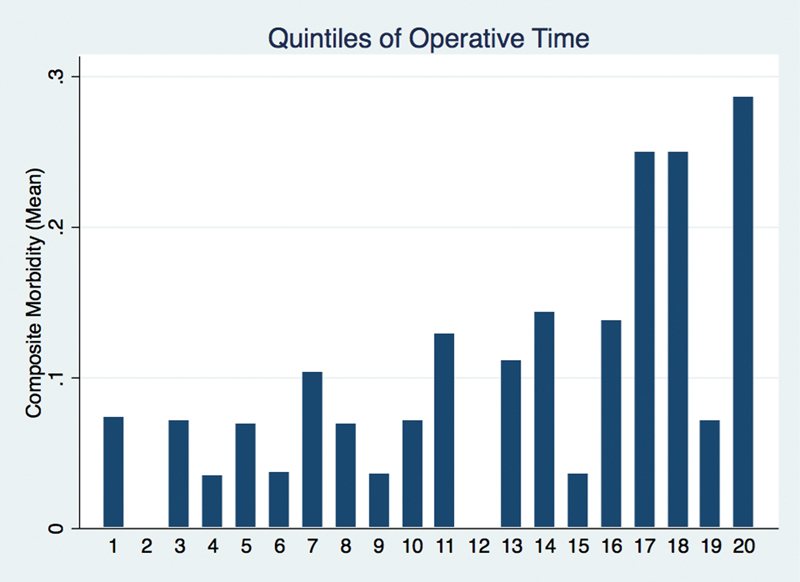
Results: A total of 565 patients were identified. Mean (median) operative time was 398 (370) minutes. The 30-day complication, readmission, and return to the operating room rates were 9.9%, 9.9%, and 7.3%, respectively, on unadjusted analyses. CSF leak requiring reoperation or readmission occurred at a rate of 3.1%. On multivariable regression analysis, operations greater than 413 minutes were associated with an increased odds of overall complication (OR 4.26, 95% CI 2.08-8.72), return to the operating room (OR 2.65, 95% CI 1.23-5.67), and increased length of stay(1.6 days, 95% CI 0.94-2.23 days). Each additional minute of operative time was associated with an increased odds of overall complication (OR 1.004, 95% CI 1.002-1.006) and increased length of stay (0.006 days, 95% CI 0.004-0.008).
Conclusion: Increased operative time in patients undergoing surgical resection of a benign cranial nerve neoplasm was associated with an increased rate of complications.
Keywords: acoustic neuroma; complications; national surgical quality improvement program; operative time; skull base; vestibular schwannoma.
Figures
References
-
- Daneman N, Simor A E, Redelmeier D A. Validation of a modified version of the national nosocomial infections surveillance system risk index for health services research. Infect Control Hosp Epidemiol. 2009;30(6):563–569. - PubMed
-
- Shen J, Liang J, Yu H, Qiu G, Xue X, Li Z. Risk factors for delayed infections after spinal fusion and instrumentation in patients with scoliosis. Clinical article. J Neurosurg Spine. 2014;21(4):648–652. - PubMed
-
- Kalish J A, Farber A, Homa K. et al. Factors associated with surgical site infection after lower extremity bypass in the Society for Vascular Surgery (SVS) Vascular Quality Initiative (VQI) J Vasc Surg. 2014;60(5):1238–1246. - PubMed
-
- Daines B K, Dennis D A, Amann S. Infection prevention in total knee arthroplasty. J Am Acad Orthop Surg. 2015;23(6):356–364. - PubMed
-
- Carlson M L, Link M J, Wanna G B, Driscoll C LW. Management of sporadic vestibular schwannoma. Otolaryngol Clin North Am. 2015;48(3):407–422. - PubMed
LinkOut - more resources
Full Text Sources
Other Literature Sources
