


Development and validation of a MRgHIFU non-invasive tissue acoustic property estimation technique
- PMID: 27441427
- PMCID: PMC5054420
- DOI: 10.1080/02656736.2016.1216184
Development and validation of a MRgHIFU non-invasive tissue acoustic property estimation technique
Abstract
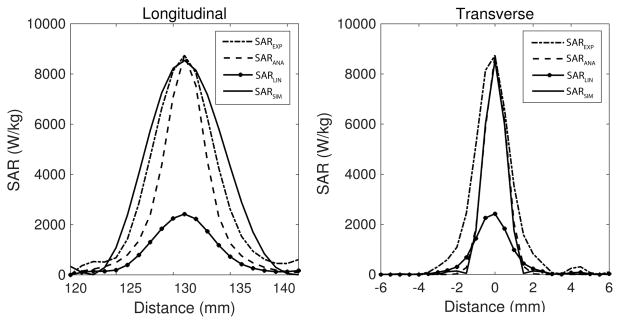
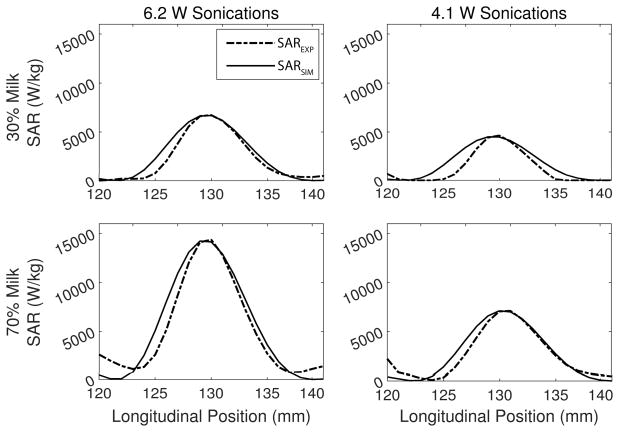
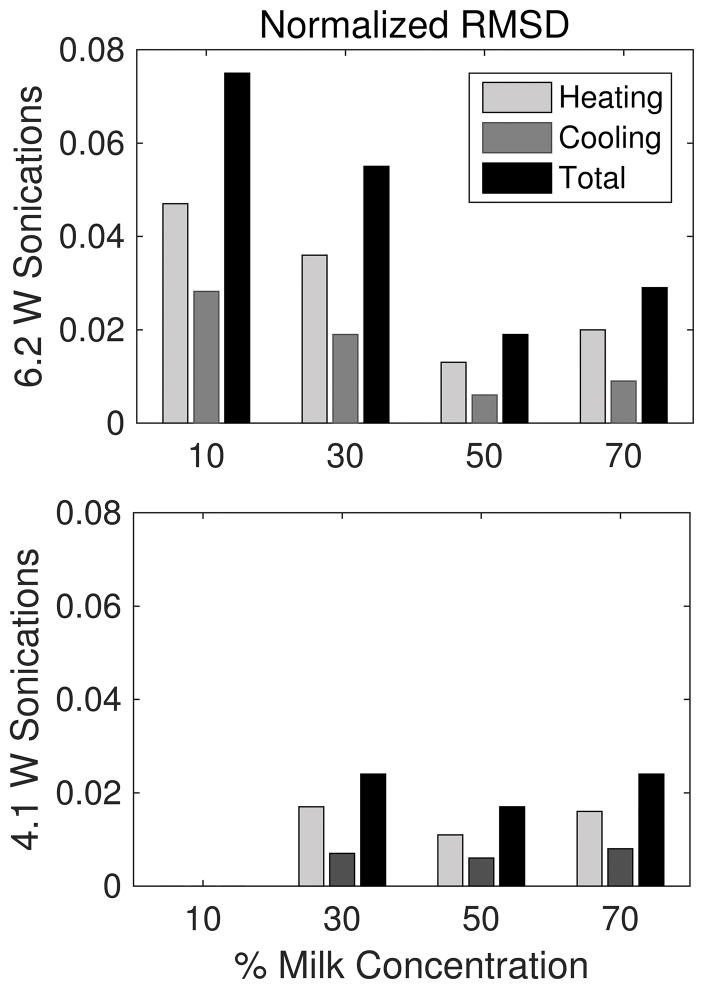
MR-guided high-intensity focussed ultrasound (MRgHIFU) non-invasive ablative surgeries have advanced into clinical trials for treating many pathologies and cancers. A remaining challenge of these surgeries is accurately planning and monitoring tissue heating in the face of patient-specific and dynamic acoustic properties of tissues. Currently, non-invasive measurements of acoustic properties have not been implemented in MRgHIFU treatment planning and monitoring procedures. This methods-driven study presents a technique using MR temperature imaging (MRTI) during low-temperature HIFU sonications to non-invasively estimate sample-specific acoustic absorption and speed of sound values in tissue-mimicking phantoms. Using measured thermal properties, specific absorption rate (SAR) patterns are calculated from the MRTI data and compared to simulated SAR patterns iteratively generated via the Hybrid Angular Spectrum (HAS) method. Once the error between the simulated and measured patterns is minimised, the estimated acoustic property values are compared to the true phantom values obtained via an independent technique. The estimated values are then used to simulate temperature profiles in the phantoms, and compared to experimental temperature profiles. This study demonstrates that trends in acoustic absorption and speed of sound can be non-invasively estimated with average errors of 21% and 1%, respectively. Additionally, temperature predictions using the estimated properties on average match within 1.2 °C of the experimental peak temperature rises in the phantoms. The positive results achieved in tissue-mimicking phantoms presented in this study indicate that this technique may be extended to in vivo applications, improving HIFU sonication temperature rise predictions and treatment assessment.
Keywords: High intensity focused ultrasound; acoustic properties; non-invasive; thermal ablation; treatment planning.
Conflict of interest statement
Declarations of Interest The authors report no conflicts of interest.
Figures




References
-
- Napoli A, Anzidei M, Ciolina F, Marotta E, Cavallo Marincola B, Brachetti G, et al. MR-Guided High-Intensity Focused Ultrasound: Current Status of an Emerging Technology. Cardiovasc Intervent Radiol [Internet] 2013 Oct;36(5):1190–203. Available from: http://link.springer.com/10.1007/s00270-013-0592-4. - DOI - PubMed
-
- Sinden D, Haar G. Dosimetry implications for correct ultrasound dose deposition: uncertainties in descriptors, planning and treatment delivery. Transl Cancer Res. 2014;3(5):459–71.
-
- Sapareto SA, Dewey WC. Thermal Dose Determination in Cancer Therapy. Int J Radiat Oncol Biol Phys. 1984;10(6):787–800. - PubMed
-
- Huang CW, Sun MK, Chen BT, Shieh J, Chen CS, Chen WS. Ultrason Sonochem [Internet] Vol. 27. Elsevier B.V; 2015. Simulation of thermal ablation by high-intensity focused ultrasound with temperature-dependent properties; pp. 456–65. Available from: http://linkinghub.elsevier.com/retrieve/pii/S1350417715001753. - PubMed
-
- El-Brawany Ma, Nassiri DK, Terhaar G, Shaw A, Rivens I, Lozhken K. Measurement of thermal and ultrasonic properties of some biological tissues. J Med Eng Technol. 2009;33(3):249–56. - PubMed
Publication types
MeSH terms
Grants and funding
LinkOut - more resources
Full Text Sources
Other Literature Sources
Medical
Miscellaneous
