Review
. 2016 Jul-Aug;22(4):257-66.
doi: 10.1097/PPO.0000000000000210.

Stereotactic Ablative Radiation Therapy Combined With Immunotherapy for Solid Tumors

Affiliations
Review

Stereotactic Ablative Radiation Therapy Combined With Immunotherapy for Solid Tumors

Eric D Brooks et al. Cancer J. 2016 Jul-Aug.

Abstract

Immunotherapy, particularly immune-checkpoint inhibition, is producing encouraging clinical responses and affecting the way numerous cancers are treated. Yet immune-checkpoint therapy is not effective for many patients, and even those who initially respond can experience relapse, fueling interest in finding new processes or tools to improve the effectiveness of these novel therapeutics. One such tool is radiation. Both preclinical and clinical studies have demonstrated that the systemic effects of immunotherapy can be amplified when it is used in combination with radiation and, conversely, that the immunogenic effects of local irradiation can be amplified and extended to distant sites when used with immunotherapy. We review how stereotactic ablative radiation therapy, a technique specifically indicated for tumors treated with immune-checkpoint inhibitors, can potentiate the effects of immune-checkpoint therapy. We further explore how these novel therapeutics may transform radiation, previously considered a local treatment option, into powerful systemic therapy.


Conflict of interest statement

The authors have disclosed that they have no significant relationships with, or financial interest in, any commercial companies pertaining to this article.

Figures
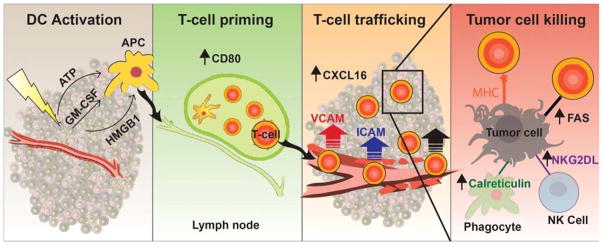
FIGURE 1
FIGURE 1
Radiation triggers the release of various factors from the tumor and surrounding tissue, including adenosine triphosphate, granulocyte-macrophage colony-stimulating factor, and high mobility group box 1 protein. These factors constitute immunogenic cell death, which allow the APCs to become activated and then migrate to the lymph node. Once at the lymph node, APCs have increased expression of CD80, resulting in T-cell activation. These T cells are then able to traffic back to the tumor through increased expression of CXCL16 by the tumor and ICAM and VCAM expression by the endothelial cells. Increased expression of MHC I, calreticulin, Fas, and NKG2D ligands on tumor cells allows immune cells to kill tumor cells. APCs indicate antigen-presenting cells. ATP, adenosine triphosphate; GM-CSF, granulocyte-macrophage colony-stimulating factor; HMGB1, high mobility group box 1 protein; APC, antigen-presenting cell; ICAM, intercellular adhesion molecule; VCAM, vascular cell adhesion molecule; MHC I, major histocompatibility complex type I.
FIGURE 2
FIGURE 2
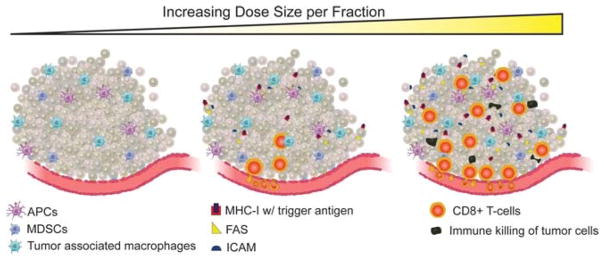
There appears to be a dose-dependent increase in tumor immunogenicity and radiation dose size per fraction. Higher dose size per fraction results in greater infiltration of tumors by CD8+ T cells as well as higher levels of ICAM, Fas, and MHC-I with loaded tumor antigen expressed on the tumor cells surface. These higher levels of expression, as a function of higher radiation dose size, correlate with improved antitumor immune-directed killing. APC, antigen-presenting cell; ICAM, intercellular adhesion molecule; MHC I, major histocompatibility complex type I; MDSC, myeloid-derived suppressor cell.
FIGURE 3
FIGURE 3
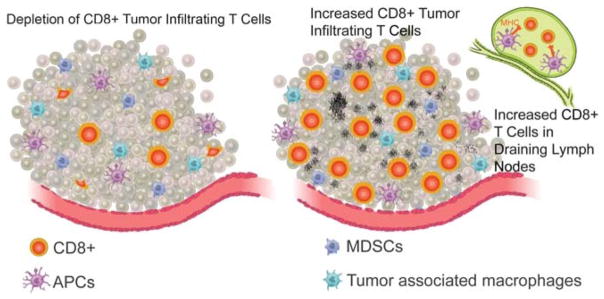
Stereotactic body radiotherapy–like regimens appear to be more immunogenic than lower-dose, or conventional, fractionated regimens in preclinical studies. Stereotactic body radiotherapy–like regimens (right) result in greater infiltration of CD8+ T cells in tumor and draining lymph nodes, as well as antigen-presenting cells in draining lymph nodes. This immune infiltration correlates with greater immune-directed tumor destruction, control, and survival. Lower-dose, or conventional, fractionated regimens (left) result in relatively less robust immune infiltration and, when radiation is prolonged for multiple weeks on end, may have immune-depleting effects, particularly on anti–tumor-infiltrating CD8+ T cells, as well as increased recruitment of myeloid derived suppressor cells. APC, antigen-presenting cell; MDSC, myeloid-derived suppressor cell.

References

    1. Leach DR, Krummel MF, Allison JP. Enhancement of antitumor immunity by CTLA-4 blockade. Science. 1996;271:1734–1736. - PubMed
    1. Krummel MF, Allison JP. CD28 and CTLA-4 have opposing effects on the response of T cells to stimulation. J Exp Med. 1995;182:459–465. - PMC - PubMed
    1. Hodi FS, O'Day SJ, McDermott DF, et al. Improved survival with ipilimumab in patients with metastatic melanoma. N Engl J Med. 2010;363:711–723. - PMC - PubMed
    1. Schadendorf D, Hodi FS, Robert C, et al. Pooled analysis of long-term survival data from phase II and phase III trials of ipilimumab in unresectable or metastatic melanoma. J Clin Oncol. 2015;33:1889–1894. - PMC - PubMed
    1. Prieto PA, Yang JC, Sherry RM, et al. CTLA-4 blockade with ipilimumab: long-term follow-up of 177 patients with metastatic melanoma. Clin Cancer Res. 2012;18:2039–2047. - PMC - PubMed

Publication types