


Effect of Oral Re-esterified Omega-3 Nutritional Supplementation on Dry Eyes
- PMID: 27442314
- PMCID: PMC4975557
- DOI: 10.1097/ICO.0000000000000940
Effect of Oral Re-esterified Omega-3 Nutritional Supplementation on Dry Eyes
Abstract
Purpose: To assess the effect of oral re-esterified omega-3 fatty acids on tear osmolarity, matrix metalloproteinase-9 (MMP-9), tear break-up time (TBUT), Ocular Surface Disease Index (OSDI), fluorescein corneal staining, Schirmer score, meibomian gland dysfunction (MGD) stage and omega-3 index in subjects with dry eyes and confirmed MGD.
Methods: This was a multicenter, prospective, interventional, placebo-controlled, double-masked study. Subjects were randomized to receive 4 softgels containing a total of 1680 mg of eicosapentaenoic acid/560 mg of docosahexaenoic acid or a control of 3136 mg of linoleic acid, daily for 12 weeks. Subjects were measured at baseline, week 6, and week 12 for tear osmolarity, TBUT, OSDI, fluorescein corneal staining, and Schirmer test with anesthesia. MMP-9 testing and omega-3 index were done at baseline and at 12 weeks.
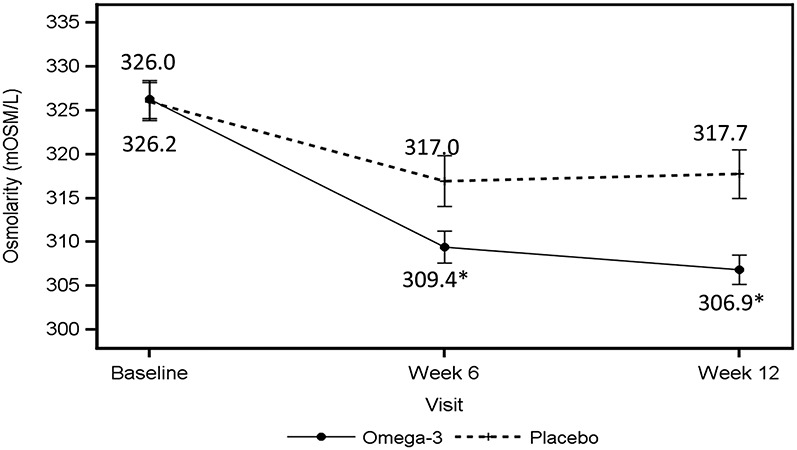
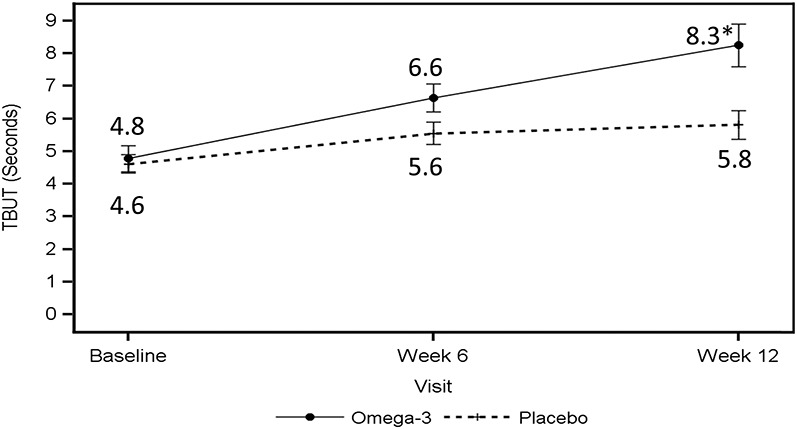
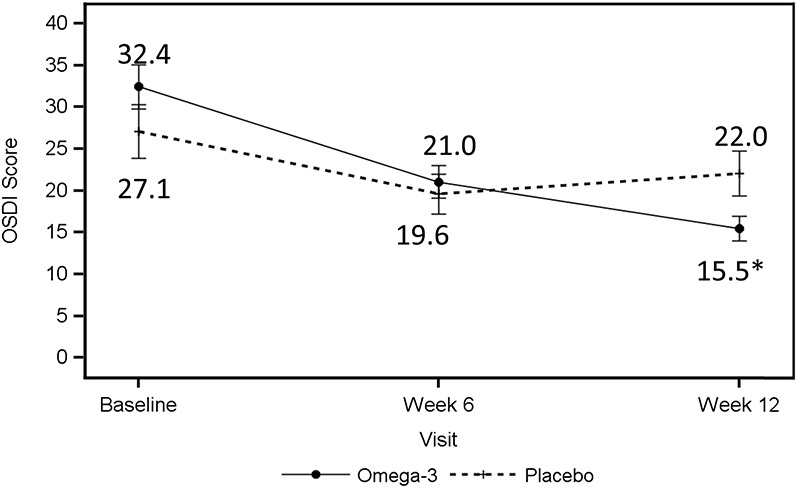
Results: One hundred five subjects completed the study. They were randomized to omega-3 (n = 54) and control group (n = 51). Statistically significant reduction in tear osmolarity was observed in the omega-3 group versus control group at week 6 (-16.8 ± 2.6 vs. -9.0 ± 2.7 mOsm/L, P = 0.042) and week 12 (-19.4 ± 2.7 vs. -8.3 ± 2.8 mOsm/L, P = 0.004). At 12 weeks, a statistically significant increase in omega-3 index levels (P < 0.001) and TBUT (3.5 ± 0.5 s vs. 1.2 ± 0.5 s, P = 0.002) was also observed. Omega-3 group experienced a significant reduction in MMP-9 positivity versus control group (67.9% vs. 35.0%, P = 0.024) and OSDI scores decreased significantly in omega-3 (-17.0 ± 2.6) versus control group (-5.0 ± 2.7, P = 0.002).
Conclusions: Oral consumption of re-esterified omega-3 fatty acids is associated with statistically significant improvement in tear osmolarity, omega-3 index levels, TBUT, MMP-9, and OSDI symptom scores.
Conflict of interest statement
A. T. Epitropoulos, E. D. Donnenfeld, Z. A. Shah, E. J. Holland, M. Gross, W. J. Faulkner, C. Matossian, S. S. Lane, M. Toyos, and F. A. Bucci Jr received compensation from PRN Physician Recommended Nutraceuticals for participating in the study. The remaining author has no funding or conflicts of interest to disclose.
Figures
References
-
- Clegg JP, Guest JF, Lehman A, et al. The annual cost of dry eye syndrome in France, Germany, Italy, Spain, Sweden and the United Kingdom among patients managed by ophthalmologists. Ophthalmic Epidemiol. 2006;13:263–274. - PubMed
-
- The definition and classification of dry eye disease: report of the International Dry Eye Workshop. Ocul Surf. 2007;5:65–204. - PubMed
-
- Dao AH, Spindle JD, Harp BA, et al. Association of dyslipidemia in moderate to severe meibomian gland dysfunction. Am J Ophthalmol. 2010;150:371–375. - PubMed
-
- Pinna A, Biasetti F, Zinellu A, et al. Meibomian gland dysfunction and hypercholesterolemia. Ophthalmology. 2013;120:2385–2389. - PubMed
Publication types
MeSH terms
Substances
LinkOut - more resources
Full Text Sources
Other Literature Sources
Medical
Miscellaneous
