


Preliminary investigation of the relationships between sleep duration, reward circuitry function, and mood dysregulation in youth offspring of parents with bipolar disorder
- PMID: 27442458
- PMCID: PMC5129838
- DOI: 10.1016/j.jad.2016.03.074
Preliminary investigation of the relationships between sleep duration, reward circuitry function, and mood dysregulation in youth offspring of parents with bipolar disorder
Abstract
Background: Altered reward circuitry function is observed in individuals with bipolar disorder (BD) and their unaffected offspring (OBP). While OBP are at elevated risk for BD, modifiable risk factors that may exacerbate neural vulnerabilities in OBP remain under-characterized. As sleep loss is strongly linked to mania in BD, this study tested associations between sleep duration, reward circuitry function, and mood dysregulation in OBP.
Methods: Two groups of youth unaffected with BD (9-17yr) completed a number-guessing fMRI reward paradigm: 25 OBP and 21 age-sex-IQ-matched offspring of control parents with non-BD psychopathology (OCP), to differentiate risk for BD from risk for psychopathology more broadly. Regressions tested effects of group status, self-reported past-week sleep duration, and their interaction on neural activity and bilateral ventral striatum (VS) functional connectivity to win>control. Correlations with parent-reported mood dysregulation were assessed.
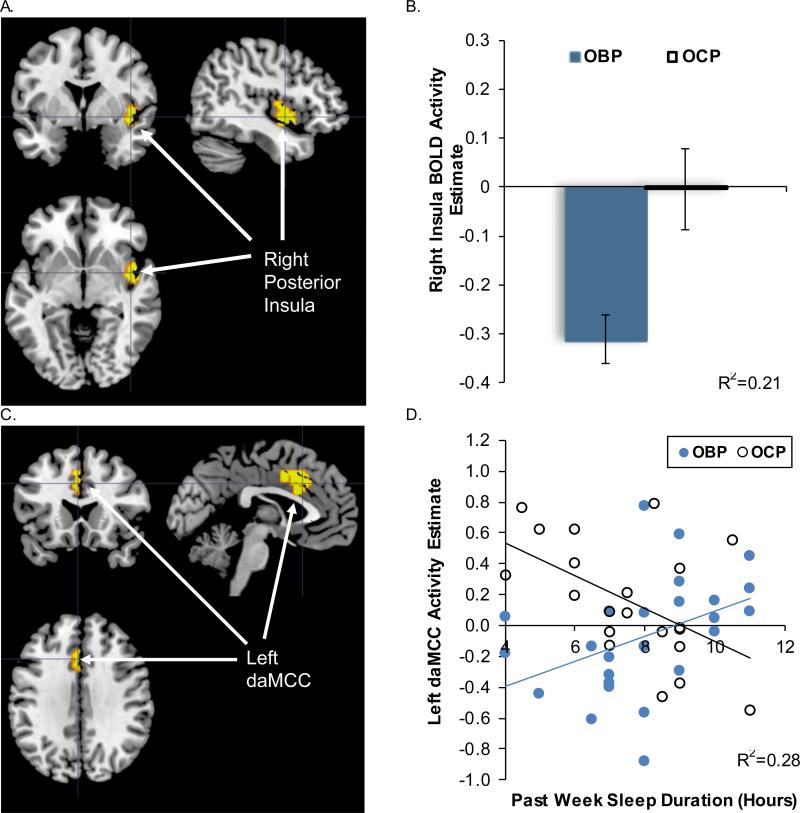
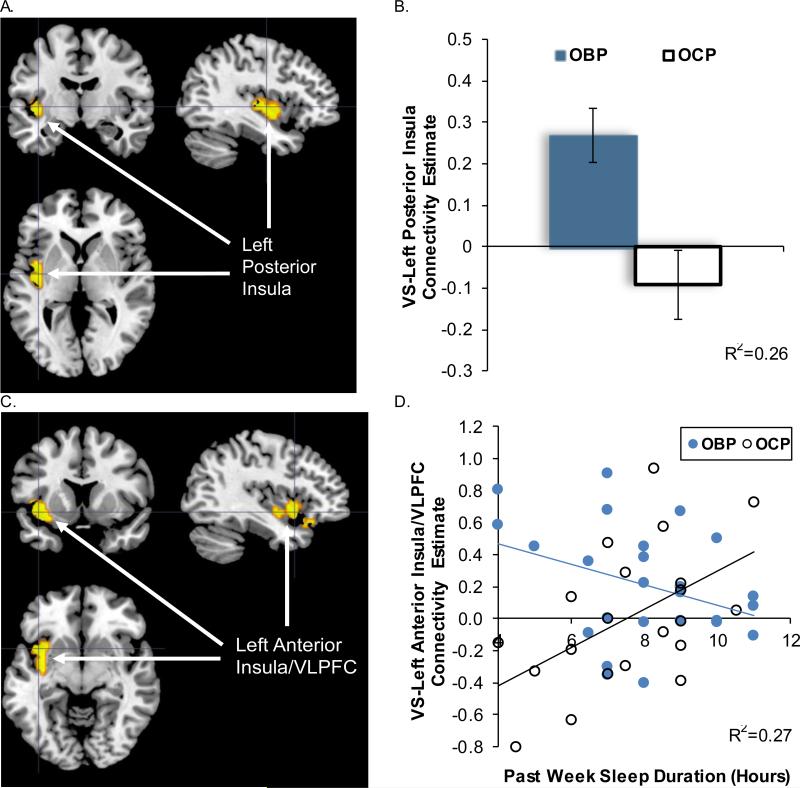
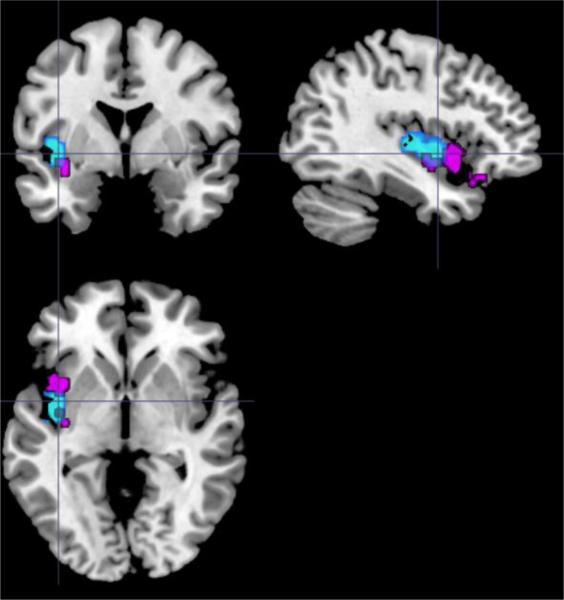
Results: Group effects were observed for right posterior insula activity (OCP>OBP) and VS-left posterior insula connectivity (OBP>OCP). Group⁎sleep duration interactions were observed for left dorsal anterior-mid-cingulate (daMCC) activity and VS-left anterior insula/ventrolateral prefrontal cortex (VLPFC) connectivity. Specifically, sleep duration and daMCC activity were positively related in OBP, but negatively related in OCP and sleep duration and VS-left anterior insula/VLPFC connectivity were negatively related in OBP, but positively in OCP. Additionally, increased VS-left posterior insula connectivity and VS-left anterior insula/VLPFC connectivity were associated with greater mood dysregulation in OBP only.
Limitations: Cross-sectional design and small sample size.
Conclusions: Altered reward-related VS-insula connectivity could represent a neural pathway underpinning mood dysregulation in OBP, and may be modulated by shortened sleep duration.
Keywords: Bipolar disorder risk; Functional MRI; Reward processing; Sleep.
Copyright © 2016 Elsevier B.V. All rights reserved.
Figures
References
-
- American Psychiatric Association . Diagnostic and statistical manual of mental disorders (4th edition, text revision) American Psychiatric Association; Washington, D.C.: 2001.
-
- Barbini B, Colombo C, Benedetti F, Campori E, Bellodi L, Smeraldi E. The unipolar-bipolar dichotomy and the response to sleep deprivation. Psychiatry Research. 1998;79:43–50. - PubMed
-
- Barnes JC, Meldrum RC. The impact of sleep duration on adolescent development: a genetically informed analysis of identical twin pairs. J Youth Adolesc. 2015;44:489–506. - PubMed
-
- Bauer M, Grof P, Rasgon N, Bschor T, Glenn T, Whybrow PC. Temporal relation between sleep and mood in patients with bipolar disorder. Bipolar Disorders. 2006;8:160–167. - PubMed
-
- Bebko G, Bertocci MA, Fournier JC, Hinze AK, Bonar L, Almeida JR, Perlman SB, Versace A, Schirda C, Travis M, Gill MK, Demeter C, Diwadkar VA, Ciuffetelli G, Rodriguez E, Olino T, Forbes E, Sunshine JL, Holland SK, Kowatch RA, Birmaher B, Axelson D, Horwitz SM, Arnold LE, Fristad MA, Youngstrom EA, Findling RL, Phillips ML. Parsing dimensional vs diagnostic category-related patterns of reward circuitry function in behaviorally and emotionally dysregulated youth in the Longitudinal Assessment of Manic Symptoms study. JAMA Psychiatry. 2014;71:71–80. - PMC - PubMed
MeSH terms
Grants and funding
LinkOut - more resources
Full Text Sources
Other Literature Sources
Medical
Research Materials
Miscellaneous
