


Royal Decree: Gene Expression in Trans-Generationally Immune Primed Bumblebee Workers Mimics a Primary Immune Response
- PMID: 27442590
- PMCID: PMC4956190
- DOI: 10.1371/journal.pone.0159635
Royal Decree: Gene Expression in Trans-Generationally Immune Primed Bumblebee Workers Mimics a Primary Immune Response
Abstract
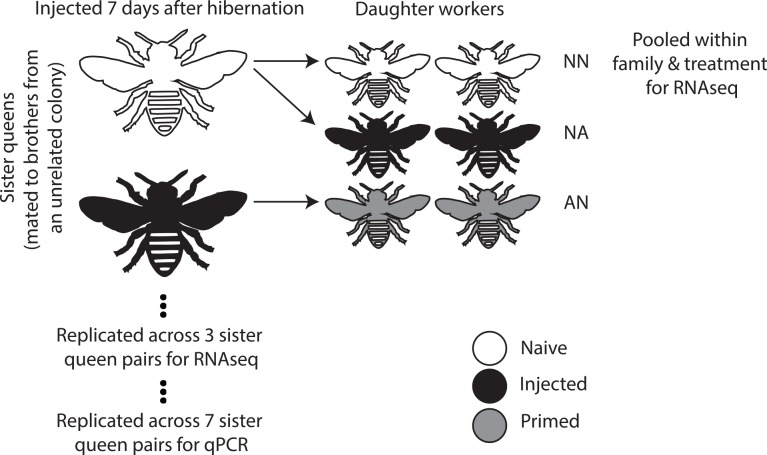
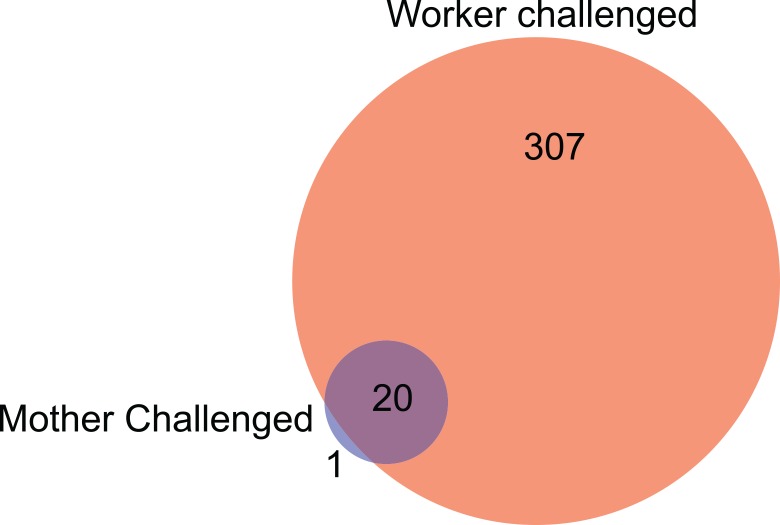
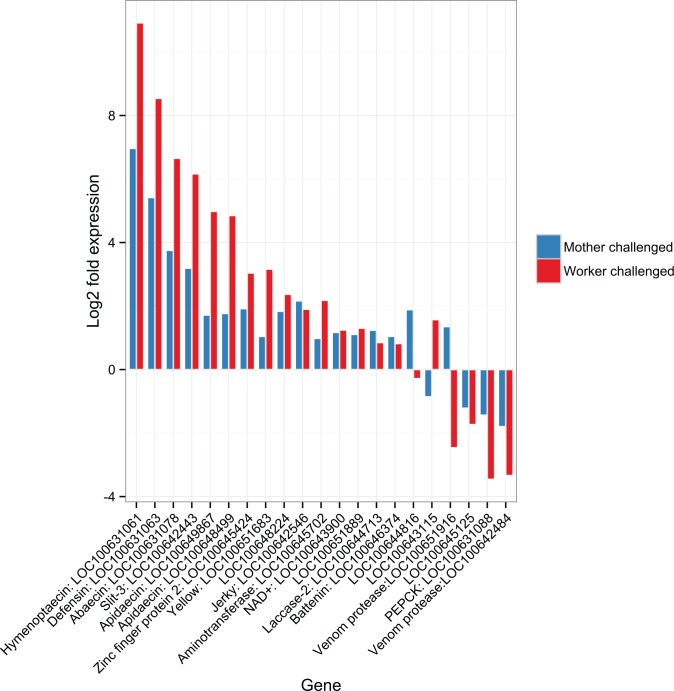
Invertebrates lack the cellular and physiological machinery of the adaptive immune system, but show specificity in their immune response and immune priming. Functionally, immune priming is comparable to immune memory in vertebrates. Individuals that have survived exposure to a given parasite are better protected against subsequent exposures. Protection may be cross-reactive, but demonstrations of persistent and specific protection in invertebrates are increasing. This immune priming can cross generations ("trans-generational" immune priming), preparing offspring for the prevailing parasite environment. While these phenomena gain increasing support, the mechanistic foundations underlying such immune priming, both within and across generations, remain largely unknown. Using a transcriptomic approach, we show that exposing bumblebee queens with an injection of heat-killed bacteria, known to induce trans-generational immune priming, alters daughter (worker) gene expression. Daughters, even when unexposed themselves, constitutively express a core set of the genes induced upon direct bacterial exposure, including high expression of antimicrobial peptides, a beta-glucan receptor protein implicated in bacterial recognition and the induction of the toll signaling pathway, and slit-3 which is important in honeybee immunity. Maternal exposure results in a distinct upregulation of their daughters' immune system, with a signature overlapping with the induced individual response to a direct exposure. This will mediate mother-offspring protection, but also associated costs related to reconfiguration of constitutive immune expression. Moreover, identification of conserved immune pathways in memory-like responses has important implications for our understanding of the innate immune system, including the innate components in vertebrates, which share many of these pathways.
Conflict of interest statement
Figures
References
-
- Hamilton WD. Sex versus non-sex versus parasite. Oikos. 1980;35:282–90.
-
- Wilson K. Evolutionary ecology of insect host-parasite interactions: an ecological immunology perspective In: Fellowes MDE, Holloway GJ, Rolff J, editors. Insect evolutionary ecology: Proceedings of the Royal Entomological Society's 22nd Symposium, Reading, UK, 2003 Wallingford: CABI Publications; 2005. p. 289–341.
-
- Schmid-Hempel P. Evolutionary Parasitology: The Integrated Study of Infections, Immunology, Ecology, and Genetics. Oxford: Oxford University Press; 2011.
MeSH terms
LinkOut - more resources
Full Text Sources
Other Literature Sources
Molecular Biology Databases
