


RNA-based mechanisms of virulence control in Enterobacteriaceae
- PMID: 27442607
- PMCID: PMC5449090
- DOI: 10.1080/15476286.2016.1201617
RNA-based mechanisms of virulence control in Enterobacteriaceae
Abstract
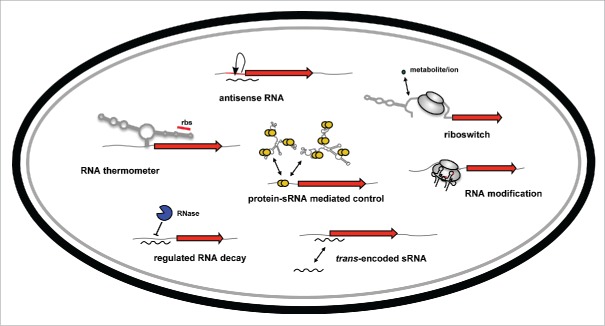
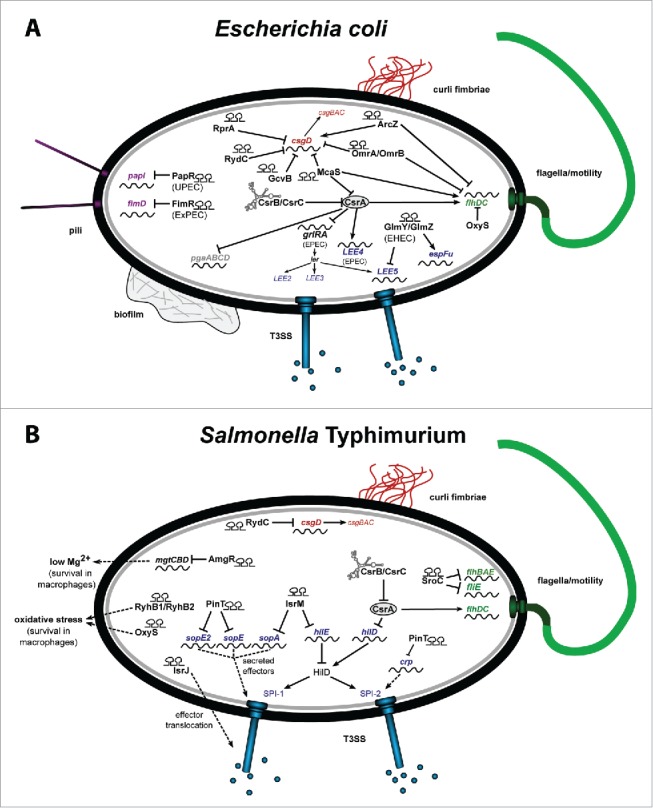
Enteric pathogens of the family Enterobacteriaceae colonize various niches within animals and humans in which they compete with intestinal commensals and are attacked by the host immune system. To survive these hostile environments they possess complex, multilayer regulatory networks that coordinate the control of virulence factors, host-adapted metabolic functions and stress resistance. An important part of these intricate control networks are RNA-based control systems that enable the pathogen to fine-tune its responses. Recent next-generation sequencing approaches revealed a large repertoire of conserved and species-specific riboregulators, including numerous cis- and trans-acting non-coding RNAs, sensory RNA elements (RNA thermometers, riboswitches), regulatory RNA-binding proteins and RNA degrading enzymes which regulate colonization factors, toxins, host defense processes and virulence-relevant physiological and metabolic processes. All of which are important cues for pathogens to sense and respond to fluctuating conditions during the infection. This review covers infection-relevant riboregulators of E. coli, Salmonella, Shigella and Yersinia, highlights their versatile regulatory mechanisms, complex target regulons and functions, and discusses emerging topics and future challenges to fully understand and exploit RNA-based control to combat bacterial infections.
Keywords: CsrA; RNA thermometers; gene regulation; regulated RNA degradation; regulatory RNAs; riboswitches; virulence.
Figures
References
-
- Waters LS, Storz G. Regulatory RNAs in bacteria. Cell 2009; 136:615-28; PMID:19239884; http://dx.doi.org/ 10.1016/j.cell.2009.01.043 - DOI - PMC - PubMed
-
- Gottesman S, Storz G. Bacterial small RNA regulators: versatile roles and rapidly evolving variations. Cold Spring Harb Perspect Biol 2011; 3:pii: a003798; PMID:20980440; http://dx.doi.org/ 10.1101/cshperspect.a003798 - DOI - PMC - PubMed
-
- Caldelari I, Chao Y, Romby P, Vogel J. RNA-mediated regulation in pathogenic bacteria. Cold Spring Harb Perspect Med 2013; 3:a010298; PMID:24003243; http://dx.doi.org/ 10.1101/cshperspect.a010298 - DOI - PMC - PubMed
-
- Papenfort K, Vogel J. Small RNA functions in carbon metabolism and virulence of enteric pathogens. Front Cell Infect Microbiol 2014; 4:91; PMID:25077072; http://dx.doi.org/ 10.3389/fcimb.2014.00091 - DOI - PMC - PubMed
-
- Koo JT, Alleyne TM, Schiano CA, Jafari N, Lathem WW. Global discovery of small RNAs in Yersinia pseudotuberculosis identifies Yersinia-specific small, noncoding RNAs required for virulence. Proc Natl Acad Sci U S A 2011; 108:E709-17; PMID:21876162; http://dx.doi.org/ 10.1073/pnas.1101655108 - DOI - PMC - PubMed
Publication types
MeSH terms
Substances
LinkOut - more resources
Full Text Sources
Other Literature Sources
