


Fatigue in people with localized colorectal cancer who do and do not receive chemotherapy: a longitudinal prospective study
- PMID: 27443634
- PMCID: PMC4999562
- DOI: 10.1093/annonc/mdw252
Fatigue in people with localized colorectal cancer who do and do not receive chemotherapy: a longitudinal prospective study
Abstract
Background: Fatigue is associated with cancer and chemotherapy and may be sustained. Here, we describe a prospective longitudinal study evaluating fatigue and putative mechanisms in people with colorectal cancer (CRC).
Patients and methods: People with localized CRC completed the Functional Assessment of Cancer Treatment-Fatigue (FACT-F) questionnaire at baseline (before chemotherapy, if given), 6, 12, and 24 months. Healthy controls (HCs) were assessed at the first three time points. Fatigue was defined by standardized FACT-F scores ≤68/100. Quality-of-life (QoL, assessed by the FACT-G questionnaire), affective, and cognitive symptoms were evaluated. Associations were sought between fatigue, baseline factors, and blood tests (including hemoglobin, cytokines, and sex hormones). Regression analyses, Fisher's exact tests, and Wilcoxon rank-sum tests assessed levels of fatigue at each time point and change in fatigue from baseline. A repeated-measures analysis investigated prognostic factors of fatigue across all time points.
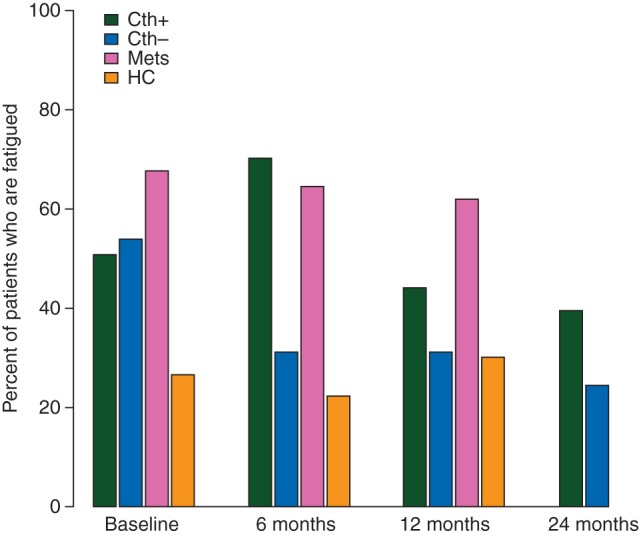
Results: A total of 289 subjects with localized CRC (173 received chemotherapy) and 72 HCs were assessed. More CRC patients had fatigue than HCs at baseline (52% versus 26%, P < 0.001). Fatigue was increased in the chemotherapy (CTh) group at 6 months [CTh+ 70% versus CTh- 31% (P < 0.001), HCs 22%] and remained more common at 12 [CTh+ 44% versus CTh- 31% (P = 0.079)] and 24 months [CTh+ 39% versus CTh- 24% (P = 0.047)]. There was no significant difference between those not receiving chemotherapy and HCs at follow-up assessments. Fatigue was associated with poor QoL, affective and cognitive symptoms, but not consistently with cytokine levels. Predictors for sustained fatigue were baseline fatigue, treatment group, cognitive and affective symptoms, poorer QoL, and comorbidities.
Conclusions: CRC patients have more fatigue than HCs at baseline. Fatigue peaks immediately after adjuvant chemotherapy, but remains common for 2 years in those who receive chemotherapy. Cognitive and affective symptoms, QoL, comorbidities, chemotherapy, and baseline fatigue predict for longer term fatigue.
Trial registration: ClinicalTrials.gov NCT00188331.
Keywords: cancer-related fatigue; chemotherapy; colorectal cancer; quality of life.
© The Author 2016. Published by Oxford University Press on behalf of the European Society for Medical Oncology. All rights reserved. For permissions, please email: journals.permissions@oup.com.
Figures
References
-
- NCCN. NCCN Clinical Practice Guidelines in Oncology: Cancer-Related Fatigue. Fort Washington, PA: NCCN; 2011.
-
- Hofman M, Ryan JL, Figueroa-Moseley CD et al. . Cancer-related fatigue: the scale of the problem. Oncologist 2007; 12(Suppl 1): 4–10. - PubMed
-
- Servaes P, Gielissen MF, Verhagen S, Bleijenberg G. The course of severe fatigue in disease-free breast cancer patients: a longitudinal study. Psychooncology 2007; 16: 787–795. - PubMed
-
- Goldstein D, Bennett BK, Webber K et al. . Cancer-related fatigue in women with breast cancer: outcomes of a 5-year prospective cohort study. J Clin Oncol 2012; 30: 1805–1812. - PubMed
Publication types
MeSH terms
Associated data
LinkOut - more resources
Full Text Sources
Other Literature Sources
Medical
